

Key Takeaways
Stopping Distance
Stopping distance is the total distance your vehicle travels from the moment you perceive a hazard to the point where the car comes to a complete stop. It combines two phases: the distance covered while your brain processes the danger and your foot reaches the brake (reaction distance), and the distance the car continues to travel while the brakes are actually working (braking distance). Both phases depend heavily on your speed.
Braking distance increases with the square of speed — meaning doubling your speed quadruples the braking distance, not just doubles it. This relationship comes from the physics of kinetic energy: KE = ½mv².
Two Phases, One Critical Number
Every time you stop your car, the process unfolds in two distinct stages — and most drivers only think about one of them.
The first is reaction distance: the ground your car covers from the instant your eyes register a hazard to the moment your foot presses the brake pedal. For an alert, unimpaired driver, this typically takes around 1.5 seconds. At 60 mph, that's roughly 132 feet of travel before braking even begins.
The second is braking distance: how far the car continues moving while the brakes work to bring it to a stop. This is where physics imposes its most unforgiving math. Add both figures together and you have your total stopping distance — a number that rises far faster than most drivers expect as speed increases.
Understanding this two-part structure is essential. It explains why following distance and reaction time are distinct concepts that both require their own buffer space.
Why Speed Is the Most Dangerous Variable
The relationship between speed and stopping distance isn't linear — it's exponential. Braking distance grows with the square of your speed, because the kinetic energy your brakes must dissipate increases the same way.
4×
Braking distance increase when speed doubles
Because braking distance scales with the square of velocity, going from 30 to 60 mph quadruples the braking distance required on the same road surface.
~132 ft
Distance traveled during reaction at 60 mph
At 60 mph, a vehicle covers approximately 88 feet per second — meaning a 1.5-second reaction time alone accounts for over 130 feet before braking begins.
50–75%
Stopping distance increase on wet roads
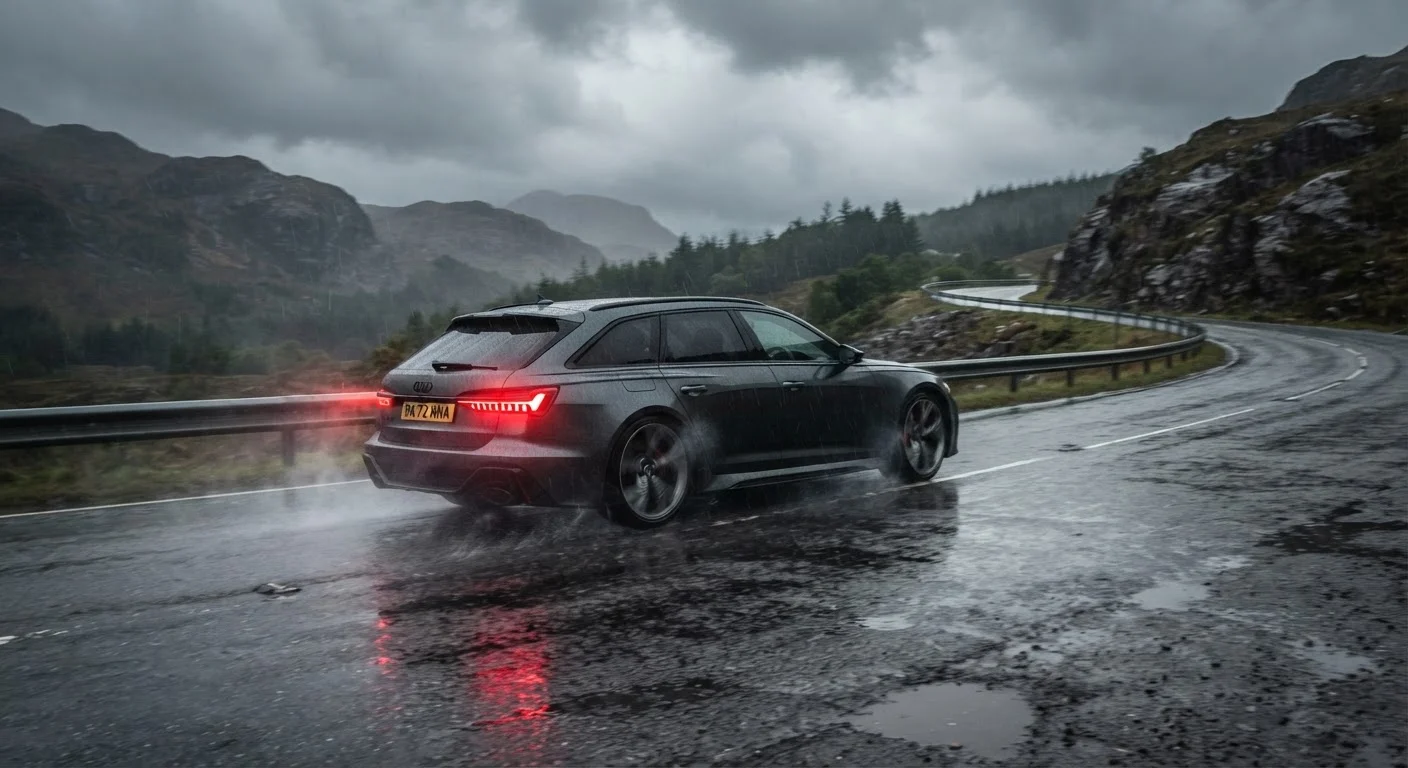
Wet pavement significantly reduces tire-road friction, extending total stopping distance well beyond dry-road figures for the same speed.
At 30 mph on a dry road, braking distance is roughly 45 feet. At 60 mph — twice as fast — braking distance is approximately 180 feet. That's four times as long, not two. The math is straightforward, but the implications are easy to underestimate in the moment.
This is also why crash severity scales so dramatically with speed. The energy released in a collision at 60 mph is roughly four times what's released at 30 mph. Even reducing speed from 40 mph to 35 mph before a hazard can meaningfully change the outcome.
“Speed is the single greatest factor in crash severity. The energy involved in a collision at 60 mph is roughly four times greater than at 30 mph — and the human body simply isn't built to absorb that difference.”
— National Highway Traffic Safety Administration (NHTSA), U.S. federal road safety agency
Conditions That Stretch Stopping Distance Further
Dry pavement and a rested driver represent best-case conditions. Real driving rarely looks like that. Several factors can add significant distance to your stopping equation:
- Wet or icy roads: Water reduces tire-to-road friction substantially. Ice can reduce it to near zero. Adjusting your speed and following distance in rain, snow, and fog is one of the most practical safety habits you can build.
- Tire condition: Worn tread reduces grip. Underinflated tires deform under load, reducing the contact patch with the road. Neither shows up dramatically in everyday driving — until you need to stop suddenly.
- Driver fatigue or distraction: These extend reaction time, sometimes doubling it. A distracted driver reacting in 3 seconds at 60 mph covers 264 feet before braking starts.
- Vehicle load: A heavier vehicle has more kinetic energy to dissipate. Towing, cargo, or even a full passenger load extends stopping distance.
- Brake condition: Degraded brake pads or overheated rotors reduce braking force. Regular inspections matter.
Urban environments compound several of these factors simultaneously — tight junctions, unpredictable pedestrian movement, and frequent stops. See how these dynamics play out in safe driving in urban areas.
Practical Habits That Give You More Room
You can't change the physics, but you can make decisions that put the math on your side.
Maintain a larger following gap than feels natural. Most drivers underestimate how much space they need. In normal conditions, a 3-second gap is a starting point — not a goal to push against. In rain or reduced visibility, extend that to 4–6 seconds. Night driving further reduces your ability to spot hazards early; night driving hazards most drivers underestimate include exactly this kind of compressed reaction window.
Reduce speed proactively, not reactively. Slowing before a curve, intersection, or weather change costs you seconds. Failing to slow costs you far more. The best time to increase your stopping buffer is before you need it.
Stay rested and undistracted. Fatigue and phone use are among the most common reaction-time killers. Neither feels as dangerous as they are in the moment.
Building a fuller picture of hazard anticipation is the foundation of what defensive driving actually means — and stopping distance is where that mindset becomes most concrete.
This article is for general informational purposes. Always follow posted speed limits and local traffic laws. Consult a certified driving instructor or safety professional for personalized guidance.