

Key Takeaways
Option A
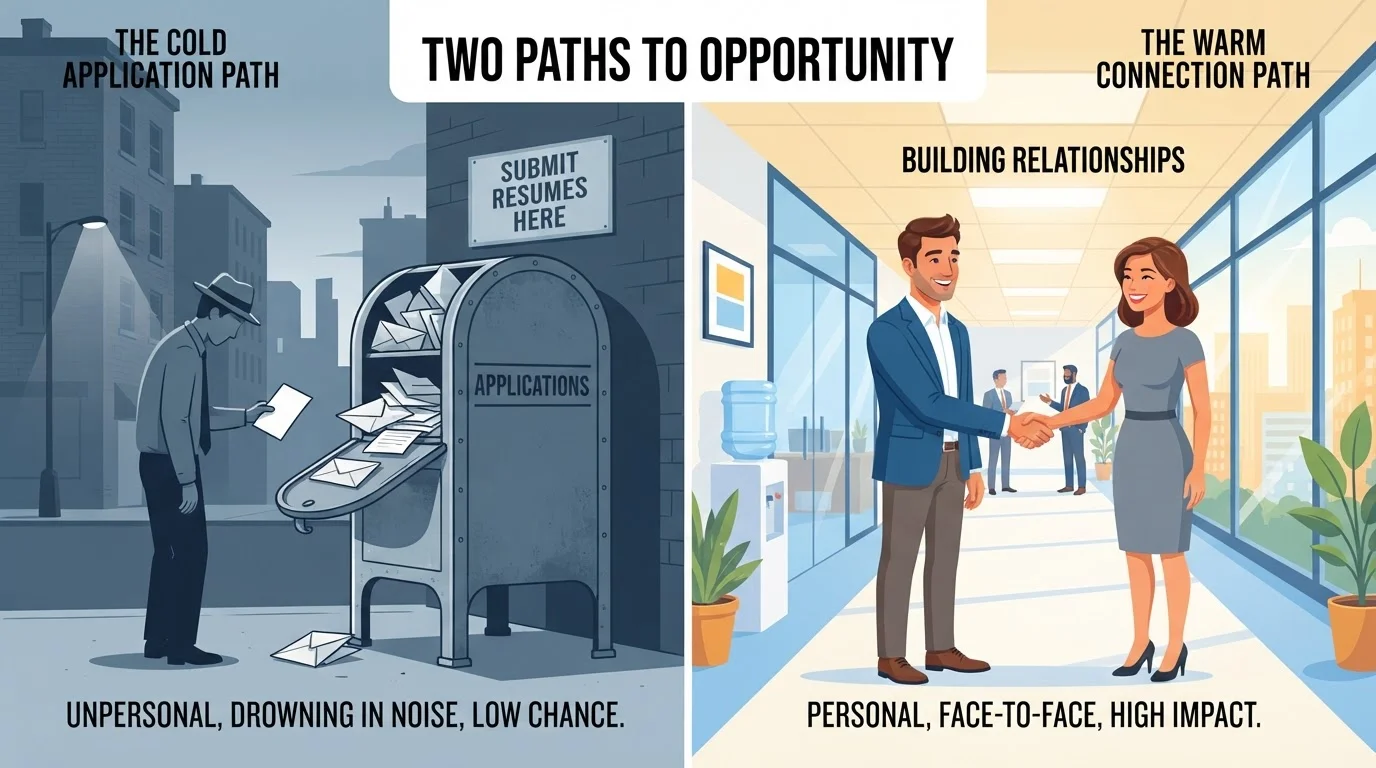
Cold Application
The direct, solo submission with no inside connection.
Best for: Job seekers exploring a wide range of roles, testing the market, or applying to companies where they have no existing network.
Option B
Referral Application
A warm introduction that puts your name in front of a hiring manager.
Best for: Candidates who have cultivated professional relationships and want to move their application past the initial screening stage.
If you're early in your search and exploring options broadly
Cold Application
Cold applications let you cast a wide net quickly, gauge market interest, and identify which roles and industries respond to your profile.
If you have a specific target company or role in mind
Referral Application
A referral dramatically improves the odds that a real person reviews your materials, making it the smarter investment of time for a defined target.
If you're re-entering the workforce after a gap
Referral Application
A trusted colleague vouching for you can help a hiring manager look past a resume gap that might otherwise trigger an automatic screen-out.
If you're targeting companies with no mutual connections
Cold Application
When your network doesn't overlap with an employer, a well-tailored cold application is your primary tool — make every word count.
What Actually Happens to Each Application
Understanding what occurs after you click submit helps explain why these two paths produce such different results. To get a fuller picture of the mechanics behind modern hiring, see how today's hiring process actually works.
Cold applications typically enter an applicant tracking system (ATS) — software that filters submissions before a recruiter ever opens them. A role at a mid-size company can attract hundreds of applicants within days. Even a strong resume can stall here if keywords don't align or formatting trips the parser.
Referral applications follow a different route. When an employee submits your name internally, most companies flag the application for direct recruiter review. Some organisations have formal employee referral programs with financial incentives for the referrer, which motivates colleagues to vouch only for candidates they genuinely believe in. The result: your resume reaches a human faster, and arrives with a layer of social credibility already attached.
| Criterion | Cold Application | Referral Application |
|---|---|---|
| Initial screening | ATS filter, often automated | Flagged for human review |
| Competition level | High — open to all applicants | Lower — fewer referral slots |
| Time to first contact | Slower, highly variable | Generally faster |
| Effort required | Resume and cover letter only | Relationship cultivation required |
| Credibility signal | Resume alone carries the argument | Employee vouches for candidate |
| Scalability | High — easy to send many | Low — network-dependent |
| Typical hire rate | Lower relative to applicants | Significantly higher per applicant |
The Numbers Behind Referrals
Research consistently shows a meaningful gap in outcomes between referred and cold candidates. Workforce analytics firm Jobvite has reported in past surveys that referred applicants are hired at higher rates than those who apply through job boards — sometimes several times higher — while also tending to onboard faster and stay longer. These figures vary by industry and company size, but the directional finding is well-established across multiple studies.
~7x
More likely to be hired via referral
According to workforce data cited by Jobvite, referred candidates can be hired at rates several times higher than those applying through job boards, though exact figures vary by company and sector.
40%+
Of hires come from employee referrals
Multiple HR industry surveys suggest referrals account for a disproportionately large share of external hires relative to the volume of referral applications submitted.
~29 days
Average time-to-hire for referred candidates
Research from Glassdoor and other workforce analysts indicates referred candidates tend to move through hiring pipelines faster than those sourced from job boards.
That said, referrals are not a magic pass. A referral gets your application read; it does not rewrite your qualifications. If the role is a poor fit, a referral buys you attention, not a hire. And for the referring employee, a weak recommendation can damage their own credibility, which is why colleagues will typically only refer candidates they genuinely trust.
Where Cold Applications Still Have Real Value
Dismissing cold applications entirely is a mistake. They serve several legitimate functions in a job search:
- Market feedback: Response rates to cold applications tell you how your resume and positioning land with employers — useful signal for refining your approach.
- Reach: You can't build a referral network at every company overnight. Cold applications extend your reach into organisations where you don't yet have contacts.
- Volume without burnout: For roles where the stakes are lower or you're genuinely exploring, a well-crafted cold application takes less relational capital than chasing a referral.
The key is submitting strategically, not reflexively. Before hitting send, run through a pre-application checklist to catch errors that tank otherwise solid submissions. And focus your tailoring effort on roles that genuinely warrant it — some postings signal clearly that extra effort will pay off.
How to Pursue a Referral Without Being Awkward About It
Most professionals feel uncomfortable asking for referrals, which is exactly why many don't bother — and leave a significant advantage on the table. A few principles make the process far less fraught:
- Lead with specificity. Don't ask a contact to "put in a good word." Identify a specific role, send your resume, and explain in two sentences why you're a genuine fit. The easier you make it for them, the more likely they'll act.
- Prioritise second-degree connections. LinkedIn is useful here — search the target company and see if any first-degree connections know someone there. A warm introduction from a mutual contact is nearly as effective as a direct referral.
- Offer value back. Referrals work best as exchanges in a healthy professional network, not one-directional asks. Keep relationships active before you need them.
If silence follows a cold application, the reasons a strong application gets ignored are often structural — ATS filtering, timing, or role changes — not a judgment of your worth. That's a signal to pursue a referral path if one is available.
This article is for general informational and career guidance purposes only and does not constitute professional career counselling or legal employment advice.