

Key Takeaways
What Makes City Driving Different
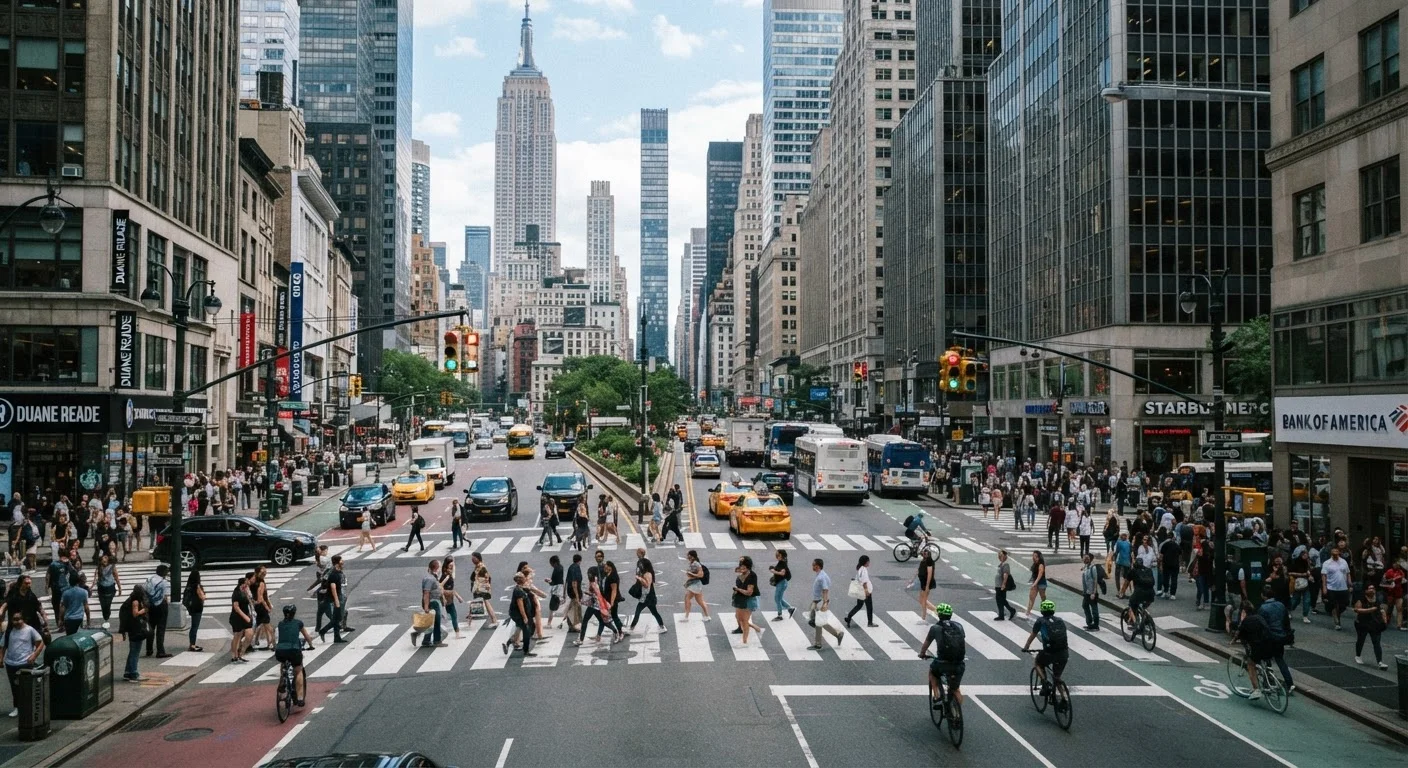
City roads operate under a different set of rules than rural routes or motorways — not legally, but practically. The density of activity is the defining factor. Within a single block, a driver may encounter parked delivery vehicles, a bus pulling away from a stop, a cyclist filtering through traffic, and pedestrians stepping between cars. Each element demands attention, and they often appear simultaneously.
Unlike motorway driving, where risks are managed largely through speed consistency and lane discipline, urban driving requires constant micro-adjustments. Motorway driving has its own hazards, but city roads layer multiple unpredictable variables in a compressed space. That's what makes them statistically more likely to produce low-speed collisions and vulnerable-road-user incidents.
Pedestrians and Cyclists: Sharing the Road Safely
Pedestrians and cyclists account for a significant share of urban road fatalities. The National Highway Traffic Safety Administration (NHTSA) consistently reports that the vast majority of pedestrian fatalities occur in urban settings. The physics are unforgiving: a pedestrian struck at 30 mph faces a dramatically higher fatality risk than one struck at 20 mph.
~80%
Pedestrian fatalities in urban areas
According to NHTSA data, the large majority of pedestrian traffic deaths occur on urban roads rather than rural ones.
75 ft
Stopping distance at 30 mph
On dry pavement, a typical passenger car needs approximately 75 feet to stop from the moment a hazard is perceived at 30 mph.
2 sec
Minimum recommended following distance
Traffic safety guidance consistently recommends at least a two-second gap behind the vehicle ahead in normal urban conditions.
Cyclists present a particular challenge because they share lane space with vehicles but move at very different speeds. Watch for cyclists near the door zone of parked cars — a suddenly opened door can force a rider directly into traffic. When turning at junctions, check mirrors and blind spots specifically for cyclists before committing. Give cyclists at least three feet of clearance when passing, as recommended by most state laws.
For pedestrians, treat any hesitation at a curb as an intention to cross. School zones, crosswalks near transit stops, and areas with outdoor dining all concentrate foot traffic in unpredictable ways. If you're new to city driving, the guide Safe Driving From Scratch covers foundational habits that transfer directly to these situations.
Navigating Tight Junctions and Blind Spots
Intersections are where most urban crashes happen. Tight city junctions — especially those without signals — require deliberate, unhurried entry. A common error is creeping forward to see around obstructions, which itself places the front of the vehicle into the path of crossing traffic.
At a blind junction, inch forward only until you can see clearly — then pause and look both ways before committing to the turn. Treat that pause as a mandatory step, not a courtesy.
A slow, staged approach to a blind junction greatly reduces the chance of conflict with crossing traffic that you couldn't see until you were partially into the road.
Before turning right across oncoming traffic in a multi-lane road, wait until you can see the full gap — not just the nearest lane. Vehicles in far lanes are frequently obscured by those already stopped.
Multi-threat crashes — where a driver is waved through by one vehicle but struck by another in an adjacent lane — are a documented and preventable collision type.
Blind spots in cities are compounded by parked vehicles, scaffolding, street furniture, and delivery lorries that obstruct sightlines in ways that don't occur on open roads. The standard mirror-check routine needs to expand: before turning, physically look into the space you're moving toward, not just the space you're leaving. At multi-lane junctions, account for the possibility that vehicles in adjacent lanes may also be turning.
Right-of-way rules are fixed, but the practical reality is that other road users don't always observe them. Treat your right of way as something to be confirmed, not assumed.
Speed, Stopping Distances, and Urban Traffic Flow
Urban speed limits — commonly 25 or 30 mph in residential and commercial zones — exist because stopping distances at those speeds are already significant. At 30 mph on dry pavement, a typical car needs roughly 75 feet to stop from the moment a hazard is seen. In a city block crowded with parked cars and foot traffic, that distance matters enormously.
Traffic flow in cities is also stop-start by nature. Tailgating — following too closely — is one of the most common causes of rear-end collisions in urban environments. Maintaining a consistent following distance of at least two seconds (more in wet conditions) gives you room to react without relying on perfect timing. In poor weather, that gap needs to grow considerably.
Distractions Unique to City Environments
Cities are designed to attract attention — storefronts, signage, people, and events compete with the road for a driver's focus. Navigation apps, while genuinely useful, create a secondary attention demand exactly when road complexity is highest. Mount your device where it doesn't obscure sightlines, set your route before moving, and use audio directions rather than glancing at the screen.
Experienced drivers are particularly vulnerable to urban complacency — familiarity with a route can cause attention to drift precisely in the areas where it's most needed. Recognizing that city driving demands active engagement, not autopilot, is itself a protective habit.
Don't Trust the Map More Than the Road
Navigation apps sometimes route drivers through one-way streets, bus-only lanes, or restricted zones without adequate warning. Always verify signs on the road itself rather than following app instructions blindly. Fines for bus lane or restricted zone violations can be significant, and some app errors have directed drivers into genuinely unsafe situations.
Practical Habits That Reduce Urban Risk
A few consistent behaviors make a measurable difference in city driving safety:
- Scan further ahead. Look two or three vehicles ahead, not just at the car immediately in front. Early awareness of a stopping bus or a double-parked truck gives you time to adjust smoothly.
- Slow before junctions, not just at them. Approaching at a reduced speed gives you more time to process what's crossing your path.
- Use horn signals sparingly but confidently. A short horn tap when a pedestrian appears unaware of your presence is safer than swerving.
- Keep your vehicle in good mechanical condition. Brakes, tires, and mirrors all perform their primary function in urban stop-start conditions. The Car Maintenance hub has practical guidance on keeping these systems reliable.
- Plan for parking before you need it. Circling for a spot while distracted is itself a risk. Know your destination and have a fallback option before you arrive.
City driving doesn't require special skills beyond those any licensed driver already has — but it does require applying them more consistently and with greater attentiveness than most other environments demand.