

Key Takeaways
Why Night Driving Is Riskier Than Most Drivers Realize
Most drivers feel comfortable behind the wheel after dark — after all, the road looks the same and the car behaves the same. But the numbers tell a different story. According to the National Safety Council, roughly half of all traffic fatalities in the United States occur at night, even though only about a quarter of driving happens after dark. That gap isn't random. It reflects a set of compounding hazards that many drivers never fully account for.
Night driving isn't simply daytime driving with the lights on. Your eyes, your brain, and your vehicle all work differently in the dark — and the margin for error shrinks considerably. The list below covers the specific dangers most commonly underestimated, along with practical ways to manage each one. If you regularly drive in adverse weather on top of darkness, the considerations from our guide on driving in rain, snow, and fog apply here too.
Reduced depth perception and peripheral vision
Human vision is heavily dependent on light. In low-light conditions, the eye shifts from cone-based (color, detail) to rod-based (motion, low-light) processing. The practical result: your ability to judge distances accurately drops, and your usable field of vision narrows — a phenomenon sometimes called tunnel vision. Objects at the edge of your headlights are harder to place in space, meaning you may misjudge how far away a pedestrian, cyclist, or stopped vehicle actually is.
The practical counter is to slow down enough that your stopping distance stays within your visible range. If your headlights illuminate 160 feet ahead and you need 190 feet to stop at your current speed, you're driving beyond your sight — regardless of the posted limit.
At night, your stopping distance can easily exceed the range your headlights actually illuminate.
Headlight glare from oncoming traffic
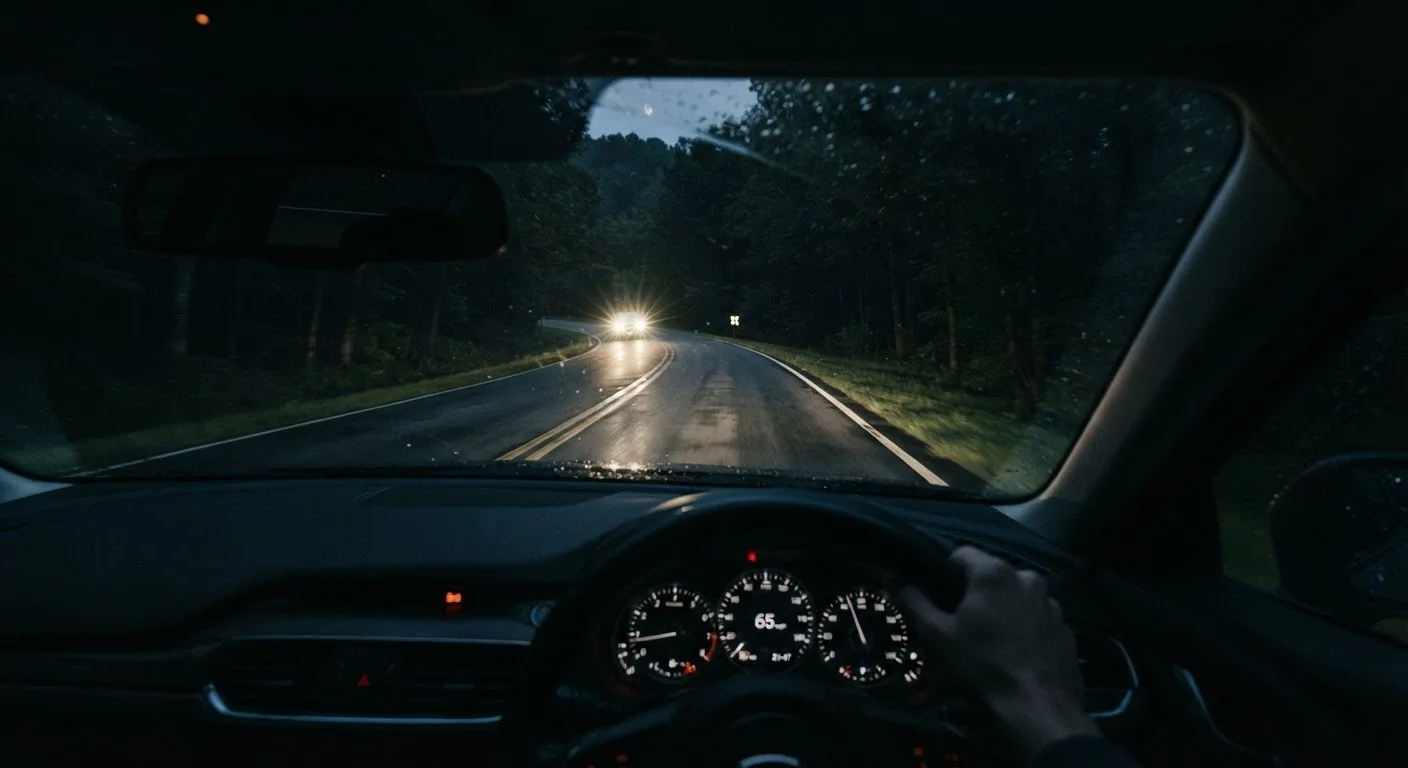
Oncoming headlights — especially modern high-intensity discharge (HID) or LED units — can cause temporary night blindness that lasts several seconds after the vehicle passes. During that recovery window, your eyes are readjusting and your reaction time is effectively lengthened. Many drivers don't consciously register this effect because it resolves quickly, but at highway speeds, a few seconds of reduced vision covers a substantial distance.
Avoid staring directly at oncoming lights. Instead, shift your gaze to the right edge of your lane and use lane markings to maintain position until your vision recovers. Keeping your windshield clean — inside and out — also reduces the halo scatter that makes glare worse.
Temporary night blindness from oncoming headlights can last several seconds — enough to cover significant ground.
Driver fatigue compounded by darkness
The body's circadian rhythm naturally promotes drowsiness in the late-night and early-morning hours, regardless of how much sleep you got the night before. Driving during these windows — roughly midnight to 6 a.m. — stacks biological sleepiness on top of every other night-driving challenge. Fatigue degrades reaction time, narrows attention, and impairs judgment in ways that parallel alcohol impairment at measurable levels.
Our detailed look at how driver fatigue impairs you covers the warning signs and safe management strategies. The short version: if you're yawning repeatedly, struggling to stay in your lane, or can't recall the last few miles, pull over safely and rest.
Biological drowsiness peaks between midnight and 6 a.m., amplifying every other night-driving risk.
Pedestrians and cyclists are far harder to see
Pedestrians and cyclists at night are dramatically less visible than drivers typically assume. A person in dark clothing at the edge of an unlit road may not appear in your headlights until they're dangerously close — sometimes inside your minimum stopping distance. Studies have shown that drivers consistently overestimate how far away they can detect a pedestrian at night.
This risk is highest in residential areas and near intersections where people cross mid-block. Slowing below the speed limit in these zones and scanning actively at the edges of your headlight beam — not just the center — significantly improves your chances of detecting a pedestrian with enough time to react. See also our guide on safe driving in urban areas for related pedestrian hazards.
Drivers consistently overestimate how far away they can spot a pedestrian in the dark.
Degraded or misaimed headlights
Many drivers operate with headlights that are dimmer, yellower, or more poorly aimed than they realize. Plastic headlight lenses oxidize over time, reducing light output substantially — in some cases by more than 50% compared to new. A headlight aimed even slightly downward or outward can cut your effective seeing distance by a meaningful margin without any obvious dashboard warning.
Check that your headlights are clean and clear, not cloudy or yellowed. If your vehicle is older and the lenses look hazy, restoration or replacement is a straightforward maintenance item. Also verify that both low and high beams work correctly. Use high beams on unlit rural roads when there's no oncoming traffic — but be ready to dim them promptly. Understanding how stopping distance scales with speed helps put your headlight range in context; our article on stopping distance and why speed matters is a useful reference.
Oxidized headlight lenses can cut light output by more than half, shrinking your safe reaction window.
Impaired and distracted drivers on the road
Night driving — particularly on weekends and late evenings — puts you statistically more likely to share the road with drivers who are impaired by alcohol or drugs, or who are distracted. Impaired drivers are more likely to drift, accelerate erratically, or run signals. Because your own visibility is already reduced, you have less time to identify and react to erratic behavior ahead.
Maintain a larger following distance than you would during the day. Watch for early warning signs of erratic driving — drifting between lanes, inconsistent speeds, delayed responses to traffic signals — and give those vehicles plenty of room. Distractions compound these risks further; our breakdown of what distractions actually take your attention off the road is worth reviewing for your own habits too.
Late-night roads have a higher statistical share of impaired drivers — build in more buffer room.
Driving Smarter After Dark
No single habit eliminates night-driving risk, but the combination of slowing down, increasing following distance, managing your own fatigue, and keeping your vehicle's lighting in good condition adds up to a meaningfully safer experience. The drivers who struggle most at night are often those who assume their daytime habits transfer directly — they don't.
Simple Pre-Drive Checks for Night Trips
Before any long night drive, take two minutes to verify your headlights, taillights, and turn signals are all working. Clean your windshield inside and out — interior film scatter significantly worsens glare. If you wear prescription glasses, confirm you have an anti-reflective coating, which noticeably reduces halo effects from oncoming lights.
Familiarity is one of the quieter risks after dark. Our article on why experienced drivers often take the most risks explains how confidence can quietly erode caution, which is especially dangerous when visibility is limited.