

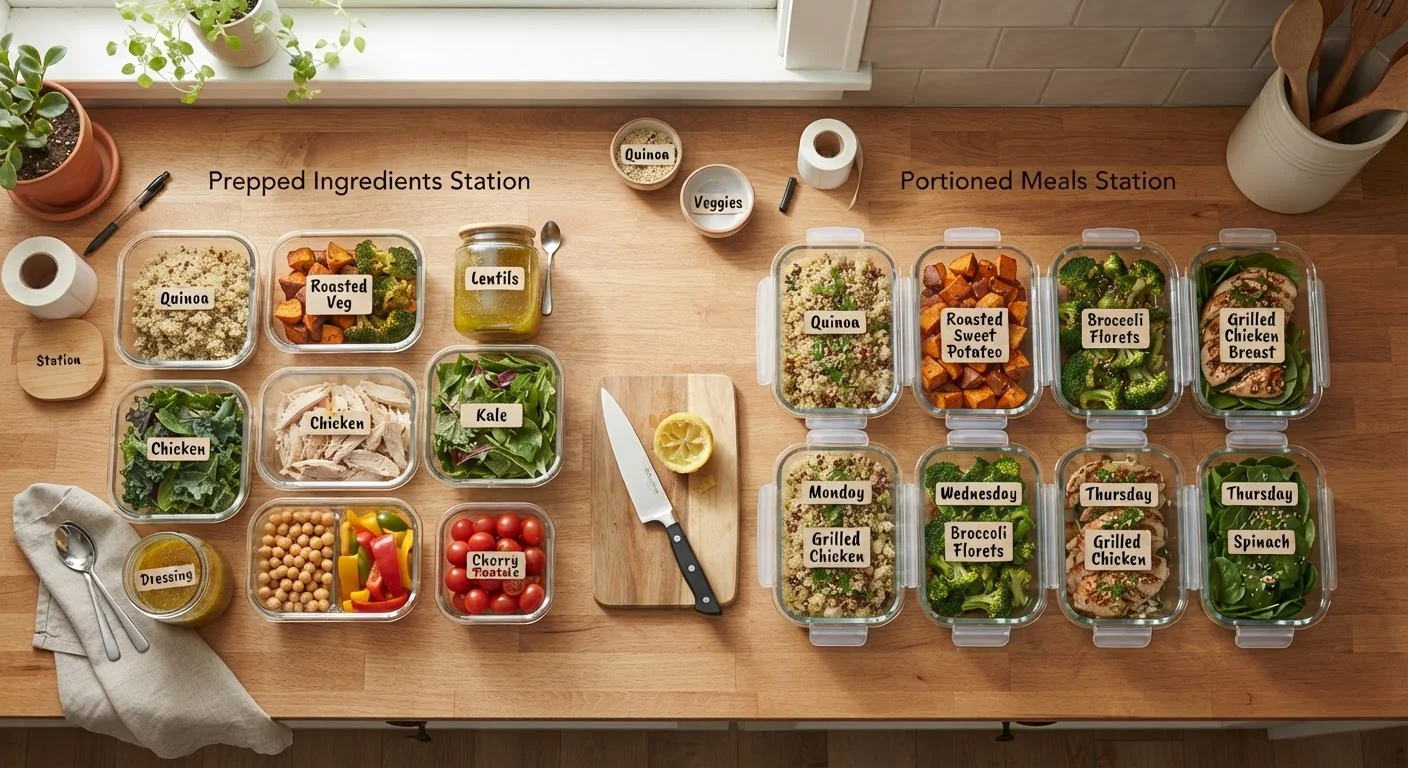
Key Takeaways
Option A
Batch Cooking
The flexible, ingredient-first approach.
Best for: People who want meal planning flexibility without committing to identical meals every day.
Option B
Full Meal Prep
The grab-and-go, fully assembled strategy.
Best for: Busy adults who need zero-decision meals ready to eat throughout the week.
If you value daily meal variety and enjoy a little creativity at mealtime
Batch Cooking
Having cooked components on hand lets you mix and match into different meals, so Monday's grain bowl doesn't have to look exactly like Thursday's lunch.
If your weeknights are relentlessly packed and you need zero-effort meals
Full Meal Prep
Fully assembled, portioned containers mean you open the fridge and eat — no thinking, no chopping, no decisions after a long day.
If you're new to meal planning and want to start small
Batch Cooking
Prepping a few staple ingredients feels less overwhelming than planning an entire week's worth of distinct complete meals from scratch.
If you're tracking nutrition and need precise portion control
Full Meal Prep
Pre-portioned meals make it straightforward to monitor what and how much you're eating without measuring each time you sit down.
If you have a family with varying tastes and dietary preferences
Batch Cooking
Keeping components separate lets everyone build their own plate, accommodating different preferences without cooking multiple separate meals.
What Each Approach Actually Means
These two terms get used interchangeably online, but they describe meaningfully different cooking strategies. Understanding the distinction helps you choose the one that actually fits your life — rather than adopting a system that burns you out by week two.
Batch cooking means cooking larger quantities of individual ingredients or components — think a big pot of brown rice, a sheet pan of roasted vegetables, or a batch of baked chicken thighs — that you store separately and mix into different meals across the week. Nothing is assembled in advance. You open your fridge, grab what you have, and build your meal in a few minutes.
Full meal prep means planning, cooking, and fully assembling complete meals in advance, then portioning them into individual containers. Tuesday's lunch is already made. So is Wednesday's dinner. The container goes straight from fridge to microwave. For a deeper breakdown of what full meal prep really involves, see Meal Prep Explained.
| Criterion | Batch Cooking | Full Meal Prep |
|---|---|---|
| What you prepare | Individual ingredients & components | Complete, assembled meals |
| Assembly required at mealtime | Yes — brief, 5–10 minutes | No — heat and eat |
| Meal variety through the week | High — mix and match | Low — same meal repeated |
| Upfront prep session length | Shorter, can be split across days | Longer, typically one dedicated session |
| Best for households | Multiple people, varying tastes | Solo adults or consistent eaters |
| Portion control ease | Requires measuring at assembly | Built in at prep time |
| Flexibility on busy nights | Moderate — still need to assemble | Maximum — fully ready to eat |
The Real Trade-offs Between the Two
Both approaches save time compared to cooking from scratch every night, but the trade-offs land differently depending on your priorities.
Flexibility vs. convenience. Batch cooking keeps your options open. A container of cooked quinoa can become a salad, a stir-fry base, or a grain bowl topping depending on your mood. Full meal prep trades that flexibility for speed — the meal is done, which is genuinely useful when exhaustion sets in.
Prep time investment. Full meal prep typically demands a longer single session upfront because you're assembling and portioning everything at once. Batch cooking sessions can be shorter and more modular — cook a protein one evening, roast vegetables another afternoon. For guidance on keeping that session manageable, building a realistic prep routine covers exactly this.
Meal fatigue. Eating the same fully prepped meal five days in a row is a common complaint with full meal prep. Batch cooking naturally sidesteps this because your components combine in different ways. If you want to explore this more, prepping components instead of full meals is a practical read.
~2.5 hrs
Average weekly time saved with meal prep
Research cited by the American Journal of Preventive Medicine suggests adults who plan meals spend less time on daily food decisions and report lower stress around eating.
35%
Reduction in food waste reported by regular preppers
A survey by the Food Marketing Institute found that structured meal planning is one of the most reliable ways households reduce ingredient spoilage each week.
How to Decide Which One Suits Your Week
The right approach depends on three honest questions about your life right now.
How predictable is your schedule?
If your week is chaotic — irregular hours, last-minute plans, variable appetites — batch cooking's flexibility is a better match. If your routine is consistent and you already know you'll be home for lunch each day, full meal prep's predictability becomes a genuine asset rather than a constraint.
How much do you enjoy cooking day-to-day?
If you find even brief weeknight cooking enjoyable, batch cooking keeps that creative element alive. If cooking on weeknights feels like a chore you'd rather eliminate entirely, full meal prep removes it almost completely.
Are you cooking for yourself or for others?
Solo adults often find full meal prep extremely efficient — prep once, eat well all week. Households with different tastes or dietary needs tend to benefit more from batch cooking's modularity, since components can be mixed and matched to suit each person. You can also combine both approaches: prep fully assembled dinners while keeping lunch components separate for flexibility. The Weekly Meal Prep Playbook walks through how to structure exactly this kind of hybrid week.
Neither approach is universally superior. The one you'll actually stick with is the one that aligns with how you realistically live — not how you plan to live starting next Monday.