

Key Takeaways
Our Verdict
DIY maintenance makes real sense for straightforward, low-risk tasks — it saves money and builds familiarity with your vehicle. But when a job involves safety systems, specialized tools, or the risk of hidden damage, a qualified mechanic is the right call. The line isn't about confidence alone; it's about honest assessment of what the job actually requires.
| Best for | Recommended |
|---|---|
| Drivers comfortable with basic tools and routine upkeep | DIY maintenance |
| Jobs involving brakes, suspension, fuel, or electrical systems | Professional mechanic |
| Anyone unsure about a task's complexity or safety implications | Professional mechanic |
| Routine fluid checks, filters, and wiper blades | DIY maintenance |
What Most Drivers Can Safely Handle at Home
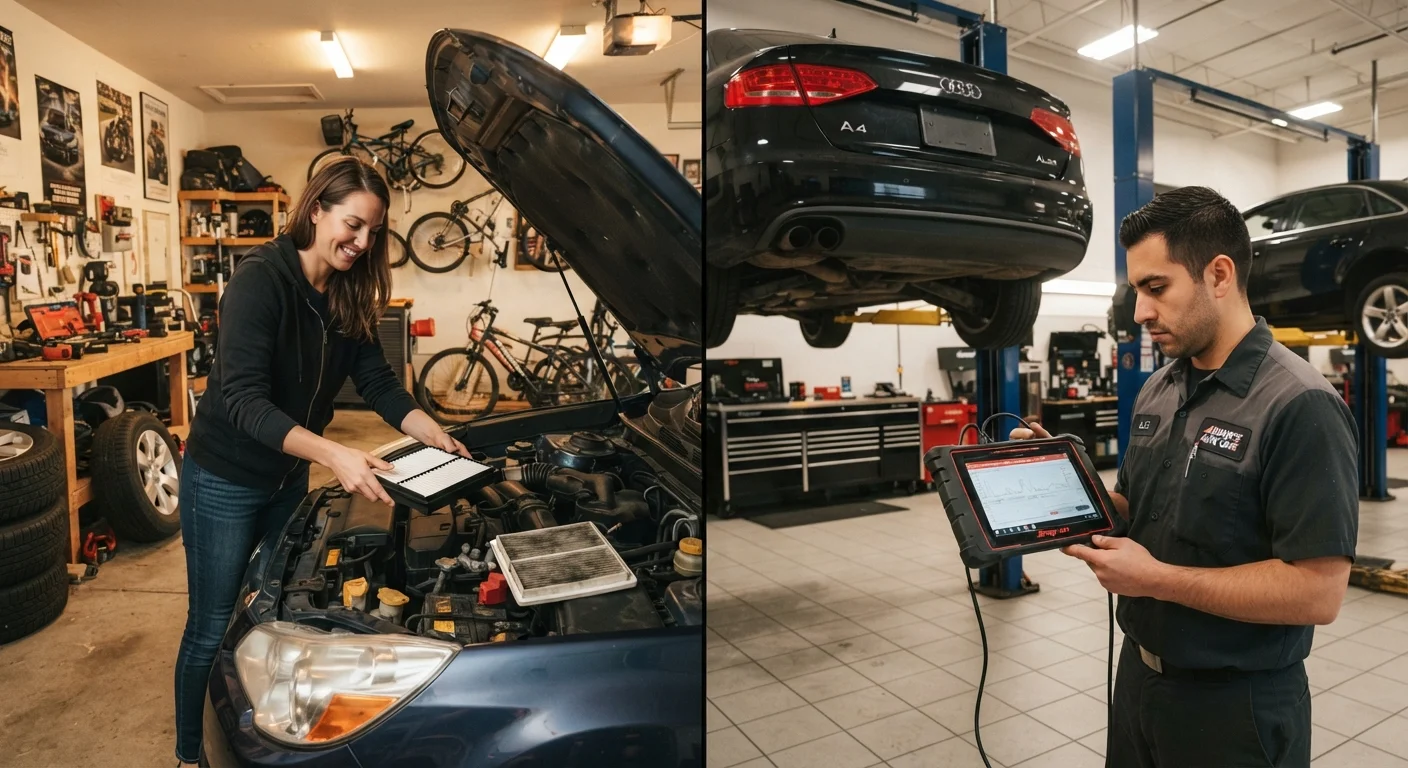
A handful of routine maintenance tasks require minimal tools, carry low risk if done incorrectly, and are well-documented in most owner's manuals. These are the jobs where doing it yourself makes practical sense.
- Engine air filter replacement: Typically a no-tool job. The filter housing snaps or clips open, and the old filter lifts straight out.
- Cabin air filter replacement: Usually located behind the glove box or under the dashboard. Most can be swapped in under 15 minutes. See why this filter often gets skipped for context on why it matters.
- Wiper blade replacement: Blades clip onto the arm. Instructions are on the blade packaging and take a few minutes per side.
- Checking and topping off fluids: Engine oil, coolant reservoir, washer fluid, and brake fluid all have marked reservoirs under the hood. Checking levels is straightforward; topping off is low-risk when you use the fluid type specified in your manual.
- Battery terminal cleaning: Corrosion on terminals can cause starting issues. Disconnecting the battery and cleaning terminals with a wire brush is manageable — just disconnect the negative terminal first.
For a broader picture of the small habits that keep a car reliable, routine between-service care is worth reading.
Always Use Jack Stands, Never Just a Floor Jack
A hydraulic floor jack can fail without warning — it is a lifting tool, not a support tool. Any time you need to work under a vehicle, use properly rated jack stands placed at the manufacturer's specified lift points. This is one of the most commonly skipped safety steps in DIY car work, and one of the most consequential.
Where DIY Gets Risky — and Why the Line Exists
The difference between a manageable task and a dangerous one usually comes down to three things: the systems involved, the tools required, and what happens if something goes wrong.
| Task | DIY-Friendly | Leave to a Mechanic | |
|---|---|---|---|
| Air & cabin filters | Yes — simple swap, no tools needed | Not necessary | |
| Wiper blades | Yes — clip-on, takes minutes | Not necessary | |
| Fluid top-offs | Yes — with correct fluid type | Not necessary | |
| Brake pad replacement | Risky without experience | Recommended — safety-critical | |
| Suspension components | Not advisable | Yes — requires torque specs & alignment | |
| Timing belt/chain | No — high complexity | Yes — specialist tools required | |
| Electrical diagnosis | Basic fuse swaps only | Yes — scan tools and expertise needed | |
| Fuel system repairs | No — fire and safety risk | Yes — regulated and hazardous |
Brake work is the clearest example. Replacing brake pads sounds straightforward, and many tutorials make it look easy. But a mistake — a caliper not seated properly, a brake line disturbed — can cause brake failure. Similarly, suspension components are under significant tension and require specific torque specs and alignment afterward. An improperly installed tie rod end, for instance, can cause a loss of steering control.
Fuel system work carries fire risk. Electrical diagnosis beyond replacing a fuse typically requires a scan tool and the knowledge to interpret fault codes accurately. Timing belts and chains require engine disassembly, precise specifications, and in many vehicles, special locking tools.
If a repair requires you to buy a specialty tool you'll use once, or if getting it wrong could affect the car's ability to stop or steer safely, that's a strong signal to leave it to a professional. Finding a trustworthy mechanic walks through how to evaluate one confidently.
Making the Call: A Practical Decision Framework
Before starting any job yourself, it helps to run through a few honest questions:
- Do I have the right tools? A torque wrench, jack stands, and a reliable floor jack are baseline requirements for many under-car jobs. A floor jack alone is not safe for working under a vehicle.
- Can I find reliable, vehicle-specific instructions? Generic video tutorials don't always match your vehicle's design. Your owner's manual and manufacturer service documentation are the most trustworthy sources.
- What's the consequence of a mistake? If the answer involves safety systems — brakes, steering, airbags — or significant additional damage, the risk calculation shifts toward professional help.
- Is the car still under warranty? Some manufacturer warranties have conditions around who performs service. Check your documentation before doing work that could affect coverage.
Understanding what a full professional service actually covers is also useful context — what happens during routine car servicing breaks that down clearly. The goal of DIY maintenance isn't to avoid mechanics entirely — it's to handle what you genuinely can, so professional visits stay focused on what actually needs trained hands.