

Key Takeaways
Why Most Starter Cages Fall Short
Walk into any pet store and the cages marketed for hamsters are often colorful, compact, and dangerously undersized. Wild Syrian hamsters have been documented traveling up to 5 miles per night. Even dwarf species cover significant ground. A cage that measures just 12 by 20 inches offers nowhere near enough room for a physically and mentally healthy animal.
The baseline recommended by many small-animal welfare organizations is a minimum of 450 square inches of unobstructed floor space — and that's a floor minimum, not a ceiling. Hamsters kept in cramped conditions are more likely to develop stereotypic behaviors (repetitive, purposeless movements) such as bar-chewing or circling. If you've noticed your pet doing this, our guide on why hamsters run in circles explains what those behaviors may signal.
The good news: you don't need a large home to give a hamster a large life. You need the right setup strategy.
Best Practices for Enriching a Hamster's Environment
Applying species-appropriate care principles — even in limited square footage — can dramatically improve your hamster's quality of life. The following practices are grounded in small-animal behavioral science and veterinary guidance.
Provide deep bedding — at least 6 inches — for burrowing.
Burrowing is a fundamental hamster behavior tied to both physical exercise and psychological security. Shallow bedding prevents natural digging and is a leading cause of stress in captive hamsters. Depth allows them to construct multi-chamber burrows, which regulates their sense of safety.
Install a solid-surface wheel sized appropriately for your species.
Running is a non-negotiable outlet for hamsters' high-energy natures. Mesh or barred wheels cause foot and spine injuries. An undersized wheel forces the hamster to run with an arched back, causing spinal strain over time. Syrians need at least a 10–12 inch diameter; dwarf species typically do well with 8–10 inches.
Scatter-feed rather than bowl-feeding to encourage foraging.
In the wild, hamsters spend substantial time searching for food — a behavior that provides mental stimulation. Placing all food in a bowl eliminates this drive and contributes to boredom. Foraging-based feeding reintroduces problem-solving and natural exploratory behavior.
Rotate and vary enrichment items regularly.
Novelty is cognitively stimulating for hamsters. A fixed set of toys quickly loses its value as the animal habituates to it. Rotating items — cork logs, cardboard tubes, wooden chews, safe clay hides — maintains exploratory motivation. This is especially important in smaller enclosures where sensory variety compensates for spatial limits.
Offer a sand bath as a regular sensory and hygiene outlet.
A shallow dish of reptile-grade sand (not calcium sand or dust) allows hamsters to roll and groom naturally, supporting coat health and providing a tactile enrichment experience. It also gives the animal a behaviorally distinct microenvironment within the enclosure.
Space-Smart Housing Upgrades
You don't have to choose between your living space and your hamster's welfare. Several practical housing approaches deliver the right footprint without dominating a room.
- Bin cages: Large, clear plastic storage bins (at minimum 40-gallon equivalent volume) are inexpensive, easy to customize with ventilation lids, and offer far more floor space than most pet-store cages. They're a widely recommended solution in the hamster-keeping community.
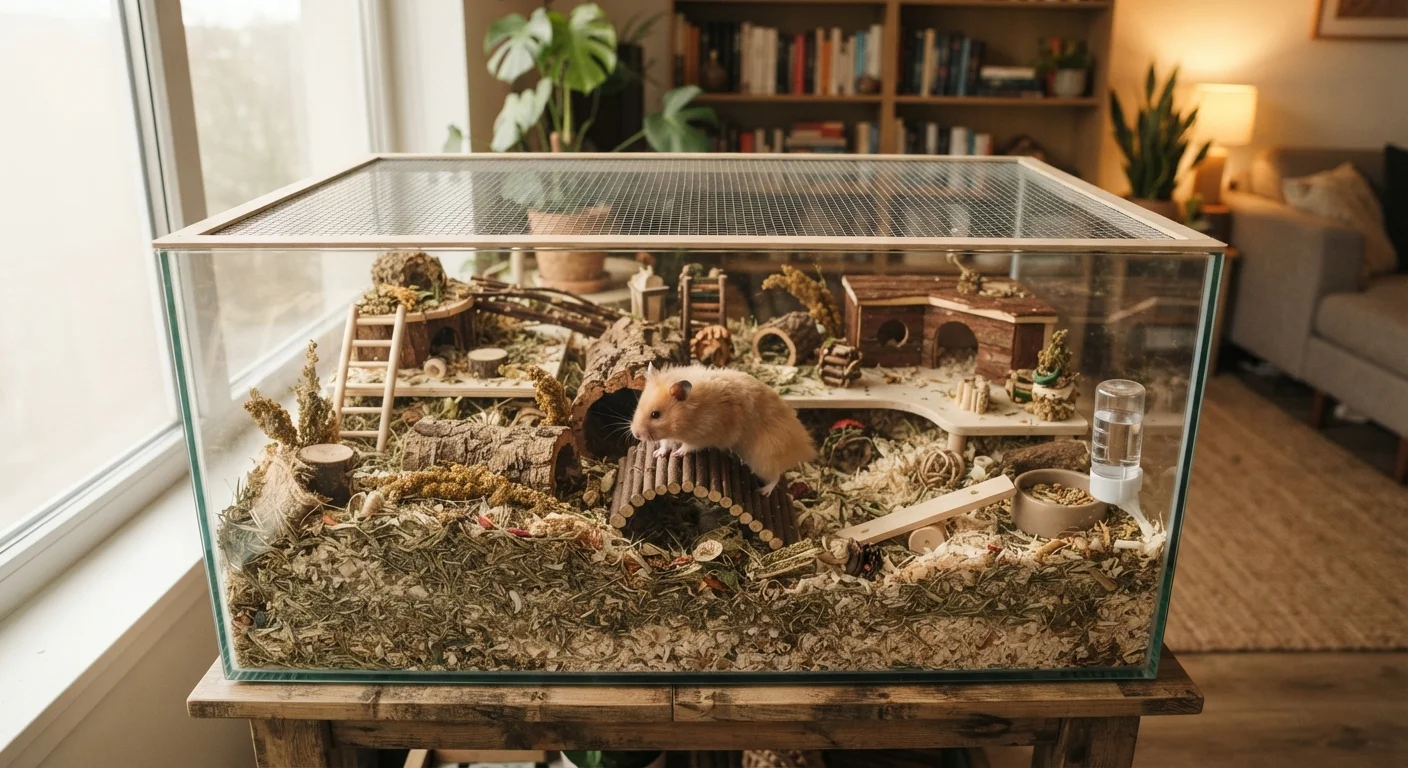
- Tank conversions: A 40-gallon glass aquarium repurposed with a mesh lid provides excellent depth for burrowing bedding and is naturally escape-proof.
- Modular expansion: Some owners connect smaller cage units with tubes to increase total roaming territory without a single large footprint on a shelf.
Ventilation Matters as Much as Size
Glass tanks offer great depth for burrowing but require a well-ventilated mesh lid to prevent ammonia buildup from bedding. Poor airflow can lead to respiratory issues even in a large enclosure. Check that at least the top surface of the habitat is open mesh, and spot-clean soiled bedding every two to three days to maintain air quality.
Whatever housing you choose, place it away from drafts, direct sunlight, and noise sources such as televisions or speakers. Hamsters have sensitive hearing and are stressed by frequencies humans can't easily detect.
For a broader look at matching small pets to living situations, see which small pets suit different lifestyles.
Daily Interaction and Routine
Hamsters are crepuscular — most naturally active around dusk and dawn rather than in the middle of the day. Waking them for handling during their rest period causes stress and can lead to nipping or lethargy. Scheduling brief, gentle handling sessions in the early evening respects their biology and builds genuine trust over time.
Keep handling sessions short initially — five minutes is plenty for a new hamster — and gradually extend them as the animal grows comfortable. Hand-feeding small pieces of suitable vegetables or protein treats during these sessions creates a positive association with human contact.
If you notice signs of illness, distress, or unusual behavior, consult a veterinarian experienced with small animals. Our reference on signs a small pet is unwell covers key warning signals to watch for across species.
This article is for general informational purposes only and does not constitute veterinary advice. Always consult a qualified veterinarian for concerns about your pet's health or behavior.