

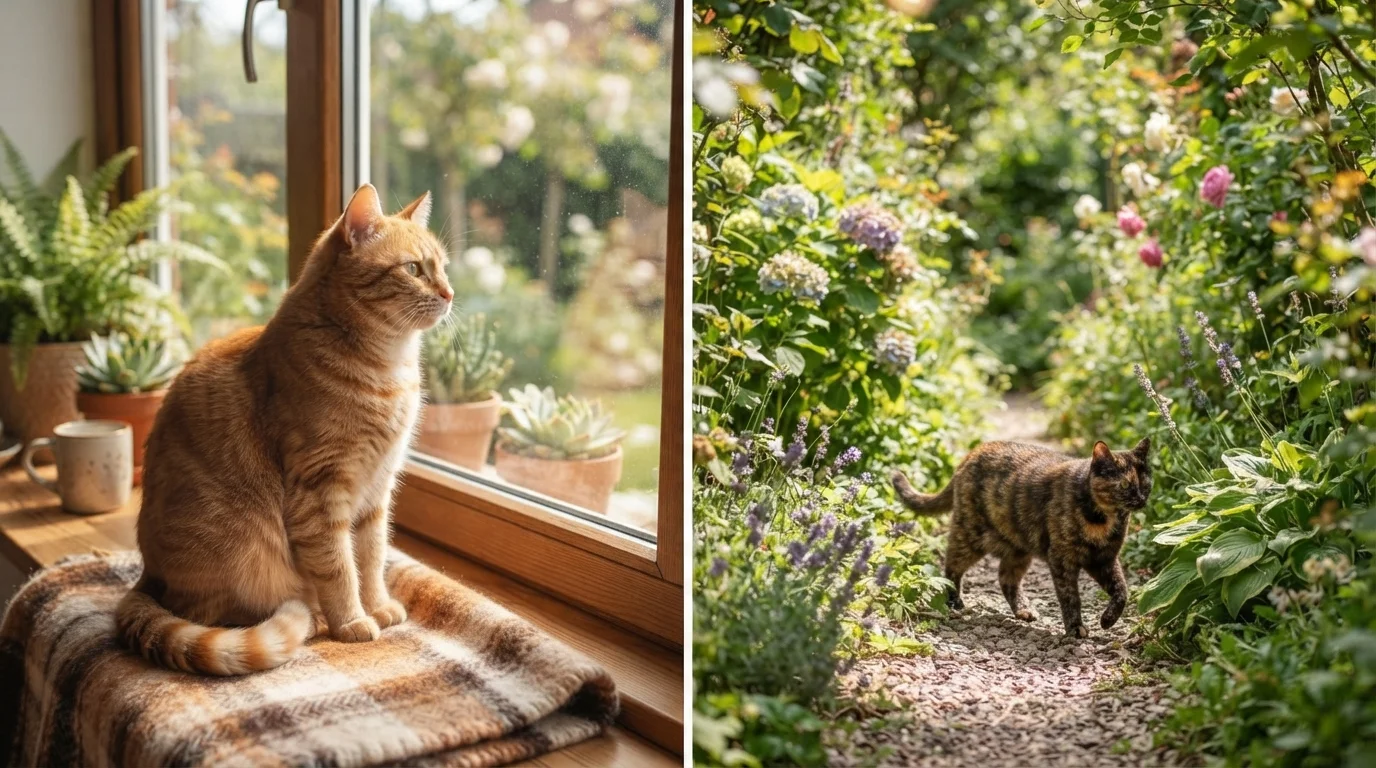
Key Takeaways
Option A
Indoor Cat
The protected, controlled environment choice.
Best for: Owners who want to minimize health risks and have the time and commitment to provide active environmental enrichment.
Option B
Outdoor Cat
The free-roaming, stimulation-rich alternative.
Best for: Cats in low-traffic rural or suburban settings where supervised access can be managed and predation risks are relatively low.
If you live near busy roads or in a dense urban area
Indoor Cat
Traffic is one of the leading causes of injury and death for outdoor cats. An indoor setup eliminates this risk entirely.
If your cat was raised outdoors or shows high prey drive and restlessness indoors
Outdoor Cat
Some cats adapt poorly to full-time confinement. A managed outdoor environment may better suit their established behavioral needs.
If you want to balance safety with natural stimulation
Indoor Cat
A well-enriched indoor environment combined with a catio or supervised leash time offers the benefits of both lifestyles with fewer of the risks.
If your cat is immunocompromised or has a chronic health condition
Indoor Cat
Outdoor exposure to pathogens, parasites, and other animals poses an amplified risk for cats with compromised immune systems.
If you live on a quiet rural property with low road traffic
Outdoor Cat
In lower-risk settings, outdoor access can provide genuine enrichment and physical exercise that is harder to replicate fully indoors.
Lifespan and Health Risks: What the Numbers Reflect
The most cited difference between indoor and outdoor cats is lifespan. Veterinary and animal welfare organizations generally note that indoor cats tend to live considerably longer on average than cats with unrestricted outdoor access — though estimates vary widely by source and population. The disparity is largely explained by the hazards outdoor cats face: vehicle collisions, attacks from dogs or wildlife, ingestion of toxins or rodenticides, and exposure to infectious diseases such as feline leukemia virus (FeLV) and feline immunodeficiency virus (FIV).
Indoor cats are not without health considerations, however. Obesity, urinary tract issues, and stress-related behavioral problems are more common in cats who lack adequate stimulation. A sedentary indoor cat with no environmental enrichment may be physically safer but still suffer in terms of overall wellbeing. For a broader look at how cat health evolves over time, see our guide to feline life stages and senior care.
| Criterion | Indoor Cat | Outdoor Cat |
|---|---|---|
| Average lifespan | Typically longer (12–18+ years) | Often shorter (varies widely) |
| Risk of injury or trauma | Low | Higher (traffic, predators) |
| Infectious disease exposure | Low | Higher (FeLV, FIV, parasites) |
| Natural enrichment | Requires deliberate provision | Gained passively outdoors |
| Obesity risk | Higher without active play | Lower with regular movement |
| Wildlife impact | Minimal | Can be significant |
| Owner oversight | High — environment is controlled | Limited during roaming periods |
| Stress and boredom risk | Higher without enrichment | Lower with outdoor stimulation |
Enrichment and Behavioral Wellbeing
Cats are natural hunters with complex sensory and social needs. Outdoor cats gain enrichment passively — through territorial exploration, prey interaction, varied terrain, and exposure to natural stimuli. This can support healthy weight, reduce boredom, and satisfy predatory instincts. The trade-off is that the same freedom exposes them to the risks outlined above.
Indoor cats depend almost entirely on their owners to provide equivalent mental and physical engagement. Vertical space (cat trees, shelves), interactive play sessions, window perches, puzzle feeders, and rotating toys all contribute to a richer indoor environment. Companion cats can also help — though introductions require care, as explored in our overview of adding a second cat. For a deeper look at specific strategies, our article on keeping an indoor cat mentally stimulated is a practical starting point.
12–18 yrs
Typical indoor cat lifespan range
Veterinary sources broadly report indoor cats living significantly longer than free-roaming counterparts, primarily due to reduced hazard exposure.
~1.3–4B
Birds killed annually by free-ranging U.S. cats
A widely cited 2013 study in Nature Communications estimated this range based on extrapolation from multiple research datasets.
2–5x
Relative outdoor disease risk increase
Cats with outdoor access have substantially higher rates of FeLV, FIV, and intestinal parasites compared to exclusively indoor cats, per veterinary epidemiology research.
Wildlife Impact and the Ecological Dimension
One consideration that often goes unaddressed in the indoor vs. outdoor debate is the ecological impact of free-roaming cats. Research published in peer-reviewed journals, including studies drawing on U.S. wildlife data, has estimated that free-ranging domestic cats kill billions of birds and small mammals annually in the United States. These figures are contested in terms of exact magnitude but are broadly accepted as ecologically significant by wildlife conservation bodies.
This does not mean outdoor cats are inherently irresponsible to keep — but it is a genuine trade-off that informed owners should weigh. Strategies such as enclosed outdoor runs (catios), leash training, and bell collars have each been studied as mitigation methods, with varying levels of effectiveness. Keeping cats indoors during peak wildlife activity periods, particularly dawn and dusk, can also reduce predation. For owners who find this dimension relevant to other pets in the home, indoor bird safety considerations offers related context.
Finding a Middle Path: Supervised and Contained Outdoor Access
For many cat owners, the binary of fully indoor versus fully outdoor does not reflect the available options. Supervised outdoor access — via leash and harness, a purpose-built catio, or a secure garden enclosure — allows cats to experience natural stimuli while significantly reducing exposure to the most serious outdoor hazards. This approach suits cats that show strong interest in the outdoors but live in environments where unrestricted roaming would be high-risk.
Leash training requires patience and is most easily introduced to younger cats, though some adult cats adapt well. Catios range from simple window box enclosures to elaborate multi-level garden structures. Neither option eliminates all risk — a bird may still land within reach, and parasites can still be encountered — but both reduce the hazard profile substantially compared to free roaming.
There is no single correct answer to the indoor vs. outdoor question. A cat's individual history, temperament, health status, and the specific environment you live in all matter. Consulting a veterinarian who knows your cat is the most reliable way to work through the decision. For a broader framework on cat ownership decisions, see our complete guide to cat ownership.
This article is for general informational purposes only and does not constitute veterinary advice. Always consult a qualified veterinarian for guidance specific to your cat's health and circumstances.