

Key Takeaways
Reduces boredom and idle-time destructive behavior
Cats with a compatible companion tend to play more actively and engage in less furniture scratching or attention-seeking behavior during periods when owners are absent.
Provides social stimulation for sociable cats
Cats that have demonstrated sociability with other felines can experience genuine psychological enrichment from feline companionship, supporting stable mood and activity patterns.
Play partners support physical exercise
Interactive play between cats encourages movement that solo cats may not self-motivate, which can contribute to maintaining a healthier weight over time.
Eases owner guilt about time away
For owners with demanding schedules, knowing their cat has a companion can reduce the concern — and sometimes the genuine behavioral consequence — of long solo hours.
Younger cats can benefit from an older cat's calm influence
A well-adjusted adult or senior cat can provide a stabilizing presence for a kitten, modeling calm behavior and setting social limits that help the kitten develop good habits.
Territory conflict is common and often prolonged
Cats are territorial animals, and even a well-managed introduction can result in months of tension, hissing, and resource guarding before — or instead of — stable coexistence.
Costs roughly double across all categories
Food, annual veterinary visits, medications, litter, and boarding expenses all increase substantially; unexpected illness in one cat can strain budgets that were sized for a single pet.
Not every cat will accept a companion
Some cats, particularly those that have been solitary their entire lives or have a history of aggression toward other cats, experience chronic stress in multi-cat households regardless of how carefully introductions are managed.
Disease transmission risk increases
Upper respiratory infections, ringworm, parasites, and certain viruses spread more readily between cats sharing a space, making up-to-date vaccinations and prompt veterinary attention more critical.
Litter box management becomes more demanding
Multiple boxes in appropriate locations must be cleaned more frequently to prevent aversion and territorial elimination outside the box — a leading behavioral complaint in multi-cat homes.
Individual health changes can be harder to notice
Monitoring food intake, litter box output, and behavior changes becomes more complex when two cats share resources, potentially delaying recognition of a health problem.
Our Verdict
A second cat can genuinely enrich a household when the existing cat is social, the introduction is handled carefully, and the owner is prepared for added cost and complexity. However, it is not an automatic fix for a lonely cat, and a poorly matched pair can experience chronic stress. The decision deserves honest assessment of your resident cat's temperament, your living space, and your long-term commitment.
Best suited for owners of sociable, adaptable cats who have the space, time, and financial resources to support a structured multi-cat household.
Why People Add a Second Cat — and What They Overlook
The most common reason people consider a second cat is concern that their current cat is lonely. While cats can experience boredom and benefit from companionship, they are not inherently social animals in the way dogs are. Unlike pack species, cats in the wild are largely solitary hunters, and not every cat welcomes a feline housemate.
That said, many cats do thrive in pairs — especially when they are introduced gradually and are reasonably compatible in energy level and temperament. The key is approaching the decision with realistic expectations rather than assuming a second cat will automatically solve behavioral problems or provide the companionship you imagine.
Before committing, honestly evaluate your resident cat's history with other cats. A cat that has hissed at, chased, or hidden from visiting cats is signaling that cohabitation may be stressful for them. Conversely, a cat that has lived with others or actively seeks social play is a stronger candidate for a companion. See our complete guide to cat ownership for a broader view of what multi-cat environments require.
The Real Advantages of a Two-Cat Home
Reduces boredom and idle-time destructive behavior
Cats with a compatible companion tend to play more actively and engage in less furniture scratching or attention-seeking behavior during periods when owners are absent.
Provides social stimulation for sociable cats
Cats that have demonstrated sociability with other felines can experience genuine psychological enrichment from feline companionship, supporting stable mood and activity patterns.
Play partners support physical exercise
Interactive play between cats encourages movement that solo cats may not self-motivate, which can contribute to maintaining a healthier weight over time.
Eases owner guilt about time away
For owners with demanding schedules, knowing their cat has a companion can reduce the concern — and sometimes the genuine behavioral consequence — of long solo hours.
Younger cats can benefit from an older cat's calm influence
A well-adjusted adult or senior cat can provide a stabilizing presence for a kitten, modeling calm behavior and setting social limits that help the kitten develop good habits.
The benefits are genuine and well-supported by feline behavioral research — but they depend heavily on compatibility and a proper introduction process.
The Honest Drawbacks to Consider
Territory conflict is common and often prolonged
Cats are territorial animals, and even a well-managed introduction can result in months of tension, hissing, and resource guarding before — or instead of — stable coexistence.
Costs roughly double across all categories
Food, annual veterinary visits, medications, litter, and boarding expenses all increase substantially; unexpected illness in one cat can strain budgets that were sized for a single pet.
Not every cat will accept a companion
Some cats, particularly those that have been solitary their entire lives or have a history of aggression toward other cats, experience chronic stress in multi-cat households regardless of how carefully introductions are managed.
Disease transmission risk increases
Upper respiratory infections, ringworm, parasites, and certain viruses spread more readily between cats sharing a space, making up-to-date vaccinations and prompt veterinary attention more critical.
Litter box management becomes more demanding
Multiple boxes in appropriate locations must be cleaned more frequently to prevent aversion and territorial elimination outside the box — a leading behavioral complaint in multi-cat homes.
Individual health changes can be harder to notice
Monitoring food intake, litter box output, and behavior changes becomes more complex when two cats share resources, potentially delaying recognition of a health problem.
None of these drawbacks are insurmountable, but overlooking them leads to frustrated owners and stressed cats. Resource competition in particular is an area many owners underestimate. The standard veterinary recommendation is one litter box per cat, plus one extra — meaning a two-cat home needs at least three boxes. Proper litter box setup becomes even more important when multiple cats share a space, as box aversion and territorial elimination are common complaints in multi-cat households.
How to Give an Introduction the Best Chance
A successful introduction is almost always a slow one. Veterinary behaviorists generally recommend a phased approach: confine the new cat to a single room for the first one to two weeks, allowing both cats to adjust to scent before any visual or physical contact. Scent swapping — exchanging bedding between the two cats — is a practical early step that helps establish familiarity without confrontation.
After the initial scent phase, brief visual introductions through a cracked door or baby gate allow both cats to observe each other at a distance. Positive associations — feeding both cats near the barrier so they associate each other's presence with food — are widely recommended by animal behavior specialists. Full, unsupervised access should be the last stage, not the first.
Introduction Pace Matters More Than Method
Rushing introductions is the single most cited mistake in multi-cat household failures. Even cats that eventually become close companions may take four to eight weeks to fully accept one another. Stress-related illness, hiding, and aggression are common signals that the pace is too fast. If either cat shows persistent signs of distress, consult a veterinary behaviorist rather than waiting it out indefinitely.
Rushing introductions is the single most cited mistake in multi-cat household failures. Even cats that eventually become close companions may take four to eight weeks to fully accept one another. Stress-related illness, hiding, and aggression are common signals that the pace is too fast.
What Actually Changes Day to Day
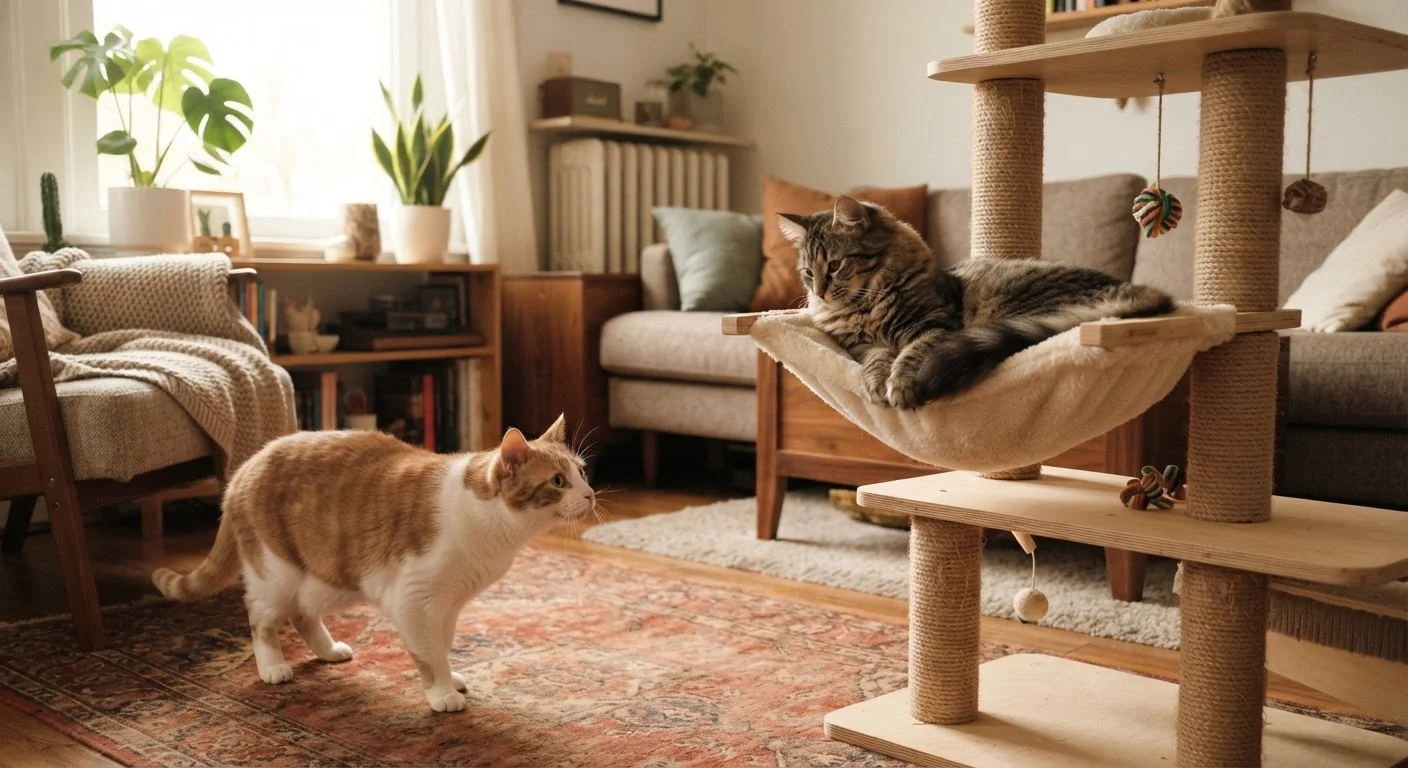
Once two cats are established in a household, daily life shifts in predictable ways. You will spend more on food, veterinary care, and supplies — that is straightforward. Less obvious is the increase in environmental management: separate feeding stations, additional vertical space (cat trees, shelves), and multiple resting spots help reduce resource guarding and tension.
Behavioral monitoring also becomes more important. It can be easy to miss subtle signs of stress or illness in one cat when attention is divided. Common cat health mistakes — such as missing behavioral changes that signal illness — become more likely in a multi-cat home if owners are not actively observing each cat individually. Scheduling separate, one-on-one interaction with each cat daily helps maintain your bond and your ability to notice changes.
~30–35%
U.S. cat-owning households with multiple cats
According to the American Pet Products Association's National Pet Owners Survey, a significant share of cat-owning households in the U.S. include more than one cat.
4–8 weeks
Typical full introduction timeline
Veterinary behaviorists generally recommend allowing four to eight weeks for a phased introduction before expecting stable, unsupervised cohabitation between two cats.
1 per cat + 1
Recommended minimum litter box count
The standard recommendation from veterinary professionals is to provide one litter box per cat in the household, plus one additional box, to reduce competition and elimination problems.