

Key Takeaways
Companion Planting
Companion planting is the practice of growing different plants close together so they can benefit one another. Some pairings deter pests, attract pollinators, improve soil health, or provide physical support. It's a time-tested gardening strategy that blends observation with a growing body of horticultural research.
Benefits range from allelopathy (chemical inhibition or attraction between plants) to nitrogen fixation by legumes, and habitat provision for beneficial insects. Not all claimed pairings have been rigorously tested.
The Real Science Behind Plant Partnerships
Companion planting has been practiced for centuries — long before anyone had a name for it. Indigenous agricultural traditions, including the famous Three Sisters method of growing corn, beans, and squash together, offered some of the earliest evidence that plant relationships matter. Today, researchers have confirmed that some of these relationships are real, while others fall squarely in the category of garden myth.
The mechanisms behind genuine companion benefits include:
- Nitrogen fixation: Legumes like beans and peas host bacteria in their root nodules that convert atmospheric nitrogen into a form usable by plants, slowly enriching the surrounding soil.
- Chemical deterrence: Some plants release volatile compounds or root exudates that repel specific insects or suppress certain soil pathogens.
- Habitat support: Flowering companions attract beneficial insects — predatory wasps, ladybugs, and hoverflies — that naturally control pest populations.
- Physical structure: Tall plants can shelter smaller ones from harsh sun or wind, while low ground covers reduce moisture loss and suppress weeds.
Understanding which mechanism applies to a given pairing helps you evaluate claims critically, rather than planting by hearsay.
~30%
Yield increase from Three Sisters polyculture
Research on traditional polyculture systems suggests intercropping corn, beans, and squash can improve land-use efficiency compared to monoculture growing.
French marigolds
Most studied companion for nematode suppression
Multiple university extension studies have documented French marigolds' ability to reduce soil-borne nematode populations when grown for a full season before susceptible crops.
~80%
Of companion planting claims lacking controlled evidence
Horticulturists have noted that the majority of popularly cited companion planting combinations have not been subject to peer-reviewed, controlled testing.
Pairings That Have Earned Their Reputation
Not all companion planting combinations are created equal. Here are some that have meaningful evidence behind them:
Tomatoes, Basil, and Marigolds
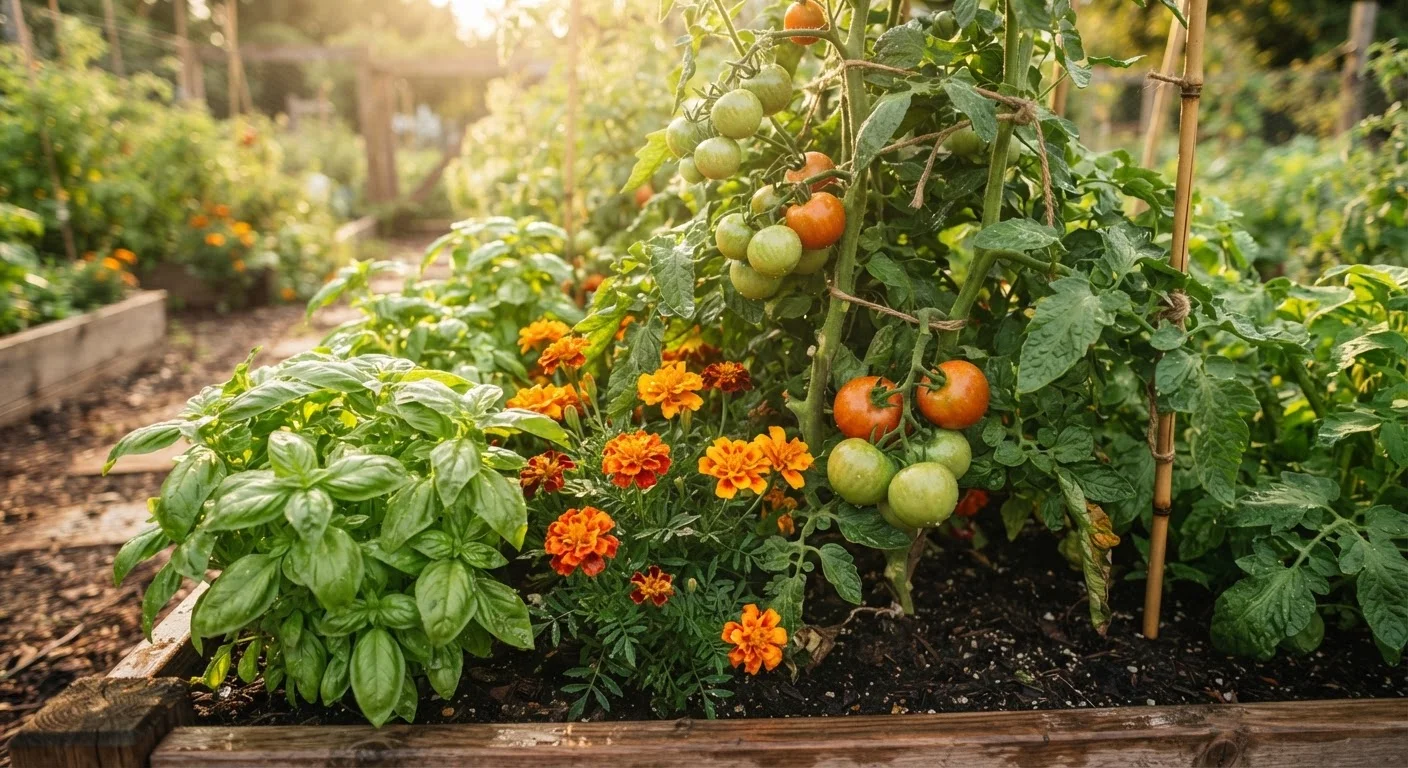
This trio is among the most popular — and one of the better-supported. Basil may help confuse or deter thrips and aphids through its strong scent compounds, and it attracts pollinators. French marigolds (Tagetes patula) have been studied for their ability to suppress soil-borne root-knot nematodes and may deter whiteflies. Together, these plants offer overlapping layers of modest protection.
The Three Sisters
Corn provides a vertical trellis for beans to climb. Beans fix nitrogen that feeds both corn and squash. Squash's broad, prickly leaves shade the soil to reduce weeds and retain moisture. Each plant contributes something distinct — which is why this combination has persisted for generations.
Brassicas and Dill or Nasturtiums
Brassicas (cabbage, broccoli, kale) are heavy targets for aphids and cabbage worms. Dill and nasturtiums can attract or serve as trap crops for these pests, drawing them away from your main crop. Nasturtiums are also edible, adding value beyond pest management.
Claims Worth Approaching With Skepticism
For every well-supported pairing, there are several that circulate primarily as gardening lore. Planting garlic near roses to repel aphids, for instance, is a common recommendation with very limited controlled research behind it. Similarly, the idea that all herbs universally deter pests oversimplifies how plant-insect interactions actually work.
That doesn't mean these practices are harmful — trying them in your garden costs little. But setting realistic expectations matters. Companion planting is unlikely to eliminate pest problems on its own. For a more complete picture of evidence-based garden pest management, see our guide on natural pest control approaches.
Start Small and Track What You Observe
Rather than redesigning your entire garden around companion planting, choose one or two well-documented pairings and observe them closely over a full growing season. Keep simple notes on pest levels and plant health. Incremental, observation-based planting beats wholesale overhaul every time.
It's also worth remembering that even beneficial companions can become problems if planted carelessly. Tall sunflowers may shade out low crops. Fennel releases allelopathic compounds that inhibit many vegetables nearby. Always check whether a pairing suits your specific layout and light conditions — the same reasoning applies to decisions about raised beds versus in-ground growing.
How to Start Companion Planting in Your Own Garden
Getting started doesn't require overhauling your entire garden. Begin with one or two well-supported pairings in a bed where you already plan to grow vegetables. Keep notes on what you observe — pest pressure, plant vigor, and harvest outcomes — season over season.
A few practical principles to guide you:
- Match growing conditions first. A companion that thrives in full sun won't help a shade-preferring plant if they're competing for the same resources.
- Don't over-crowd. Spacing still matters — packing plants together in hopes of pest suppression can restrict airflow and invite disease instead.
- Layer your strategy. Use companion planting alongside other approaches: good soil health, appropriate watering, and physical barriers when needed. Avoid common mistakes by revisiting garden watering myths.
- Think about bloom timing. Flowers that attract beneficial insects need to be blooming when your crops are most vulnerable, so timing plantings matters.
Companion planting rewards patient observation over rigid rules. The gardeners who get the most from it treat each season as a low-stakes experiment, building knowledge gradually rather than expecting a perfect outcome from year one.