

Key Takeaways
Option A
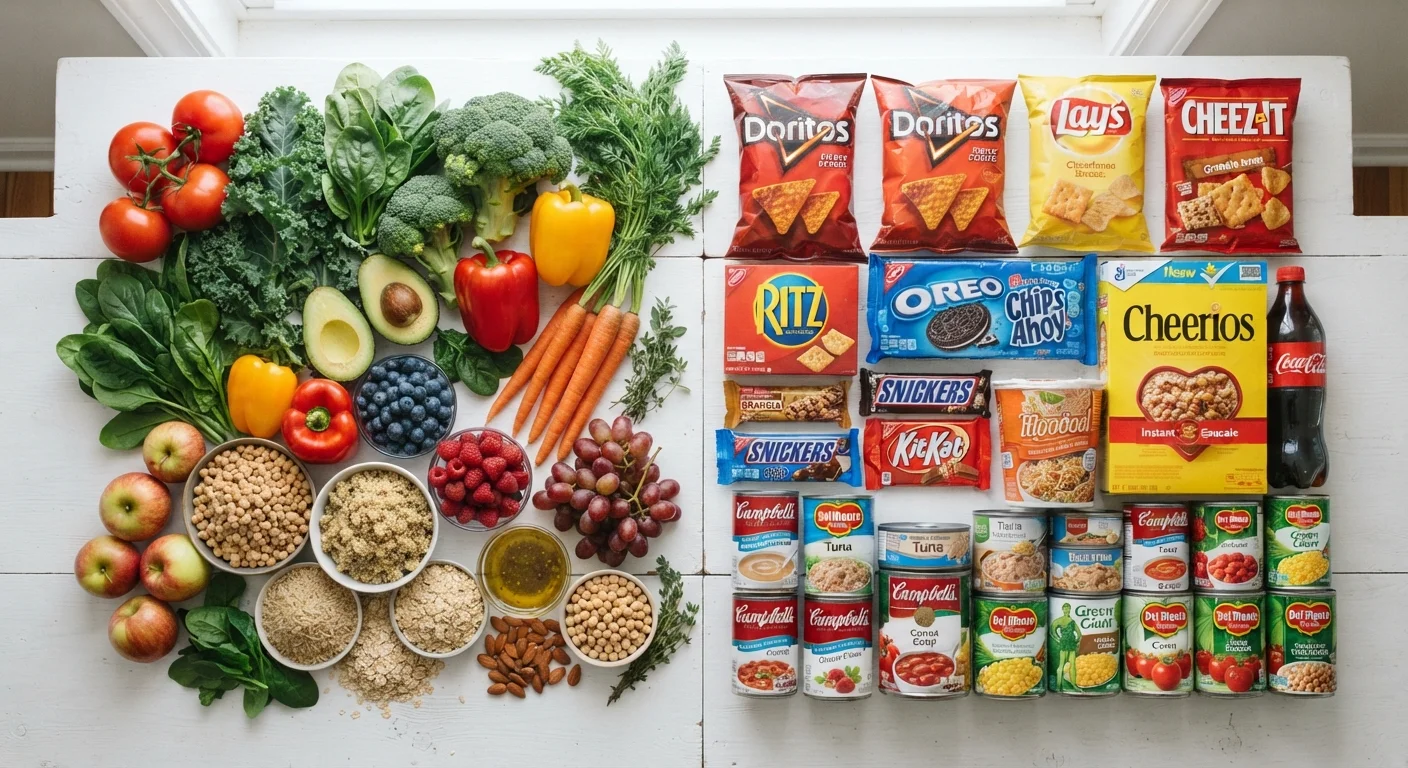
Whole Foods
The minimally altered, close-to-nature option.
Best for: Maximizing nutrient density and minimizing additives in your daily diet.
Option B
Processed Foods
A broad category ranging from mildly altered to heavily engineered.
Best for: Convenience, shelf life, and affordability — though quality varies enormously within the category.
If you want to maximize nutrient density with minimal effort
Whole Foods
Whole foods require no label-reading — an apple is an apple. They deliver fiber, vitamins, and minerals without additives or excess sodium.
If you're managing a tight budget or busy schedule
Processed Foods
Lightly processed staples like canned beans, frozen vegetables, and plain oats offer solid nutrition at low cost and with minimal prep time.
If you're trying to reduce sodium, added sugar, and artificial additives
Whole Foods
Whole foods contain no added sodium, sugar, or preservatives by definition, making it far easier to stay within sensible intake ranges.
If you need practical, sustainable everyday eating habits
Processed Foods
A balanced approach using both whole foods and minimally processed options is realistic and widely considered nutritionally sound by dietitians.
Defining the Terms: What Do They Actually Mean?
The phrase whole food refers to any food that is eaten in — or very close to — its natural state, with little to no processing. Think of a raw carrot, a handful of walnuts, a plain chicken breast, or a cup of rolled oats. These foods haven't had nutrients stripped out or ingredients added in.
Processed food, by contrast, describes almost any food that has been altered from its original form before you eat it. This is where the definition gets complicated: under that umbrella, bagged salad greens count as processed (they've been washed and cut), and so does a fluorescent-orange cheese puff. Clearly, those two things are not nutritionally equivalent.
To cut through this confusion, nutrition researchers commonly use the NOVA classification system, which groups foods into four categories based on the degree and purpose of processing:
- Group 1: Unprocessed or minimally processed foods (fresh fruits, plain meat, eggs, milk)
- Group 2: Processed culinary ingredients (flour, butter, oil, salt)
- Group 3: Processed foods (canned fish, cheese, cured meats)
- Group 4: Ultra-processed foods (packaged snacks, sugary drinks, instant noodles)
The distinction that matters most to your health is between lightly processed and ultra-processed — not simply whole versus processed.
A Note on Food Labeling Language
Terms like 'natural,' 'clean,' and 'minimally processed' on food packaging are not standardized by the FDA in the same way that terms like 'organic' are. This means a product labeled 'natural' may still contain significant additives or sodium. The ingredient list and nutrition facts panel are your most reliable tools for evaluating any packaged food — not front-of-package claims.
Head-to-Head: Key Nutritional Differences
When comparing whole foods and processed foods, the differences show up most clearly in fiber, sodium, added sugar, and additive content.
| Criterion | Whole Foods | Processed Foods |
|---|---|---|
| Fiber content | Naturally high | Often reduced by refining |
| Added sugar | None | Frequently added, especially in ultra-processed items |
| Sodium levels | Naturally low | Often high as a preservative or flavoring |
| Additives & preservatives | None | Common in packaged products |
| Convenience | Requires prep and shorter shelf life | Ready-to-eat or long shelf life |
| Cost | Varies; fresh produce can be pricey | Staples like canned goods are often affordable |
| Nutrient density | Generally high | Highly variable — from good to poor |
Whole foods are generally higher in fiber, micronutrients, and beneficial plant compounds. Processing often reduces these through refining, heating, or removing outer layers — like turning whole wheat into white flour. At the same time, manufacturers frequently add back sodium, sugar, or fats to improve palatability and shelf stability.
Ultra-processed foods in particular tend to be designed to be hyper-palatable — engineered combinations of salt, fat, and sugar that are harder to moderate. Research published in journals such as The BMJ has associated high ultra-processed food consumption with increased risk of several chronic conditions, though researchers note this is an area of ongoing study and that dietary patterns overall matter more than any single food. For balanced guidance on reading package labels, see our guide to nutrition labels.
The Gray Zone: Not All Processing Is Bad
It's worth resisting the reflex to treat 'processed' as a synonym for 'bad.' Many foods that undergo some form of processing are genuinely nutritious and practical:
- Frozen vegetables: Typically frozen within hours of harvest, retaining most vitamins and minerals
- Canned legumes: Convenient, affordable, and high in protein and fiber — just rinse to reduce sodium
- Plain yogurt: Cultured and strained, but still a solid source of protein and probiotics
- Whole grain bread: Processed, but retains the bran and germ when made with 100% whole grain flour
The issue arises when processing is used primarily to extend shelf life, cut costs, or maximize addictive appeal — stripping nutrition while layering in additives. Knowing how to read an ingredient list helps enormously here. If the first few ingredients are recognizable foods and the list is short, you're likely looking at a lightly processed product. If it reads like a chemistry textbook, that's a signal to look more closely.
Incorporating more whole foods doesn't have to mean overhauling your entire routine at once. Strategies like meal prepping on weekends can make whole food cooking practical even for busy schedules.
This article is for general informational and educational purposes only and is not a substitute for personalized advice from a registered dietitian or qualified healthcare professional.