

Key Takeaways
Why Knife Skills Pay Off Immediately
Most recipe frustration doesn't happen at the stove — it happens during prep. Vegetables cut unevenly end up half-burned and half-raw. Herbs hacked instead of sliced turn bruised and bitter. A chicken breast carved awkwardly wastes good meat. Knife skills fix these problems at the source.
You don't need culinary school to develop a solid foundation. A handful of techniques — practiced with intention — will noticeably speed up your prep and improve the quality of nearly everything you cook. If you're just getting started in the kitchen, see our beginner's guide to cooking for a broader starting point before diving into technique.
Below are the core knife skills worth building first, in a logical order that compounds as you go.
The Pinch Grip
Most home cooks hold the knife handle like a hammer. The pinch grip — thumb and index finger pinching the blade itself, just above the bolster, with the remaining fingers curled around the handle — gives you far more control and precision.
It feels unfamiliar at first, but your movements become shorter and more deliberate. Your wrist guides the knife rather than your whole arm, which reduces fatigue during longer prep sessions. Spend five minutes practicing this grip each time you cook and it becomes second nature within a week or two.
Pinching the blade — not just the handle — is the single biggest control upgrade you can make.
The Claw Hand
The hand holding the food is just as important as the hand holding the knife. Curl your fingertips under so your knuckles face the blade — this is called the claw. The flat side of the blade then rests lightly against your knuckles as you cut, keeping fingers safely out of the path of the edge.
It feels awkward to relearn how you hold vegetables, but the claw is a genuine safety mechanism. It also allows you to guide the knife more precisely by moving the claw hand in small, measured increments rather than repositioning the whole ingredient.
Curled fingertips protect your hand and let your knuckles guide every cut.
The Rock Chop
This is the fundamental chopping motion used in most professional kitchens. The tip of the knife stays in contact with the board while the heel rocks up and down through the ingredient. Rather than lifting the entire blade on each stroke, you pivot — which is faster, quieter, and easier on your wrist.
The rock chop works best for herbs, garlic, and roughly chopped vegetables. Once you're comfortable, it becomes an almost rhythmic motion that significantly speeds up volume prep.
Keeping the tip on the board turns chopping into a smooth, controlled rocking motion.
The Basic Dice
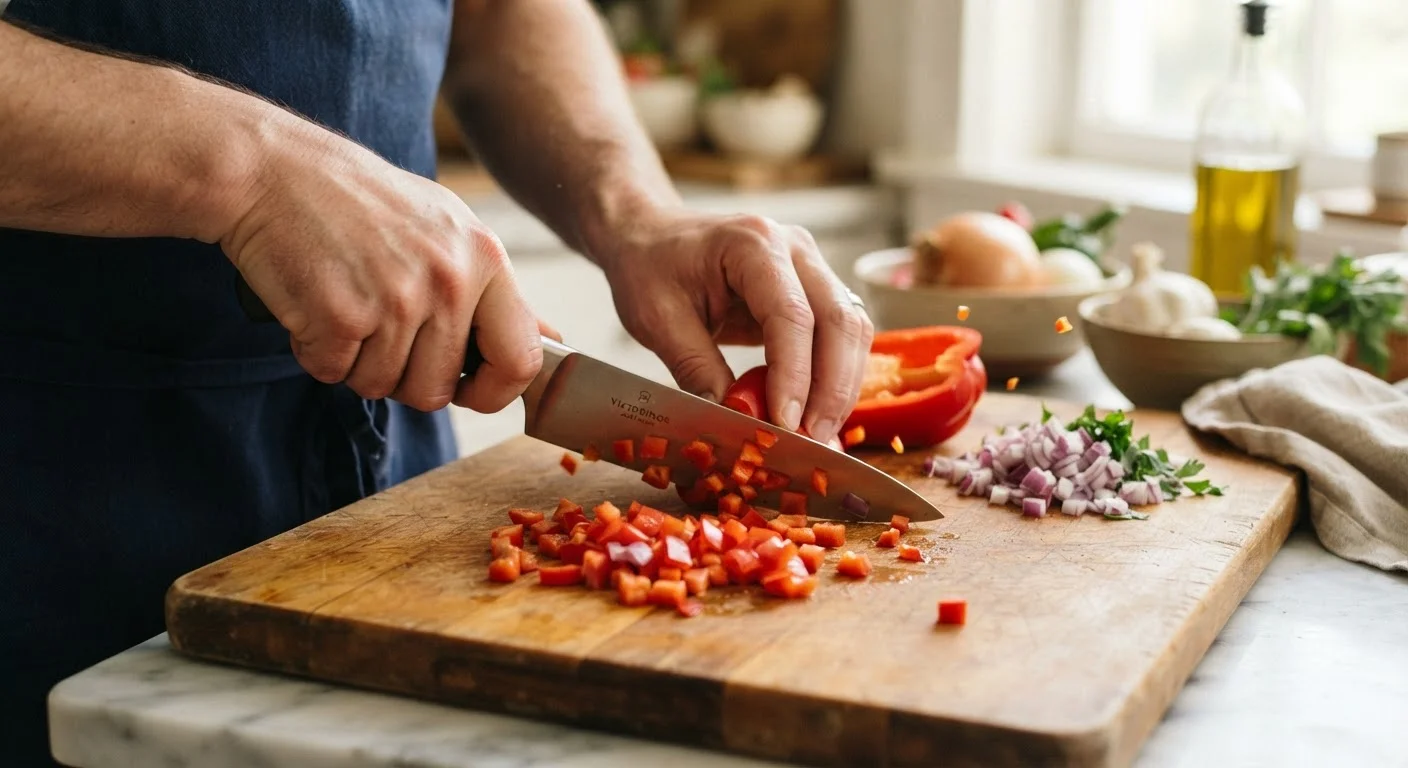
A proper dice starts with consistent slices. First, cut the ingredient into planks of even thickness. Then stack or align those planks and cut into uniform batons. Finally, turn 90 degrees and cut across the batons to produce cubes. Three steps, consistent size.
Size matters practically, not just visually. A small dice (roughly ¼ inch) cooks quickly and disappears into sauces. A medium dice (about ½ inch) holds its shape in soups and stews. Matching the cut to the dish keeps everything cooking at the same rate — a basic principle covered across nearly every recipe in the meal prep hub.
Three cuts — planks, batons, cubes — produce a consistent dice every time.
The Chiffonade
This technique is used specifically for leafy herbs and greens like basil, mint, or kale. Stack the leaves, roll them tightly lengthwise into a cylinder, then slice across the roll in thin ribbons. The result is a clean, delicate cut that preserves texture and appearance.
Why it matters: crushing or roughly chopping tender herbs bruises the cell walls, releasing enzymes that cause browning and turn flavor bitter. Chiffonade keeps the cut clean and the flavor bright — especially useful when using herbs as a finishing garnish.
Rolling herbs before slicing prevents bruising and keeps the flavor clean and fresh.
Keeping the Knife Sharp
A dull knife requires more pressure to cut, which makes the blade more likely to slip sideways off the ingredient. A sharp knife glides through food with minimal effort, giving you more control. This is why professional kitchens treat sharpening as maintenance, not a special occasion.
For most home cooks, using a honing steel before each session (which realigns the edge) and getting the knife properly sharpened a few times per year (which removes metal to restore a worn edge) is sufficient. These are two different tools doing two different jobs — honing maintains, sharpening restores.
A sharp knife is a safer, more precise knife — sharpness is a maintenance habit, not a luxury.
Building the Habit
Knife skills aren't memorized — they're built through repetition. Set up your workspace before you begin: a damp paper towel under the cutting board keeps it from sliding, and an organized counter means less reaching and fewer interruptions. This kind of pre-prep mindset connects directly to mise en place, a professional habit that pays off quickly for home cooks too.
Practice on low-stakes ingredients first
Carrots, onions, and zucchini are forgiving practice materials — they're inexpensive, firm enough to hold their shape, and used in dozens of recipes. Run through your cuts deliberately before you're under time pressure. Ten minutes of focused practice during a calm prep session is worth more than rushing through techniques while cooking.
Once your prep is consistent, you'll notice it changes how you cook, not just how fast you chop. Even cuts mean more predictable results, which pairs well with tasting as you cook — another skill that separates confident cooks from hesitant ones. For a full pre-session checklist, setting up your kitchen before a prep session walks through exactly what to have in place.