

Key Takeaways
Why Storage Myths Persist — and What They Cost You
Most of us learned how to store food by watching the adults in our households. These habits get passed down with total confidence, which makes them hard to question. But food science has a lot to say about what actually keeps produce, proteins, and pantry staples at their best — and some of the most widely held storage instincts turn out to be wrong in ways that quietly drive up food waste.
According to the USDA, American households waste a significant share of the groceries they buy each year, and improper storage is a major contributing factor. The good news: fixing these habits takes almost no extra effort once you know what the evidence actually says. If you're also looking to stretch your grocery budget further, simple grocery-saving habits can pair well with better storage practices.
Myth
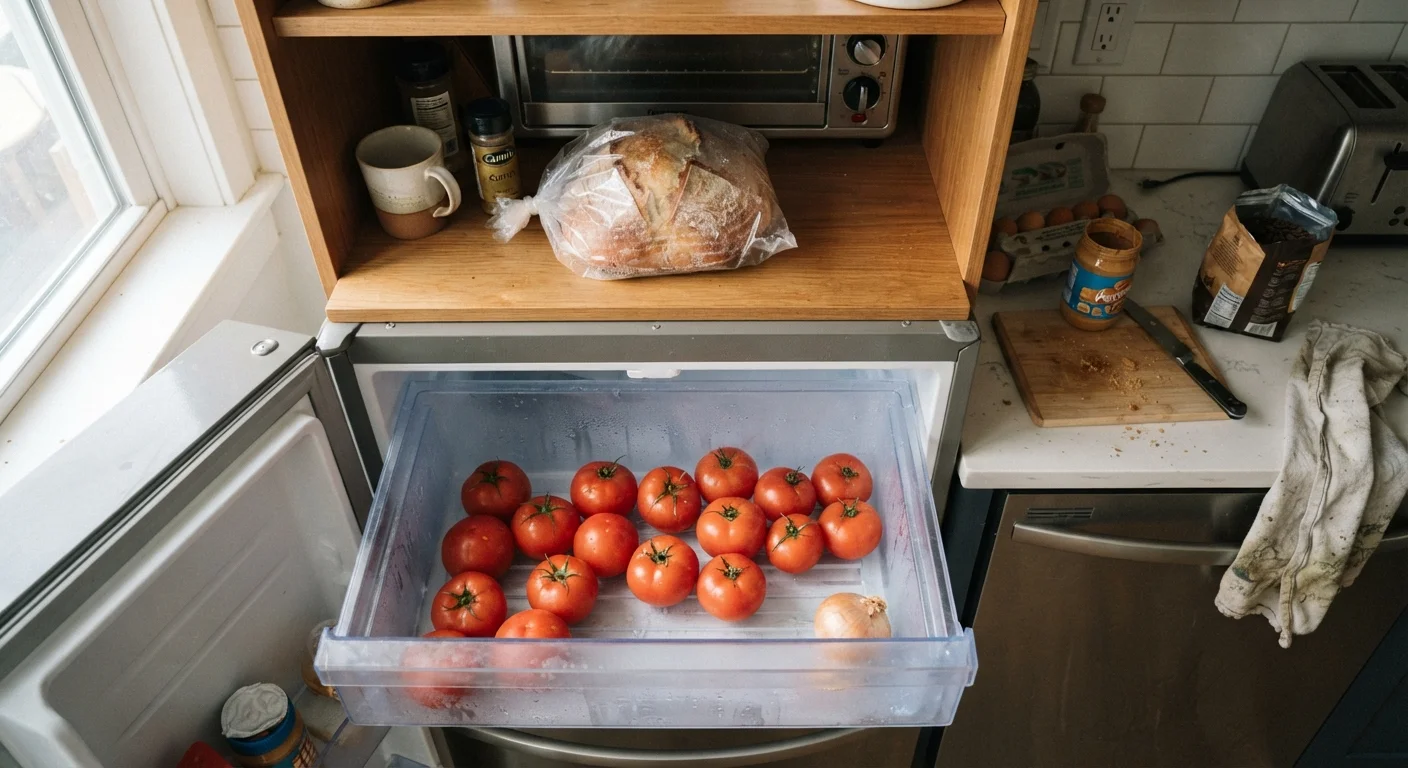
Tomatoes should be stored in the refrigerator to keep them from spoiling.
Fact
Refrigerating tomatoes damages their cell structure and halts the ripening enzymes that produce flavor, making them mealy and bland.
Tomatoes are cold-sensitive. Research published in the Proceedings of the National Academy of Sciences has shown that chilling tomatoes below 54°F (12°C) suppresses the genes responsible for producing the volatile compounds that give tomatoes their characteristic aroma and taste. Once that damage is done, it cannot be reversed by bringing the tomato back to room temperature. Store tomatoes stem-side down on a counter, away from direct sunlight, until fully ripe. Once cut, refrigerating is fine — but whole tomatoes belong at room temperature.
Myth
Putting bread in the refrigerator keeps it fresh longer.
Fact
Refrigeration actually accelerates staling in bread by speeding up a process called starch retrogradation.
Starch retrogradation is what happens when the starch molecules in bread recrystallize after baking — it's the scientific mechanism behind staleness. This process happens faster at refrigerator temperatures than at room temperature. The best approach: keep bread you'll eat within two to three days in a bread box or wrapped at room temperature, and freeze any remainder. Frozen bread thaws and toasts well, maintaining far better texture than refrigerated bread ever does.
Myth
Washing berries as soon as you get home from the store keeps them fresher.
Fact
Washing berries before storage introduces moisture that promotes mold growth, shortening their shelf life significantly.
Berries have a naturally porous surface. Moisture trapped in crevices creates an ideal environment for mold spores — which are already present on nearly all fresh produce — to take hold quickly. The USDA recommends washing berries just before eating, not before storing. To extend shelf life further, store unwashed berries in a single layer on a paper-towel-lined container, loosely covered, in the refrigerator. Some cooks add a brief rinse in a dilute white vinegar solution just before eating to reduce surface mold load, then dry thoroughly.
Myth
Eggs must be refrigerated as soon as possible, or they're unsafe at room temperature.
Fact
Whether eggs need refrigeration depends on how they were processed — U.S. commercial eggs are washed and must be refrigerated; unwashed eggs can be safely stored at room temperature.
In the United States, commercial eggs are washed and sanitized, which removes the natural protective coating (called the cuticle or bloom) that prevents bacteria from entering through the shell. This makes refrigeration necessary. In many other countries, eggs are not washed and can safely sit on a countertop for weeks. This is purely a processing difference, not a quality one. In the U.S., keep eggs in the coldest part of the refrigerator — typically not the door, where temperatures fluctuate every time it opens.
Myth
Cooking oils can be stored indefinitely in a cabinet next to the stove.
Fact
Heat, light, and air are the primary causes of oil rancidity; storing oils near the stove significantly accelerates their degradation.
Oxidation is the chemical reaction that makes oils go rancid, and heat dramatically speeds it up. A cabinet directly above or beside a stove is one of the warmest spots in a kitchen. Most cooking oils — especially delicate ones like extra-virgin olive oil or nut oils — store best in a cool, dark location like a pantry cabinet away from the stove. If you go through oil quickly, a small amount in a countertop dispenser is fine; the bulk supply should be kept away from heat sources. Rancid oil has a noticeably off smell and a bitter taste, and consuming it won't provide the same nutritional quality as fresh oil.
Myth
"Best by" dates mean food is unsafe to eat after that date.
Fact
"Best by" and "use by" dates on most packaged foods indicate peak quality, not a safety cutoff — with a few important exceptions.
The FDA and USDA have clarified that most date labels on packaged foods — such as "best by," "sell by," or "best if used by" — are manufacturer estimates of peak quality, not safety indicators. Exceptions include infant formula and certain ready-to-eat deli meats, where date adherence is more critical. Shelf-stable pantry items like canned goods, dried pasta, and rice often remain safe and palatable well beyond their printed dates if stored properly. Using your senses — smell, appearance, and taste — along with reliable food safety guidelines, is a practical approach for most pantry items. When in doubt, official resources like FoodSafety.gov provide specific guidance by food category.
The Storage Decisions That Matter Most
Beyond individual foods, the bigger picture is your overall kitchen system. Where you keep things, how they're contained, and how organized your space is all influence food longevity. For example, oils and spices kept next to the stove — a near-universal habit — degrade faster because repeated heat exposure breaks down their compounds. A cool, dark cabinet extends their usable life considerably.
Similarly, a well-organized pantry makes it easier to rotate stock and actually use what you buy before it turns. Principles for a functional pantry go hand-in-hand with knowing which items genuinely need refrigeration versus which ones just feel like they should. And if you meal prep regularly, pairing smart storage habits with the right containers for prepped meals makes a measurable difference in how long your food stays safe and appetizing.
30–40%
U.S. food supply wasted each year
According to the USDA Economic Research Service, the U.S. wastes an estimated 30–40% of its food supply, with household storage decisions being a significant contributing factor.
54°F
Temperature threshold that damages tomato flavor
Research indicates tomatoes stored below approximately 54°F (12°C) suffer irreversible loss of the volatile compounds responsible for aroma and taste.
Getting storage right isn't about being more cautious — it's about being more accurate. Small corrections to deeply ingrained habits can reduce what ends up in the trash, save money over time, and mean you're eating food that actually tastes the way it should.
This article is for general informational purposes only. Food safety guidelines may vary; when in doubt about the safety of a specific item, consult official resources such as FoodSafety.gov or your local agricultural extension service.