

Why Right-of-Way Rules Confuse So Many Drivers
Right-of-way rules rank among the most misunderstood aspects of everyday driving. Many conflicts at intersections — from near-misses to low-speed collisions — happen not because drivers are reckless, but because they're working from an incomplete or incorrect understanding of who goes first. This reference guide covers the core rules for roundabouts, priority roads, and common intersection scenarios in plain language.
One important clarification upfront: right-of-way is a legal concept, but yielding it is ultimately a safety decision. Even when you technically have priority, always check that the other driver is actually stopping before you proceed. For more on how broader road conditions affect your decisions, see our guide on driving in rain, snow, and fog.
Roundabouts: Who Yields to Whom
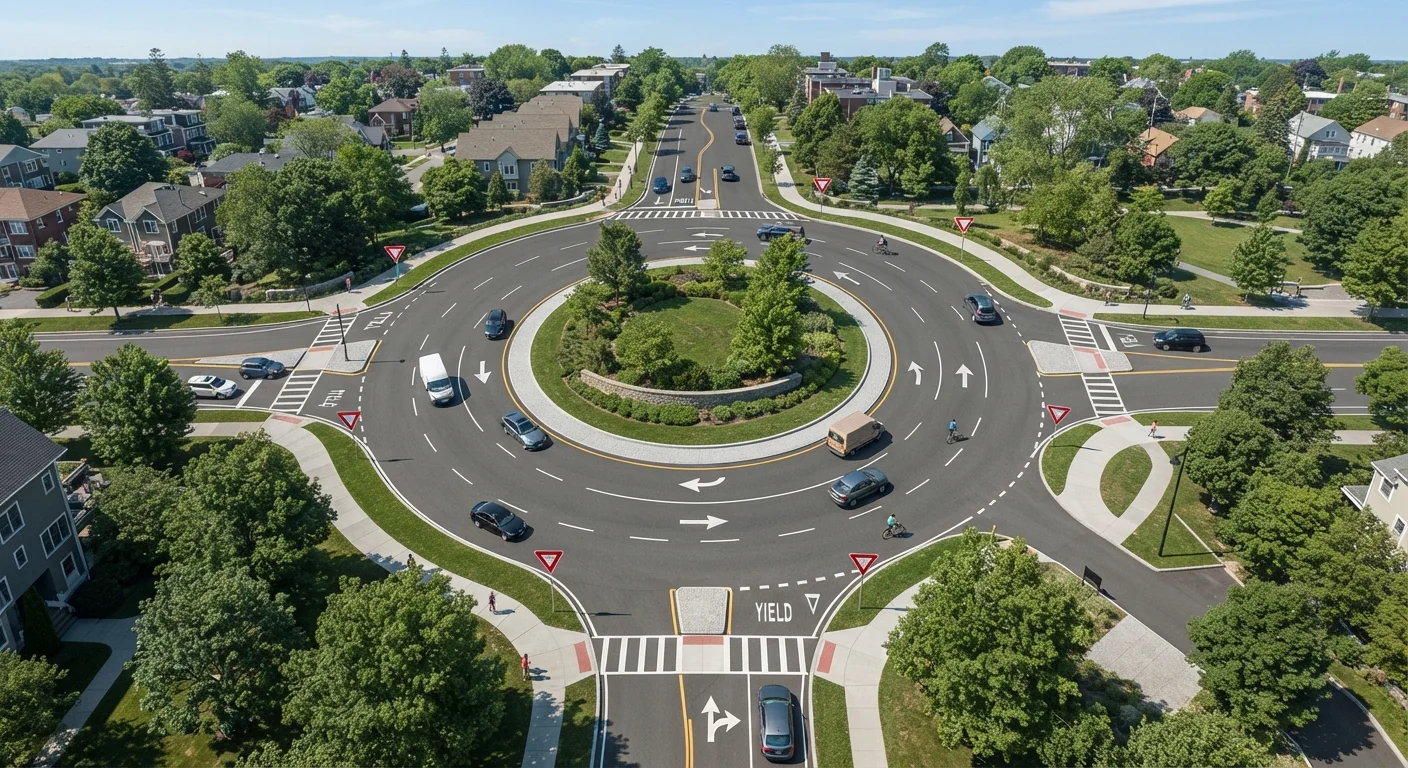
In the United States, roundabouts follow a consistent rule: traffic already inside the roundabout has the right of way. Drivers entering from any approach must yield to circulating traffic before merging in. You do not take turns by approach road — you enter when there is a safe gap.
Key roundabout rules at a glance
- Yield at the entry line — marked with a dashed yield line and usually a yield sign. Stop if necessary; do not force entry.
- Travel counterclockwise — all US roundabouts circulate counterclockwise. Do not stop in the circle unless forced to by an emergency.
- Multi-lane roundabouts — choose your lane before entering based on your exit. Right lane is generally for right turns or going straight; left lane for going straight or turning left. Check pavement markings — they vary by design.
- Pedestrians and cyclists — yield to pedestrians at the crosswalks on your approach and exit. Cyclists may take the full lane in single-lane roundabouts.
Roundabouts are statistically safer than traditional signalized intersections. The Federal Highway Administration notes they eliminate the most dangerous conflict types — high-speed right-angle and left-turn crashes — by design.
Priority Roads and Unmarked Intersections
Outside of controlled intersections, two other scenarios regularly trip up drivers: priority roads and unmarked intersections.
Priority roads
A priority road (sometimes called a through road or main road) is a road where traffic has the right of way over roads joining it. These are typically marked with a yellow diamond sign in many countries, but in the US, the equivalent is a combination of signage: through-traffic often faces a yield or stop sign on the minor road, while the major road has none. If you're on a road with no signage and another driver faces a stop or yield sign, you have priority — but verify before assuming.
Unmarked intersections
When two roads of similar size meet with no signs or signals, most US states apply the right-hand rule: the driver on the left must yield to the driver approaching from the right. Treat these intersections with extra caution — approach slowly, make eye contact where possible, and be ready to stop. Urban environments concentrate these scenarios; city driving hazards deserve their own attention.
T-intersections
At a T-intersection (where one road dead-ends into another), traffic on the terminating road must yield to traffic on the through road — even if there are no signs present.
Common Scenarios and Who Goes First
These everyday situations cause the most confusion:
| Scenario | Who Has Priority |
|---|---|
| Four-way stop, all arrive simultaneously | Driver on the right goes first |
| Four-way stop, one arrives first | First to stop goes first |
| Left turn at a green light (no arrow) | Oncoming straight-through traffic |
| Entering a roundabout | Circulating traffic already inside |
| Merging onto a highway | Traffic already on the highway (merge responsibly) |
| Unmarked intersection of equal roads | Driver on the right has priority |
| Emergency vehicle approaching | All other traffic must yield and pull right |
The left-turn rule trips up many drivers: at a standard green light, you do not have the right of way to turn left if oncoming traffic is moving through. You must wait for a safe gap or a dedicated green arrow. This is one of several persistent road safety myths worth revisiting.
New drivers especially benefit from understanding these rules early. Our introduction for new licence holders covers how to build these habits from the start. And for high-speed situations, motorway merging and lane discipline explains how right-of-way principles extend to faster roads.