

Key Takeaways
Engine Oil Degradation
Engine oil degradation is the gradual breakdown of motor oil's ability to lubricate, clean, and cool your engine's moving parts. Fresh oil flows freely and carries away heat and contaminants. Over time and miles, it thickens, becomes acidic, and loses its protective properties — leaving metal surfaces vulnerable to friction and wear.
Oil degrades through oxidation, thermal breakdown, and contamination from combustion byproducts. Once additive packages are depleted, the oil can no longer neutralize acids or suspend particles effectively.
What Engine Oil Actually Does
Motor oil does three essential jobs simultaneously: it lubricates metal surfaces that are moving at high speed against each other, it carries heat away from critical components, and it suspends tiny contaminants — metal particles, combustion byproducts, dirt — so they can be trapped by the oil filter rather than grinding through your engine.
Fresh oil is relatively thin, chemically stable, and loaded with additives that help it do all three jobs well. As it ages and accumulates miles, those additives deplete, the oil oxidizes, and it starts absorbing more contaminants than it can effectively hold. What was once a protective film becomes an increasingly inadequate one.
For a broader picture of what gets checked during a routine service visit, see what actually happens during a car service.
The Mechanical Consequences of Skipping Changes
The damage doesn't announce itself. It builds gradually through a predictable sequence:
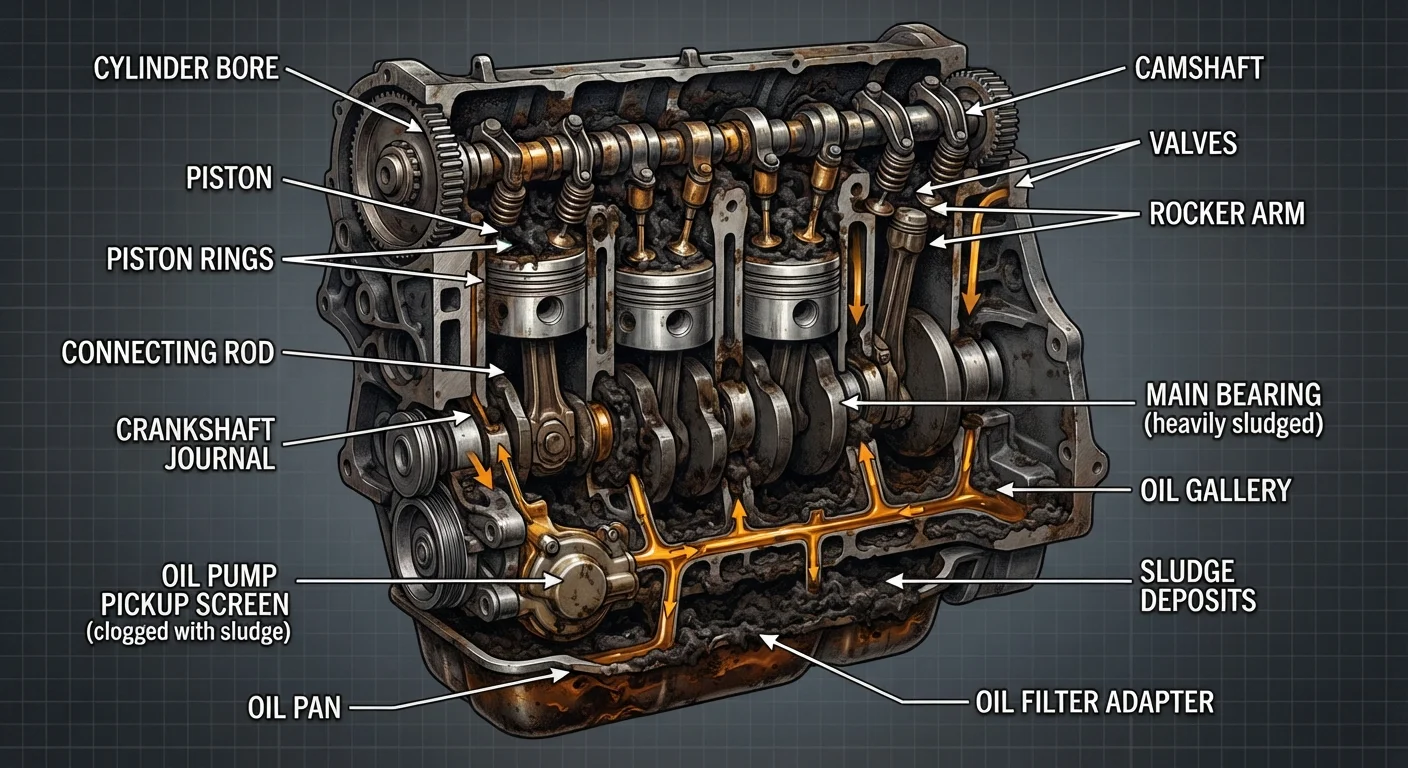
- Increased friction: As oil loses viscosity and its lubricating film thins, metal parts that should never make direct contact begin to do exactly that. Bearings, camshaft lobes, and cylinder walls are especially vulnerable.
- Sludge formation: Severely degraded oil can thicken into a tar-like sludge that clogs narrow oil passages. When those passages are blocked, oil can't reach the parts that need it most — and lubrication-starved components wear rapidly.
- Heat buildup: Oil helps regulate engine temperature by pulling heat away from components. Degraded oil does this poorly, causing localized overheating that accelerates metal fatigue.
- Accelerated corrosion: Old oil becomes acidic as combustion byproducts accumulate. That acidity actively corrodes metal engine surfaces rather than protecting them.
5,000–10,000 mi
Typical oil change interval range
Manufacturer-recommended intervals vary by vehicle and oil type; consult your owner's manual for the correct schedule.
~$4,000+
Potential cost of engine sludge repair
Sludge-related engine damage can require partial or full engine repair, with costs varying widely depending on vehicle and severity.
2 minutes
Time to check oil level with a dipstick
A quick monthly dipstick check is one of the simplest habits for catching oil issues before they become expensive problems.
High-mileage vehicles are particularly sensitive to these effects. Maintaining a high-mileage car involves closer attention to oil condition because older engines often have worn seals and tighter tolerances that degrade faster under oil neglect.
Why the Damage Creeps Up Quietly
Most drivers don't notice the early stages because the symptoms are subtle: a slight uptick in engine noise, marginally lower fuel efficiency, oil that looks darker than usual on the dipstick. By the time a problem becomes undeniable — an engine knocking, a warning light that won't go off, oil pressure dropping — the wear is already significant.
This is what makes oil change neglect different from a flat tire or a cracked windshield. Those problems are immediate and visible. Oil degradation works silently, and the repair bill arrives well after the window to prevent it has closed.
Check Your Oil Monthly — Not Just at Service Time
Pull the dipstick when the engine is cold or has been off for a few minutes. Wipe it clean, reinsert fully, then pull again to get a clear reading. Look at both the level and the color. If it's low or looks extremely dark and gritty well before your next scheduled change, have it checked by a mechanic.
It's also worth knowing that not all oil is the same. Synthetic versus conventional motor oil behave differently under heat and stress, which affects how long each type stays effective before it needs to be changed.
Staying Ahead of the Problem
The good news is that oil changes are one of the most straightforward and cost-effective ways to protect an engine. Following your manufacturer's recommended interval — found in your owner's manual — is the baseline. Many modern vehicles also include an oil life monitoring system that adjusts the recommendation based on actual driving patterns rather than a fixed mileage number.
Checking your oil level and condition between changes takes about two minutes with a dipstick. Dark brown or black oil isn't always cause for immediate alarm, but oil that looks gritty, smells burned, or sits well below the minimum line needs attention promptly.
Oil changes are just one piece of the maintenance picture. Other often-skipped maintenance tasks — like coolant flushes and spark plug replacements — have a similar pattern: easy to defer, quietly costly when neglected.