

Key Takeaways
Why Career Stage Shapes Your Balance Needs
Work-life balance is often framed as a single problem with a single solution: work less, rest more. But the reality is that what balance means — and what it costs to achieve it — changes substantially as your career evolves. The pressures on a 26-year-old navigating entry-level ambition bear little resemblance to those on a 42-year-old managing a team while raising children, or a 58-year-old preparing for a career transition.
Before diving into each stage, it helps to ground this in what balance actually is. As explored in our guide to what work-life balance really means, the concept isn't a fixed formula — it's a personal calibration that shifts with your circumstances, values, and capacity. Career stage is one of the most significant drivers of that shift.
77%
Workers reporting workplace burnout
A Gallup workplace study found roughly 76–77% of workers experience burnout on the job at least sometimes, with intensity varying significantly by career stage.
2 in 5
Mid-career workers with dual caregiving duties
Pew Research data suggest a substantial share of adults in their 40s simultaneously provide care for both children and aging parents, amplifying work-life strain.
54%
Employees who feel work interferes with personal life
According to Gallup's State of the American Workplace reports, over half of employees say their job regularly encroaches on family or personal time.
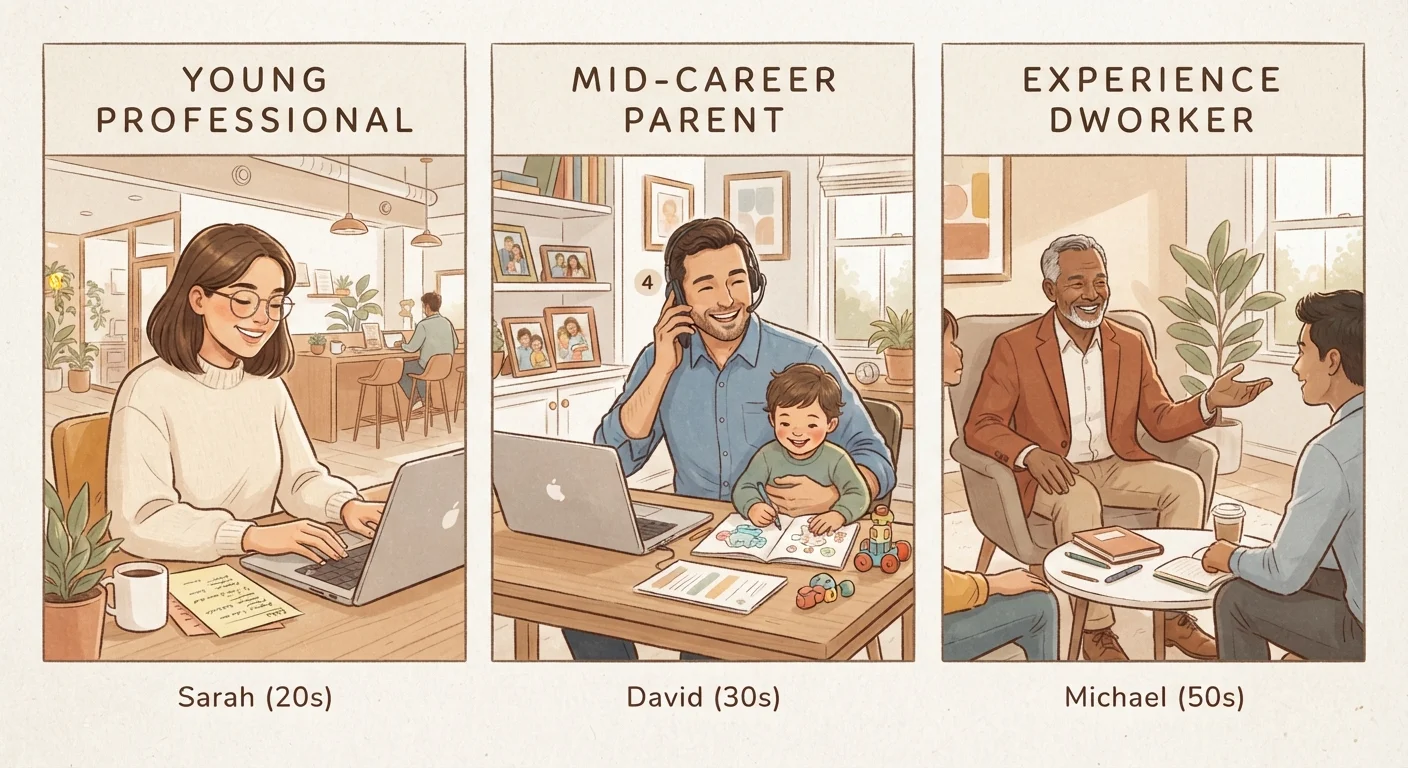
Early Career (20s–Early 30s): Building Without Burning Out
The early career years come with a specific tension: you need to invest heavily in skill-building and professional reputation, but that same intensity can create habits that are hard to shake later. Many early-career workers absorb the unspoken message that availability equals dedication — responding to emails at 10 p.m. or skipping vacation to signal commitment.
The risk here isn't just fatigue. Research on occupational burnout consistently shows that patterns established early in a career tend to persist. Workers who normalize overwork in their 20s are more likely to carry those habits into higher-stakes roles where the costs compound.
Practical anchors for this stage:
- Treat recovery as a job skill. Sleep, exercise, and downtime aren't rewards — they're inputs to performance.
- Learn to say no to low-value asks. Not every opportunity deserves a yes, and selective focus builds more credibility than stretched-thin availability.
- Understand what flexibility is actually worth. Flexible schedules come with real trade-offs that aren't always visible upfront — weigh them carefully before committing.
In your early career, protect one non-work activity with the same seriousness you protect a client meeting — schedule it, show up for it, and don't trade it away.
Early habits compound. Workers who establish at least one consistent recovery anchor in their 20s tend to maintain healthier boundaries when workloads increase later.
When transitioning into a new role at any stage, negotiate your expectations in writing before you start — including response-time norms for after-hours messages.
Role transitions are the highest-leverage moment for boundary-setting. Once norms are established informally, they're much harder to renegotiate without friction.
Mid-Career (Mid-30s–Late 40s): Peak Pressure, Peak Stakes
Mid-career is where work-life tension tends to peak. Professionally, many workers are taking on management responsibilities or navigating demanding senior individual-contributor roles. Personally, this is often when caregiving demands — children, aging parents, or both — are at their most intense.
This collision of pressures is not a personal failing; it's a structural reality of how American working life is organized. For working parents in particular, the coordination load alone — school schedules, childcare, elder care appointments — is a second job. A Working Parent's Roadmap to Managing Time Without Constant Guilt addresses exactly this pressure with practical time-structuring strategies.
At this stage, boundary-setting becomes more consequential, not less. The very authority that comes with mid-career seniority can make it harder to model limits — managers often feel they must be perpetually available to their teams. That impulse is understandable but counterproductive over time.
Chronic Overload Has Cumulative Health Costs
Sustained high-pressure work without adequate recovery is associated with increased risk of cardiovascular stress, sleep disruption, and diminished cognitive performance over time. These effects don't resolve on their own when the project ends — they accumulate. If you're regularly running on empty, consider speaking with a healthcare provider or a mental health professional, not just adjusting your schedule.
Financial pressures often peak here too, which links balance decisions directly to money. Financial priorities at this life stage shape how much flexibility workers can realistically afford — or demand from employers.
Late Career (50s and Beyond): Redefining What Enough Looks Like
Workers in their 50s and beyond often have more leverage than they realize — and more room to redefine what their working life looks like. Accumulated expertise, professional networks, and often increased job security create conditions where negotiating for reduced hours, phased retirement, or different responsibilities is genuinely feasible.
Yet this stage also carries its own pressures: concerns about relevance, ageism in hiring, and the psychological complexity of winding down a career that has been central to identity for decades. The risk here isn't usually overwork — it's the difficulty of stepping back without feeling like you're stepping out.
Late-career balance strategies often center on intentional transition rather than abrupt exit: mentoring, project-based work, or moving into roles that draw on depth rather than hours. This is also the stage at which the question shifts from how do I fit life around work? to how do I fit work into the life I want?
What Never Changes, Regardless of Stage
Across all three stages, certain fundamentals hold. These aren't stage-specific tactics — they're durable principles that remain relevant whether you're 25 or 55.
- Imbalance rarely announces itself clearly. It usually accumulates quietly. Recognizing the early signals that balance has slipped is a skill worth cultivating at any age.
- Boundaries require active maintenance. They erode under organizational pressure unless deliberately reinforced.
- Recovery time is non-negotiable. The form it takes changes — a 30-year-old might need social connection; a 55-year-old might need solitude — but the need itself doesn't disappear.
- Honest self-assessment matters more than external benchmarks. Comparing your balance to a colleague's is rarely useful; their circumstances, values, and constraints are different from yours.
It's also worth naming what common myths about balance get wrong at every stage: the idea that perfect equilibrium is the goal, that balance means equal time for everything, or that wanting more recovery time signals weak ambition. None of these hold up.
Practical Strategies That Adapt as You Grow
Rather than a single playbook, think of balance as a set of practices that you adjust as your circumstances change. A few that scale across stages:
- Audit your commitments annually. What made sense to agree to last year may no longer fit. A yearly review of how you're spending your time — professionally and personally — creates space for deliberate adjustment.
- Use role transitions as reset points. A new job, a promotion, or a team change is a natural moment to renegotiate expectations before old patterns calcify.
- Separate urgency from importance. Much of what feels urgent at work is not actually important. Identifying the difference reduces reactive behavior that erodes personal time.
- Communicate capacity explicitly. Colleagues and managers generally respond better to clear, early signals about capacity than to silent overload followed by disengagement.
For workers navigating the specific dynamics of remote or hybrid setups, how remote and office work differ in practice is worth understanding — the setting changes some fundamentals of balance without eliminating the underlying challenges.
Whatever your stage, the goal isn't a perfect score. It's a working arrangement that you've consciously chosen, can sustain without steady deterioration, and can adjust as your life continues to change. For broader context on thriving in any work environment, the Workplace Success hub covers communication, growth, and resilience across career types and settings.