

Key Takeaways
Why Savings Strategies Must Evolve
A 24-year-old renting a studio apartment and a 52-year-old with a mortgage, college-bound kids, and an eye on retirement have almost nothing in common financially — even if their incomes are similar. That's the core reality of personal finance: the right savings approach depends heavily on where you are in life, not just how much you earn.
Most general savings advice treats adults as a monolith. In practice, your obligations, risk tolerance, and time horizon shift constantly. A strategy that fits your twenties can actively work against you in your forties. This guide breaks savings down by life stage so you can focus energy where it matters most right now — and plan for what's ahead.
This article is general financial information and education, not personalized financial advice. For guidance on your specific situation, consult a qualified financial professional.
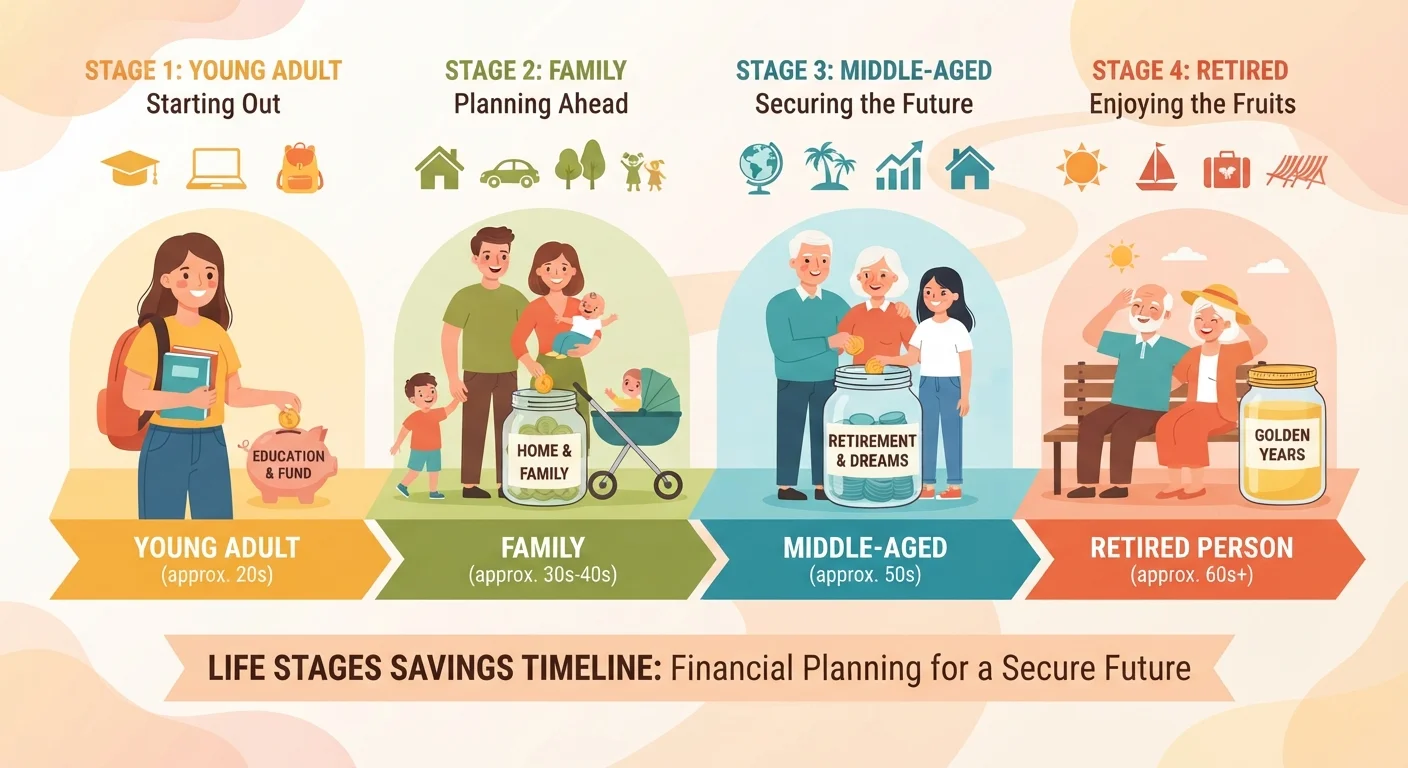
Your Twenties: Building the Foundation
In your twenties, income is often modest and expenses feel relentless — student loans, rent, and the cost of setting up independent adult life all compete for the same paycheck. The temptation is to delay saving until things settle down. That delay is usually a mistake.
The single most important move in your twenties is establishing an emergency fund — typically three to six months of essential expenses, kept in a liquid account. This buffer prevents a single setback (a job loss, a car repair) from forcing you into debt.
The second priority is capturing any employer match in a workplace retirement plan. An employer match is additional compensation you earn by contributing — not participating is leaving part of your pay on the table.
When you receive a raise, automate an increase in your savings contribution before updating your spending habits. Even routing an additional 1–2% of each raise to savings compounds meaningfully over a decade.
Behavioral research consistently shows that people adapt their spending to available income. Capturing savings increases before the money hits a checking account sidesteps that pattern entirely.
In your thirties and forties, build a dedicated account for irregular but predictable expenses — car registration, insurance renewals, annual subscriptions — rather than absorbing them from your monthly budget.
Lumpy expenses are a leading cause of budget disruption and emergency fund raids. A dedicated 'sinking fund' smooths cash flow and protects savings intended for longer-term goals.
Watch out for lifestyle inflation early. When your first raise arrives, it's tempting to upgrade everything simultaneously. Directing even half of each raise toward savings before adjusting your spending locks in progress that compounds over decades.
If your budget feels squeezed, consider whether you're saving a fixed amount or a percentage of income — our comparison of fixed amounts vs. percentage-based saving can help you choose the approach that suits your cash flow.
Your Thirties: Balancing Competing Priorities
The thirties often bring the most financial complexity of any decade: a mortgage, children, career transitions, aging parents, and rising costs all arrive in a compressed window. Savings goals multiply faster than income does for most people.
The key discipline here is triage. If you have high-interest debt, paying it down is often the most reliable return available. Once that's handled, prioritize in rough order: fully funded emergency fund, retirement contributions up to any employer match, then medium-term goals like education savings or a home purchase fund.
Watch for Lifestyle Creep in Your Thirties
Higher income in the thirties often leads to proportionally higher spending on housing, cars, and experiences — leaving savings rates flat or declining even as earnings rise. Track your savings rate as a percentage of income, not just the dollar amount, to spot this pattern early.
Lifestyle creep is especially aggressive in the thirties. As income grows, so does spending on housing, vehicles, travel, and childcare. Reviewing your budget annually — not just when something goes wrong — helps you catch drift before it becomes entrenched.
Automation is your ally when life is hectic. Scheduled transfers on payday mean saving happens before discretionary spending has a chance to absorb the funds. See how automating your savings can reduce friction and where the approach has limits.
Your Forties: Accelerating Progress
For many people, the forties represent peak earning years. Fixed costs like childcare may be declining while income is at or near its highest point. This creates a genuine opportunity to accelerate savings — but only if you're deliberate about redirecting that freed-up cash.
Retirement savings should take center stage. If your contributions have been lower than ideal in earlier years, now is the time to close the gap. Review your retirement account balance against general benchmarks (many financial planners suggest having roughly three times your annual salary saved by age 40, and six times by 50, though individual circumstances vary widely).
36%
Adults with no retirement savings
According to Federal Reserve survey data, a meaningful share of U.S. adults report having no retirement savings or pension at all.
3–6 months
Recommended emergency fund size
The Consumer Financial Protection Bureau (CFPB) generally recommends keeping three to six months of essential living expenses in an accessible savings account.
$7,500
IRS catch-up contribution limit (50+)
As of recent IRS guidance, adults aged 50 and older can contribute an additional $7,500 per year to eligible 401(k) plans beyond the standard limit — verify current-year limits on IRS.gov.
Be mindful of quiet erosion — fees, inflation, and stagnant account rates can silently reduce your savings' purchasing power. Understanding how your account type affects growth becomes increasingly important as balances grow.
Your Fifties and Beyond: Protecting What You've Built
In your fifties, the horizon shifts from accumulation to preservation and conversion. Retirement is no longer abstract — it's a planning target with a realistic date attached.
A meaningful tool available at this stage is the IRS catch-up contribution provision, which allows adults 50 and older to contribute more than the standard annual limit to tax-advantaged retirement accounts. These higher limits exist precisely because many people enter their fifties with savings gaps to address.
Risk management also becomes more prominent. A portfolio appropriate for a 30-year-old — weighted heavily toward equities — may carry more volatility than is comfortable when retirement is 10 years away. This is a conversation worth having with a licensed financial adviser, who can assess your specific situation.
Healthcare costs tend to rise with age, and planning for them is an often-underestimated part of retirement readiness. Factor potential out-of-pocket costs into your projections rather than treating healthcare as a residual expense.
Habits That Work at Every Age
Across every life stage, a few behaviors consistently distinguish people who make steady savings progress from those who don't.
- Save first, spend what remains. Treating savings as a non-negotiable line item — not an afterthought — is the single most reliable habit across income levels.
- Review annually. Life changes fast. A savings strategy built around one set of circumstances can become misaligned within a year or two. An annual review keeps you calibrated.
- Automate where possible. Willpower is finite. Removing the decision from the equation reduces the chance of skipping contributions in a tight month.
- Avoid comparing your progress to others. Savings benchmarks are useful anchors, not verdicts. Everyone's timeline and obligations differ.
Financial priorities shift with life — and that's expected. The goal isn't a perfect strategy at every moment; it's a strategy that's good enough to keep moving forward, adjusted as your circumstances change.