

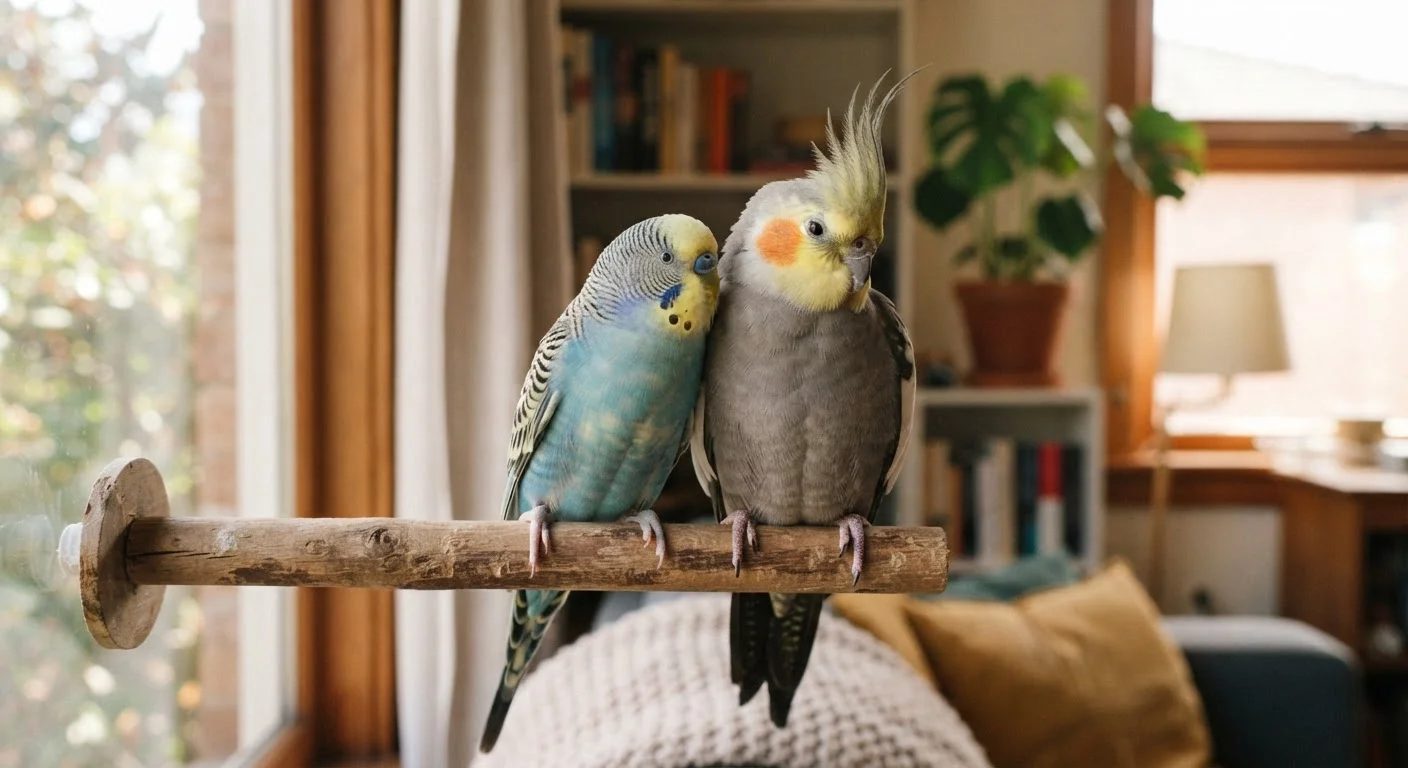
Key Takeaways
Option A
Budgerigar (Budgie)
The compact, lively, budget-friendly starter bird.
Best for: Owners who want an interactive, space-efficient bird with a manageable noise level and lower upfront cost.
Option B
Cockatiel
The affectionate, melodic companion with a gentle personality.
Best for: Owners seeking a cuddly, sociable bird that bonds closely and tolerates gentle handling well.
If you want a first pet bird with a smaller footprint and lower cost
Budgerigar (Budgie)
Budgies require a smaller cage, eat less, and generally cost less to acquire and maintain, making them a practical entry point into bird ownership.
If you want a deeply affectionate bird that enjoys being held
Cockatiel
Cockatiels are known for seeking out physical contact, shoulder-perching, and forming strong individual bonds — qualities that make them exceptionally rewarding companions.
If you live in an apartment or have noise-sensitive neighbors
Budgerigar (Budgie)
Budgies chatter and chirp but rarely reach the volume of a cockatiel's contact calls or whistling sessions, making them more apartment-friendly.
If you have allergy concerns in the household
Budgerigar (Budgie)
Cockatiels produce significantly more feather dust and dander than budgies, which can aggravate respiratory sensitivities or bird-related allergies.
If you want a bird capable of learning whistled tunes and songs
Cockatiel
Cockatiels are natural whistlers and can learn recognizable melodies with patient, consistent training, offering a rich auditory experience for music-loving households.
Size, Lifespan, and What to Expect Day to Day
Budgerigars typically measure around 7 inches from beak to tail and weigh between 1 and 1.4 ounces. Cockatiels are noticeably larger — usually 12 to 13 inches long and weighing 2.8 to 3.5 ounces. That size difference has practical implications: cockatiels need a meaningfully larger cage, which takes up more floor space and costs more to furnish appropriately.
Lifespan is another key distinction. Budgies commonly live 7 to 12 years in good health, while cockatiels frequently reach 15 to 20 years with proper care. Choosing a cockatiel is, in many respects, a longer commitment — one that should be weighed honestly before bringing one home.
Day to day, both birds need a minimum of one to two hours outside their cage in a safe, supervised environment. Neither thrives as a purely caged display animal. For comprehensive guidance on housing and daily routines, see our full pet bird care guide.
| Criterion | Budgerigar | Cockatiel |
|---|---|---|
| Typical size | ~7 inches, ~1.2 oz | ~12 inches, ~3 oz |
| Average lifespan | 7–12 years | 15–20 years |
| Affection level | Moderate | High |
| Noise level | Low to moderate chirping | Moderate to high whistling |
| Dander production | Low | High |
| Cage space needed | Smaller cage adequate | Larger cage required |
| Talking ability | Can mimic words clearly | Better at whistled melodies |
| Tolerance for alone time | Moderate (pairs do better) | Low — bonds closely |
Temperament, Socialization, and Noise
Budgerigars are curious, energetic, and highly social with other budgies. They are generally friendly toward humans but can be more independent than cockatiels. Many budgies enjoy interacting with their owners, and some individuals — particularly those hand-raised from a young age — learn to mimic words and short phrases with remarkable clarity.
Cockatiels are widely regarded as one of the most affectionate pet bird species available. They often seek out their favorite person, enjoy head scratches, and can become visibly distressed if left alone for extended periods. Households where someone is home most of the day tend to suit cockatiels better than busy, frequently empty ones.
On noise: budgies chatter and chirp throughout the day, but their volume is modest. Cockatiels whistle loudly — especially contact calls when they feel isolated — and this carries through walls. In shared-wall housing, that distinction matters considerably.
15–20 yrs
Cockatiel average lifespan in captivity
Per established avian veterinary guidance, well-cared-for cockatiels frequently outlive many small mammals kept as pets.
~7–12 yrs
Budgerigar average lifespan in captivity
Budgies in good health with appropriate diet and veterinary care routinely reach the upper end of this range.
2 hrs+
Recommended daily out-of-cage time for both species
Avian welfare organizations generally advise a minimum of one to two hours of supervised free-flight or out-of-cage exploration daily.
Diet, Health, and Veterinary Care
Both species thrive on a diet that goes beyond seed mixes. Pellets formulated for small parrots, supplemented with fresh leafy greens, vegetables, and limited fruit, support far better long-term health than an all-seed diet, which tends to be high in fat and nutritionally incomplete. Fresh water should be available at all times.
Cockatiels are prone to several specific health concerns, including respiratory infections, egg-binding in females, and psittacosis (a bacterial infection transmissible to humans). Budgies are susceptible to tumors — particularly in older birds — and to a condition called scaly face caused by the Knemidocoptes mite. Both species should be seen by an avian veterinarian at least annually, even when appearing healthy.
Bird-proofing your home is equally important for both species. Common household items pose serious risks that are easy to underestimate. Our room-by-room guide to indoor bird hazards covers the most critical risks, including non-stick cookware fumes and toxic houseplants.
This article provides general educational information about pet bird species and is not a substitute for professional veterinary advice. Always consult a qualified avian veterinarian for guidance specific to your bird's health and care needs.