

Key Takeaways
Dog Food Label
A dog food label is the regulated set of information printed on pet food packaging that describes the product's ingredients, nutrient content, feeding instructions, and manufacturer details. In the United States, these labels are governed by standards set by the Association of American Feed Control Officials (AAFCO) and, for certain claims, the FDA. Reading a label correctly allows pet owners to assess whether a food meets their dog's nutritional needs.
AAFCO establishes nutrient profiles for dog foods labeled 'complete and balanced,' and manufacturers must either meet those profiles through formulation or pass a feeding trial to use that claim.
The AAFCO Statement: Start Here
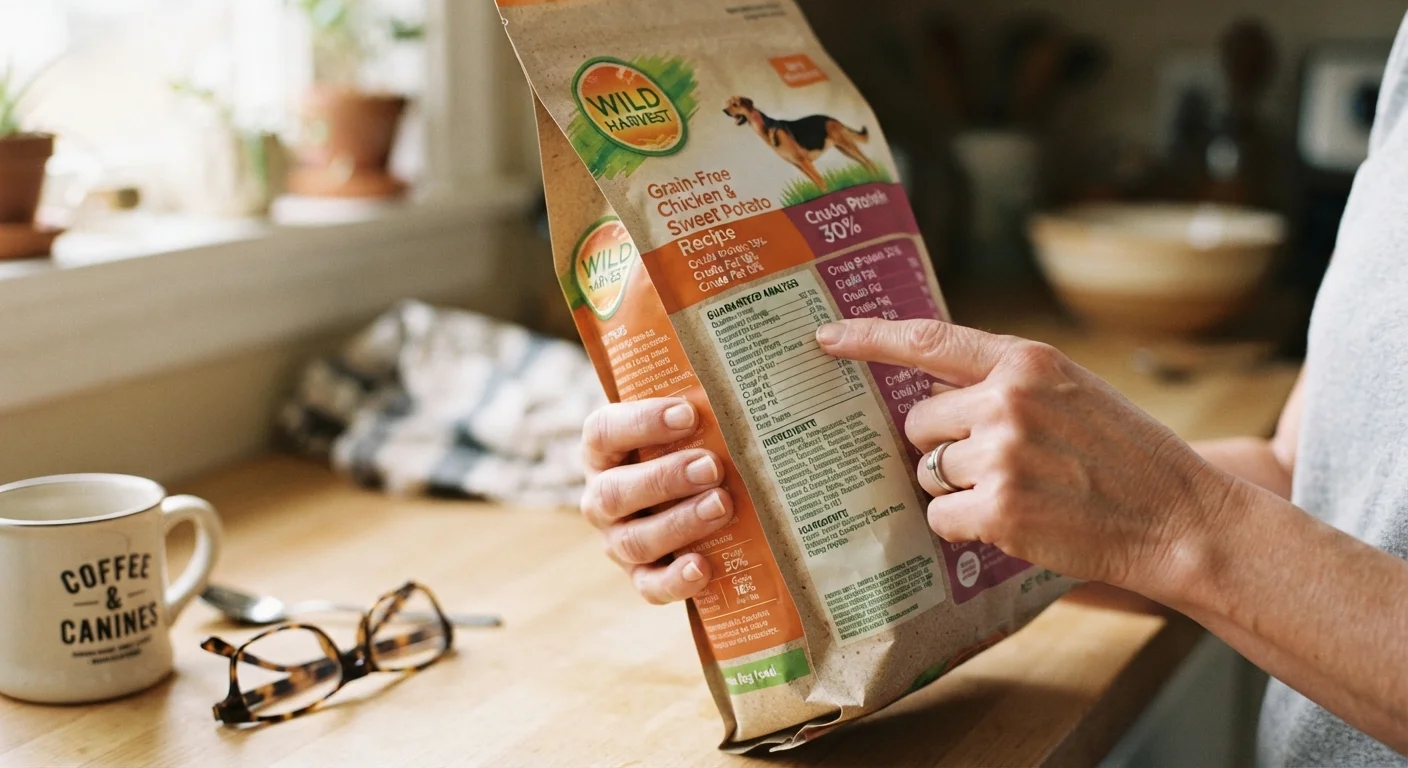
Before scanning ingredients or checking protein percentages, find the AAFCO nutritional adequacy statement. This small block of text — often tucked near the bottom of the label — tells you whether the food is designed to be a dog's complete diet or just a supplement or treat.
A complete and balanced food will say something like: " is formulated to meet the nutritional levels established by the AAFCO Dog Food Nutrient Profiles for ." The life stage designation matters enormously. Foods labeled for adult maintenance do not meet the higher calcium and phosphorus requirements puppies need for skeletal development. A food labeled for all life stages meets the more demanding puppy standard and is suitable across the board.
If a label says "intended for intermittent or supplemental feeding only," that product should not be your dog's primary food source, no matter how premium the branding appears.
AAFCO Sets Standards, Not Guarantees
AAFCO does not test or certify individual pet food products before they reach store shelves. The organization establishes nutrient profiles and ingredient definitions that manufacturers self-report compliance against. The FDA oversees pet food safety and can take enforcement action, but pre-market approval is not required for most commercial dog foods.
The Ingredient List: Reading Past the Marketing
Ingredients are listed in descending order by weight before processing. This matters because raw chicken contains roughly 70% water. After cooking, its actual contribution to the food's protein content is far smaller than its top-of-list position suggests. A dry ingredient like chicken meal — rendered and dried — may deliver more protein per pound than fresh chicken listed above it.
Watch for ingredient splitting, a practice where a single ingredient is divided into multiple forms to push it lower on the list. For example, "ground corn," "corn gluten meal," and "corn bran" listed separately may collectively outweigh the named protein above them.
By-products are another commonly misunderstood term. Meat by-products are non-rendered parts other than meat — organs, blood, bone — which can be nutritionally dense. They are not the same as low-quality fillers. The key question is always whether the overall formulation delivers a complete and balanced nutrient profile, not whether any single ingredient sounds appealing. For a broader look at how ingredient terminology is used in food labeling generally, see how human food labels work — many of the same principles apply.
The Guaranteed Analysis: Minimums, Maximums, and What They Miss
The guaranteed analysis panel lists four core values required by AAFCO:
- Crude protein (minimum %)
- Crude fat (minimum %)
- Crude fiber (maximum %)
- Moisture (maximum %)
These are regulatory limits, not precise measurements. A "minimum 26% crude protein" label means the food contains at least that much — it could contain more. Importantly, crude protein counts all nitrogen-containing compounds; it does not confirm digestibility or amino acid balance.
Comparing guaranteed analysis values between a wet food and a dry kibble requires converting both to a dry matter basis — stripping out moisture mathematically — otherwise the numbers aren't comparable. A wet food with 10% crude protein and 78% moisture contains significantly more protein per dry ounce than those raw numbers suggest. Wet food and dry kibble have distinct nutritional trade-offs worth understanding before relying on guaranteed analysis numbers alone.
9-point
Body condition score scale used by veterinarians
The Body Condition Score (BCS) system, widely used in veterinary practice, helps owners and clinicians evaluate whether a dog's weight is appropriate independent of feeding label guidelines.
~70%
Moisture content in fresh raw chicken
Because ingredients are listed by pre-processing weight, raw chicken's high water content means its actual dry protein contribution after cooking is far smaller than its label position implies.
4
Required guaranteed analysis values on every label
AAFCO regulations require all dog food labels to list minimum crude protein, minimum crude fat, maximum crude fiber, and maximum moisture — the four standard guaranteed analysis entries.
Feeding Guidelines and How to Use Them
Feeding guidelines on dog food packaging are population-level estimates, not personalized prescriptions. They are typically based on average activity levels for a given body weight range. A highly active working dog may need significantly more; a sedentary, older, or neutered dog may need considerably less.
Use the chart as your starting point, then assess your dog's body condition score (BCS) — a nine-point scale used by veterinarians to evaluate whether a dog is underweight, ideal, or overweight by evaluating rib coverage, waist definition, and abdominal tuck. Adjust portions based on that assessment over several weeks rather than making sharp, sudden changes.
Also note that feeding guidelines are written for the food as the sole diet. If you add toppers, treats, or table scraps regularly, those calories count and the base portion should be reduced accordingly. Your veterinarian is the most reliable resource for dialing in the right amount for your individual dog's health profile.
This article is for general informational purposes and does not constitute veterinary nutritional advice. Always consult a licensed veterinarian for guidance specific to your dog's health and dietary needs.