

Key Takeaways
Feline Behaviour Signalling
Cats cannot verbally communicate discomfort, stress, or illness, so they express it through changes in behaviour. Scratching, spraying urine, and withdrawing are not random acts — they are a cat's primary means of communicating an unmet need or an underlying problem. Recognising these signals early gives owners the opportunity to address health issues or environmental stressors before they escalate.
Veterinary behaviourists distinguish between behaviours rooted in normal feline communication (such as territorial scent-marking) and those that indicate pathology (such as periuria linked to lower urinary tract disease). Context and pattern matter as much as the behaviour itself.
Why Cats Communicate Through Behaviour
Cats evolved as both predators and prey, which means showing vulnerability is instinctively risky for them. Rather than displaying obvious signs of distress, they default to behaviour — and those behavioural signals are the primary language owners have to work with.
A shift in a cat's normal patterns is rarely arbitrary. Whether the change is increased scratching, urine spraying outside the litter box, or a sudden preference for hiding, each behaviour carries informational weight. The challenge for owners is learning to read context rather than reacting to the behaviour's surface appearance.
For a broader look at how misreading these signals can compound over time, see common mistakes cat owners make about feline health.
~10%
Cats affected by FLUTD at some point
Veterinary estimates suggest feline lower urinary tract disease affects roughly one in ten cats over their lifetime, making it one of the most common reasons for unplanned vet visits.
30%
Senior cats with arthritis showing behaviour changes
Studies in veterinary geriatrics indicate a substantial proportion of older cats with degenerative joint disease present initially through behaviour shifts — such as altered scratching or reduced activity — rather than obvious lameness.
Up to 90%
Elimination problems with a medical component
Veterinary behaviour specialists note that a significant majority of cats presenting for inappropriate elimination have an underlying medical condition contributing to the problem, underscoring the importance of a physical examination first.
Scratching: Instinct, Territory, and Frustration
Scratching is one of the most misunderstood behaviours in domestic cats. It is not destructive by nature — it is a biological necessity. Cats scratch to shed outer claw sheaths, stretch the tendons and muscles of their forelimbs, and deposit scent from the glands between their paw pads.
When scratching becomes problematic, the issue is usually one of three things: a shortage of appropriate scratching surfaces, surfaces placed in the wrong location (cats prefer to scratch in socially prominent spots, not hidden corners), or an underlying state of stress that is amplifying the behaviour.
If a cat that previously used a scratching post reliably has shifted to walls, corners, or furniture, consider what has changed in the environment. A new pet, a shift in household routine, or even rearranged furniture can prompt a cat to reinforce its territorial markers through increased scratching activity.
The science behind puzzling feline behaviours explores how scratching and other instinct-driven actions are rooted in evolutionary biology rather than wilfulness.
Urine Spraying: When It Is Medical, When It Is Behavioural
Few behaviour changes alarm owners more than a cat spraying urine on vertical surfaces or urinating outside the litter box. Distinguishing between the two matters: spraying (small amounts on vertical surfaces) is typically communicative or territorial, while inappropriate elimination (larger volumes outside the box) is more commonly medical in origin.
Feline lower urinary tract disease (FLUTD) — an umbrella term covering bladder inflammation, crystals, and blockages — is among the most common reasons a previously reliable cat begins urinating outside the litter box. Kidney disease, diabetes, and arthritis (which can make entering a high-sided box painful) are also frequent culprits.
Territorial spraying is more common in unneutered males, but any cat can spray in response to perceived threats: a stray cat visible through a window, the introduction of another pet, or even a new piece of furniture carrying an unfamiliar scent.
Track Changes Before the Vet Visit
When you notice a behaviour change, note its frequency, duration, and any circumstances surrounding it — recent household changes, new foods, visible stressors. This information helps a veterinarian distinguish between a medical and a behavioural cause far more efficiently. A brief written log is more reliable than memory alone during an appointment.
Because the medical and behavioural causes of spraying overlap — and because untreated urinary conditions can become emergencies — a veterinary examination is the appropriate first step whenever this behaviour appears.
Hiding: Normal Coping or a Reason for Concern?
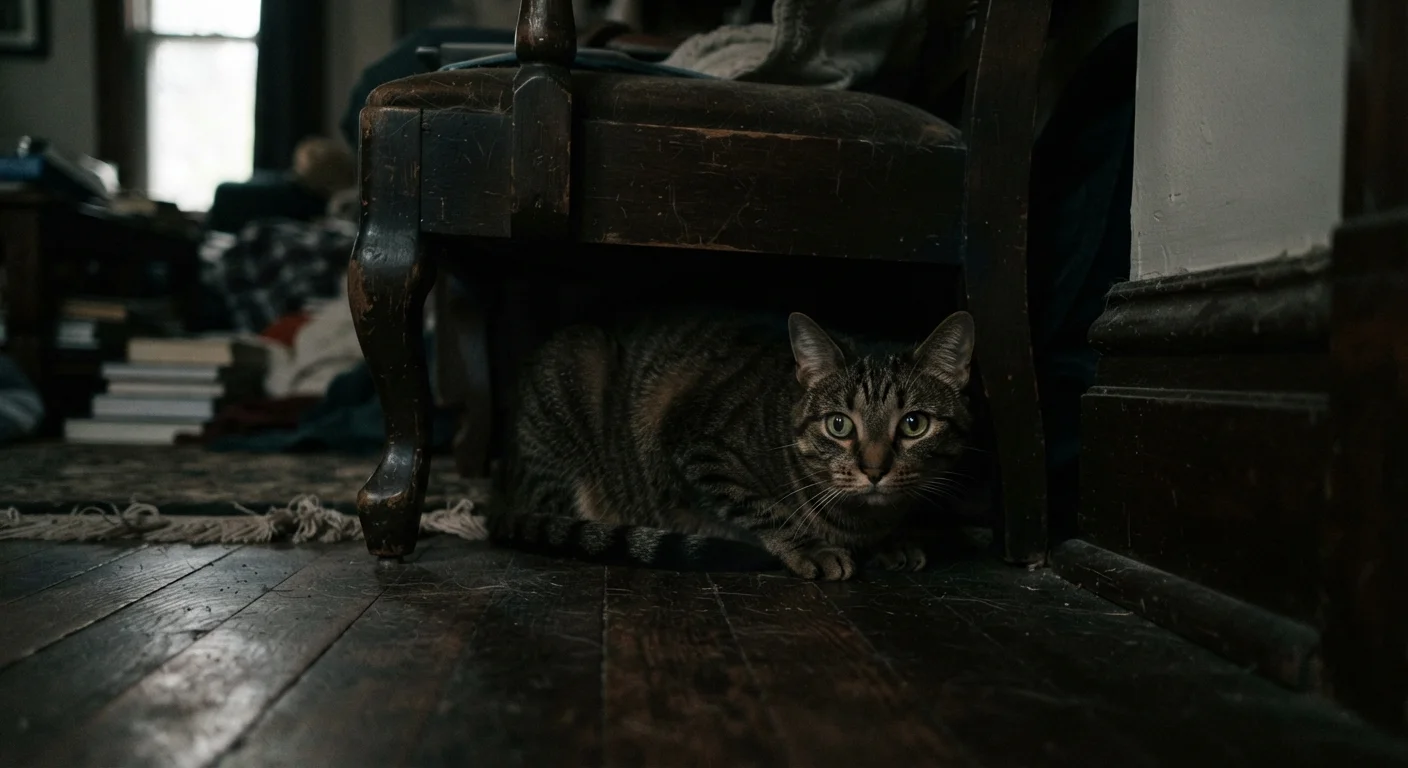
Cats seek enclosed, elevated, or concealed spaces as a normal stress-response. After a veterinary visit, a thunderstorm, or the arrival of guests, retreating briefly to a safe spot is adaptive behaviour, not cause for alarm.
The concern arises when hiding is prolonged, when the cat stops eating or drinking while withdrawn, or when hiding represents a departure from the cat's established baseline. Cats in pain or experiencing nausea frequently hide as a way of minimising vulnerability — a trait inherited from wild ancestors for whom displaying weakness attracted predation.
If your cat has been hiding for more than 24 to 48 hours and is not eating normally, contact a veterinarian. Changes in body weight, coat condition, or elimination habits accompanying the hiding make a prompt evaluation more urgent.
Understanding your cat's normal posture and body language creates a baseline that makes deviations far easier to spot. Decoding your cat's body language covers the physical cues — tail position, ear orientation, eye dilation — that reveal internal states before behaviour escalates.
Addressing the Root Cause
The most effective approach to problematic cat behaviour is identifying and addressing its source rather than suppressing the behaviour itself. Punishment — spraying the cat with water, startling it, or blocking access — does not communicate anything useful and consistently increases anxiety, which typically worsens stress-driven behaviour.
Environmental enrichment, consistent routine, and appropriate social structure help reduce background stress. For multi-cat households, ensuring each cat has sufficient resources — feeding stations, litter boxes, resting spaces — reduces competition that often underlies territorial behaviour.
When health is ruled out and the problem appears primarily behavioural, a veterinary behaviourist or a veterinarian with a behavioural focus can provide a structured plan. A complete picture of cat ownership offers further guidance on aligning health, environment, and routine into a sustainable approach.
This article provides general information about cat behaviour and is not a substitute for personalised veterinary advice. If your cat's behaviour changes suddenly or significantly, consult a licensed veterinarian.