

Key Takeaways
Our Verdict
No single insulation type wins for every situation. Batts work well for accessible, open cavities on a modest budget; blown-in cellulose or fiberglass is the practical answer for retrofitting existing walls and attics; spray foam delivers premium air-sealing where performance is the priority; and foam board shines in tight, flat spaces like basements and exterior sheathing. Match the material to your specific location, climate zone, and budget.
| Best for | Recommended |
|---|---|
| Budget-conscious DIYers insulating open cavities | Batt insulation |
| Retrofitting finished walls or hard-to-reach attics | Blown-in insulation |
| Maximum air sealing in crawl spaces or rim joists | Spray foam insulation |
| Basement walls and exterior continuous insulation layers | Foam board insulation |
Why Insulation Type Matters in an Existing Home
Upgrading insulation in an existing home is rarely as straightforward as it is during new construction. Walls are already closed, attic access varies, and some areas are difficult to reach without creating significant disruption. Choosing the right insulation type from the start prevents wasted effort, unnecessary expense, and subpar thermal performance.
The key measurement to understand is R-value — a rating of a material's resistance to heat flow. Higher R-values mean better insulation, and the U.S. Department of Energy publishes recommended R-values by climate zone for different parts of the home. Before selecting any material, identify your climate zone and the specific location you're insulating (attic, exterior wall, basement, crawl space), as these factors narrow your realistic options considerably.
It's also worth addressing air leaks before or alongside any insulation project. Insulation slows heat transfer, but gaps and cracks allow conditioned air to escape entirely. See our guide to caulking vs. weatherstripping for sealing those gaps first.
Comparing the Four Main Insulation Types
Here is how the four most common residential insulation types compare across the factors that matter most to homeowners retrofitting an existing home.
| Batt | Blown-In | Spray Foam | Foam Board | |
|---|---|---|---|---|
| R-value per inch | R-3.0 to R-4.3 | R-3.2 to R-3.8 | R-3.5 to R-7.0 | R-3.8 to R-6.5 |
| DIY-friendly | Yes, open cavities | Moderate, needs blower | No, professional recommended | Yes, specific locations |
| Best location | Open walls, attics | Closed walls, attics | Crawl spaces, rim joists | Basements, exterior sheathing |
| Air sealing ability | Low | Moderate | Very high | Moderate (taped seams) |
| Moisture resistance | Low (fiberglass) | Low to moderate | High (closed-cell) | High |
| Relative material cost | Low | Low to moderate | High | Moderate |
Each type has a distinct installation profile and cost range. The sections below break down where each performs best and where it falls short.
Batt and Blown-In Insulation: The Accessible Options
Batt insulation — sold in pre-cut fiberglass or mineral wool panels — is the most familiar type. It fits neatly between standard wall studs and attic joists, making it practical for open cavities. Fiberglass batts typically achieve R-3.0 to R-4.3 per inch; mineral wool (also called rock wool) runs slightly higher and is naturally fire-resistant. Batts are the most DIY-accessible insulation type, though proper fit is critical — gaps or compression significantly reduce performance. They are not suitable for retrofitting closed walls without opening the drywall.
Blown-in insulation — either loose-fill fiberglass or cellulose (recycled paper treated for fire resistance) — is installed using a blowing machine. Cellulose achieves roughly R-3.2 to R-3.8 per inch and settles well into irregular spaces. This makes blown-in the go-to solution for existing attics and closed wall cavities, where a small drill hole allows the material to be injected without full demolition. Many tool-lending programs at home improvement stores offer blower rental. Settling over time is a consideration with cellulose; some homeowners add extra depth at installation to account for this.
Check Existing Insulation Before Adding More
Before choosing a new insulation type, inspect what's already there. Compressed, water-damaged, or moldy insulation should be removed before new material is added — layering over a problem traps moisture and reduces effectiveness. In attics, measure existing depth and compare it to the recommended R-value for your climate zone to determine how much additional material you actually need.
Spray Foam and Foam Board: Higher-Performance Solutions
Spray polyurethane foam (SPF) comes in two forms: open-cell and closed-cell. Open-cell foam is softer, vapor-permeable, and achieves around R-3.5 per inch. Closed-cell foam is denser, provides a vapor barrier, and reaches R-6 to R-7 per inch — the highest R-value per inch of any common insulation. Critically, spray foam expands to fill every gap, making it an exceptional air-sealing material, not just a thermal barrier. However, professional installation is strongly recommended. Improper mixing ratios or application can result in off-gassing, adhesion failures, or fire-code issues. This is not a standard DIY project. For a broader look at where the DIY boundary lies, see our guide to DIY home maintenance limits.
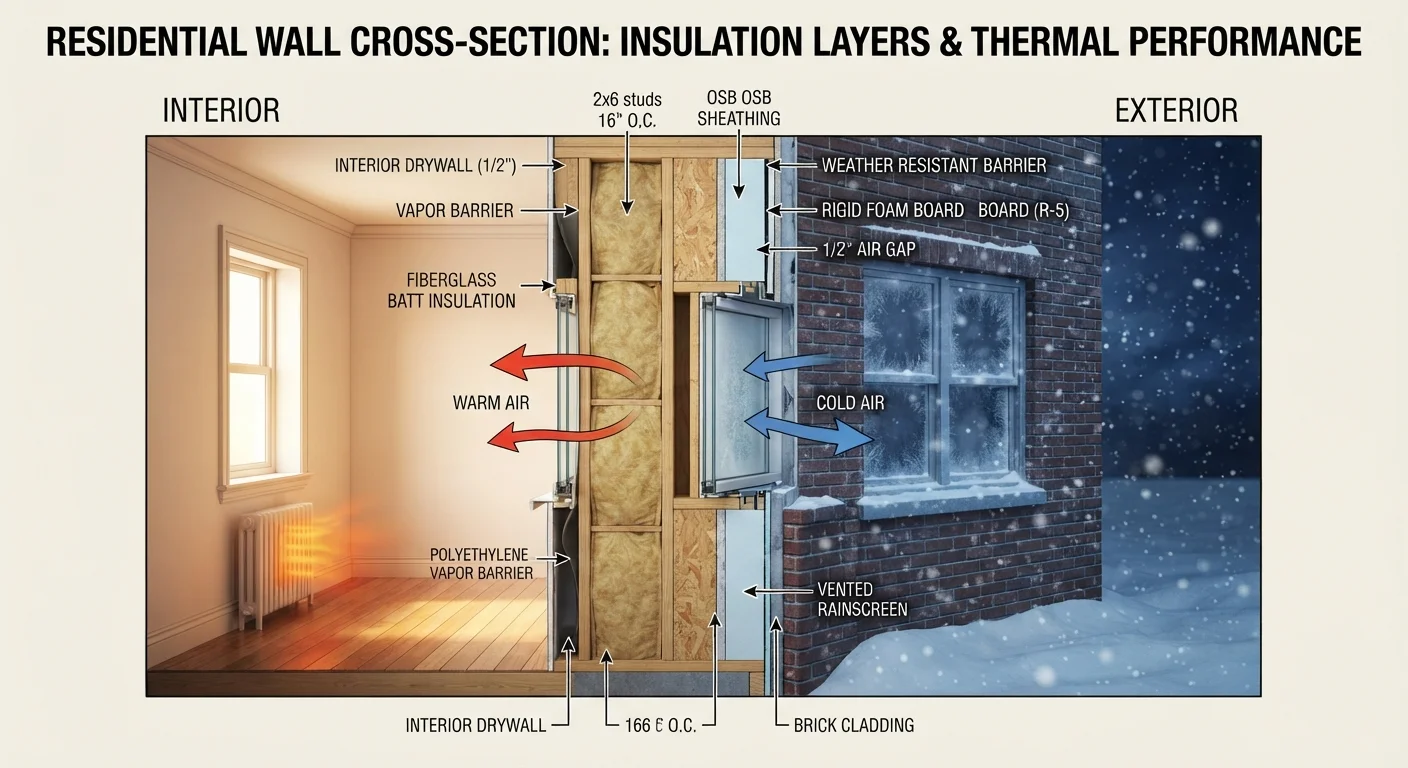
Foam board insulation — rigid panels of expanded polystyrene (EPS), extruded polystyrene (XPS), or polyisocyanurate (polyiso) — achieves R-3.8 to R-6.5 per inch depending on material. It is ideal for flat, continuous applications: basement walls, exterior sheathing, and under slab. Foam board is cut with a utility knife and can be a manageable DIY task in those specific locations. Seams must be taped to limit air infiltration, and most foam board requires a fire-rated covering (such as drywall) when installed in living spaces — check local building codes before proceeding.
Choosing the Right Fit for Your Home
Use these practical rules of thumb when narrowing your choice:
- Open attic floor: Blown-in cellulose or batt insulation are both practical; blown-in fills irregular joist bays more completely.
- Closed exterior walls: Blown-in injection is the least invasive retrofit option.
- Basement walls: Foam board or closed-cell spray foam resist moisture better than fiberglass batts in below-grade environments.
- Crawl space and rim joists: Closed-cell spray foam's dual role as insulation and air/vapor barrier makes it particularly effective here.
- Garage or workshop walls (open cavities): Batts offer a cost-effective, manageable DIY solution.
Always verify local permit requirements before beginning insulation work, particularly in finished spaces or when adding vapor barriers. Requirements vary by jurisdiction, and some work may require a licensed contractor or inspection.