

Key Takeaways
Our Verdict
Neither route is universally better — it depends on your priorities. Private sales reward patience with a higher return, while part-exchange rewards convenience with a faster, lower-friction process. Understanding the real costs and effort involved in each helps you choose the path that fits your situation.
| Best for | Recommended |
|---|---|
| Those who want maximum return and have time to manage the process | Private Sale |
| Those prioritizing speed and simplicity when buying their next car | Part-Exchange |
| Sellers with a well-maintained, in-demand vehicle and good documentation | Private Sale |
| Those with a high-mileage or older vehicle unlikely to attract strong private-buyer interest | Part-Exchange |
The Core Trade-Off: Money vs. Convenience
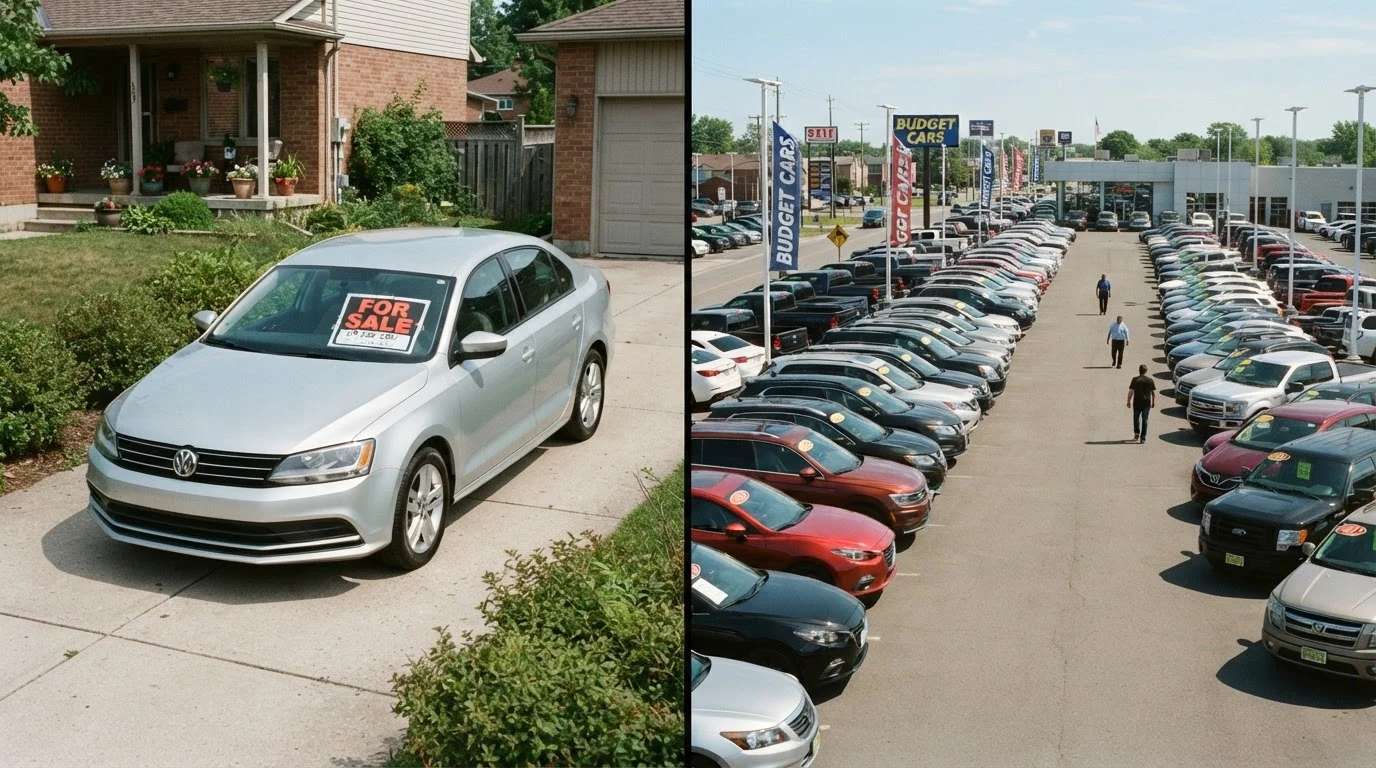
When it's time to move on from your current car, you broadly have two options: sell it privately to another individual or trade it in as part of a deal with a dealership. Each route involves a different balance of effort, time, and money returned.
Private sales generally yield a higher price because you're selling directly to an end buyer rather than through a middleman. Dealerships, by contrast, need to profit on any vehicle they resell, so they'll factor that into what they offer you. The gap between a strong private-sale price and a part-exchange offer on the same car can be meaningful — sometimes hundreds, occasionally more, depending on the vehicle.
That said, the private-sale route isn't free effort. You'll handle the listing, field inquiries, arrange viewings, deal with test drives, and negotiate. Part-exchange is largely handled by the dealership, and the transaction folds neatly into your purchase of a new car. See also the real cost of running a car each year for context on how selling fits into the broader financial picture of ownership.
| Private Sale | Part-Exchange | |
|---|---|---|
| Likely return | Higher — closer to market value | Lower — dealer needs resale margin |
| Time to complete | Days to weeks | Same day as new car purchase |
| Effort required | High — listing, viewings, negotiation | Low — dealer handles everything |
| Outstanding finance | Complicates the sale significantly | Dealer can often absorb it in the deal |
| Buyer negotiation | Seller handles directly | Dealer negotiates on seller's behalf |
| Risk of no-shows or scams | Present — requires caution | None — dealing with a business |
| Documentation burden | Seller manages all paperwork | Dealer manages most paperwork |
What Private Selling Actually Involves
A private sale starts with preparation. That means cleaning the car thoroughly, gathering all documentation (service history, MOT certificates, the V5C logbook), and taking clear photographs. Pricing it competitively requires research — look at comparable listings for the same make, model, mileage, and condition.
You'll need to list the car on a classified platform, which may carry a fee. Expect to respond to multiple inquiries, some serious and some not. Arranging safe test drives — ideally with the buyer providing proof of insurance — adds another layer of coordination. Payment should be handled carefully; bank transfers are generally safer than cash for large sums, and you should confirm funds have cleared before handing over keys.
Vet Buyers Carefully Before a Test Drive
Always meet prospective buyers in a public place or at your home when someone else is present. Ask to see a valid driver's license before allowing a test drive, and confirm the buyer has insurance covering them to drive your vehicle. Trust your instincts — if something feels off, it's fine to decline.
If your car has outstanding finance, you cannot legally sell it as if it were yours outright without settling the finance first or coordinating the sale through your lender. This applies to both private sales and part-exchange, but private buyers are less likely to navigate that complexity than a dealership.
Keep records of the sale — complete a V5C transfer correctly and retain proof of the transaction.
How Part-Exchange Works at a Dealership
Part-exchange means using your existing car as part-payment toward a vehicle at a dealership. You'll typically receive a valuation from the dealer, which is then deducted from the price of your next car. The process is straightforward: one visit, minimal paperwork on your end, and no need to deal with private buyers.
The trade-off is the offer itself. Dealers need room to recondition and resell your car at a profit, so their valuation will generally sit below what a private buyer might pay. This isn't necessarily unfair — it reflects the service of taking the car off your hands quickly and handling everything afterward.
It's worth getting more than one dealer valuation, and you can also use online valuation tools to establish a baseline before you walk in. Going in informed means you can assess whether an offer is reasonable or significantly below market. For broader context on dealership transactions, how you pay for your next car can also affect how a part-exchange is structured.
Which Route Makes Sense for Your Situation
A few practical factors tend to point toward one route or the other:
- Car condition: A well-maintained car with full service history will attract private buyers more easily and justify a higher asking price. A high-mileage vehicle with wear may be harder to sell privately at a competitive price.
- Time pressure: If you're in a hurry — relocating, changing circumstances — part-exchange removes the uncertainty of waiting for the right buyer.
- Comfort with negotiation: Private buyers often negotiate. If that feels uncomfortable or you'd rather avoid it, part-exchange puts the process in the dealer's hands.
- Outstanding finance: If finance is still owed on the car, a dealership can often handle this as part of the transaction, whereas a private sale with outstanding finance requires extra steps.
For anyone buying their next car — whether new or used — it's worth thinking about how the sale proceeds will be applied. Deciding between a new and used car involves similar trade-off thinking, and knowing what you'll net from your current car helps set a realistic budget.
If your car is well-documented and you're comfortable with the process, a private sale often makes financial sense. If convenience and speed matter more than squeezing out extra value, part-exchange is a perfectly reasonable choice — just go in with realistic expectations on the offer you'll receive.