

Key Takeaways
Full manufacturer warranty covers major repair costs
New cars typically include at least a 3-year/36,000-mile bumper-to-bumper warranty, plus longer powertrain coverage. This reduces financial exposure to unexpected mechanical failures.
Latest safety and technology features included
Modern standard safety systems — such as automatic emergency braking and blind-spot monitoring — are now common on new vehicles but may be absent in older used models.
No unknown ownership history
You know exactly how the car has been treated from mile zero, removing uncertainty about prior maintenance practices or undisclosed damage.
Lower-interest financing is often available
Automakers and lenders frequently offer lower APR financing on new vehicles compared to used car loans, which can reduce the total interest paid over the loan term.
Lower purchase price reduces upfront financial burden
Used cars generally cost less to acquire, which can mean a smaller down payment, lower monthly payments, or less debt overall.
Steep early depreciation already absorbed by prior owner
A vehicle that is two to four years old has typically already lost the largest share of its value, meaning you get more car per dollar compared to buying new.
More model variety available at accessible price points
The used market offers a wide range of vehicles — including higher trim levels or makes that would be out of reach new — at prices that fit more buyers' budgets.
Rapid early depreciation erodes value quickly
New vehicles can lose a significant portion of their value in the first year or two, which matters most for buyers who don't plan to keep the car long-term.
Higher purchase price stretches budgets further
New cars cost more upfront, which can mean larger loan amounts, higher monthly payments, and more interest paid over the life of the loan.
Unknown mechanical history increases repair risk
A used car's past maintenance, accident history, and driving conditions may not be fully visible even with a history report, creating uncertainty about long-term reliability.
Typically higher interest rates on used car loans
Lenders generally charge more to finance older vehicles, which can partially offset the savings from a lower purchase price depending on loan term and amount.
May lack current standard safety technology
Older used vehicles are less likely to include features like automatic emergency braking or lane-departure warnings, which are increasingly standard on new models.
Our Verdict
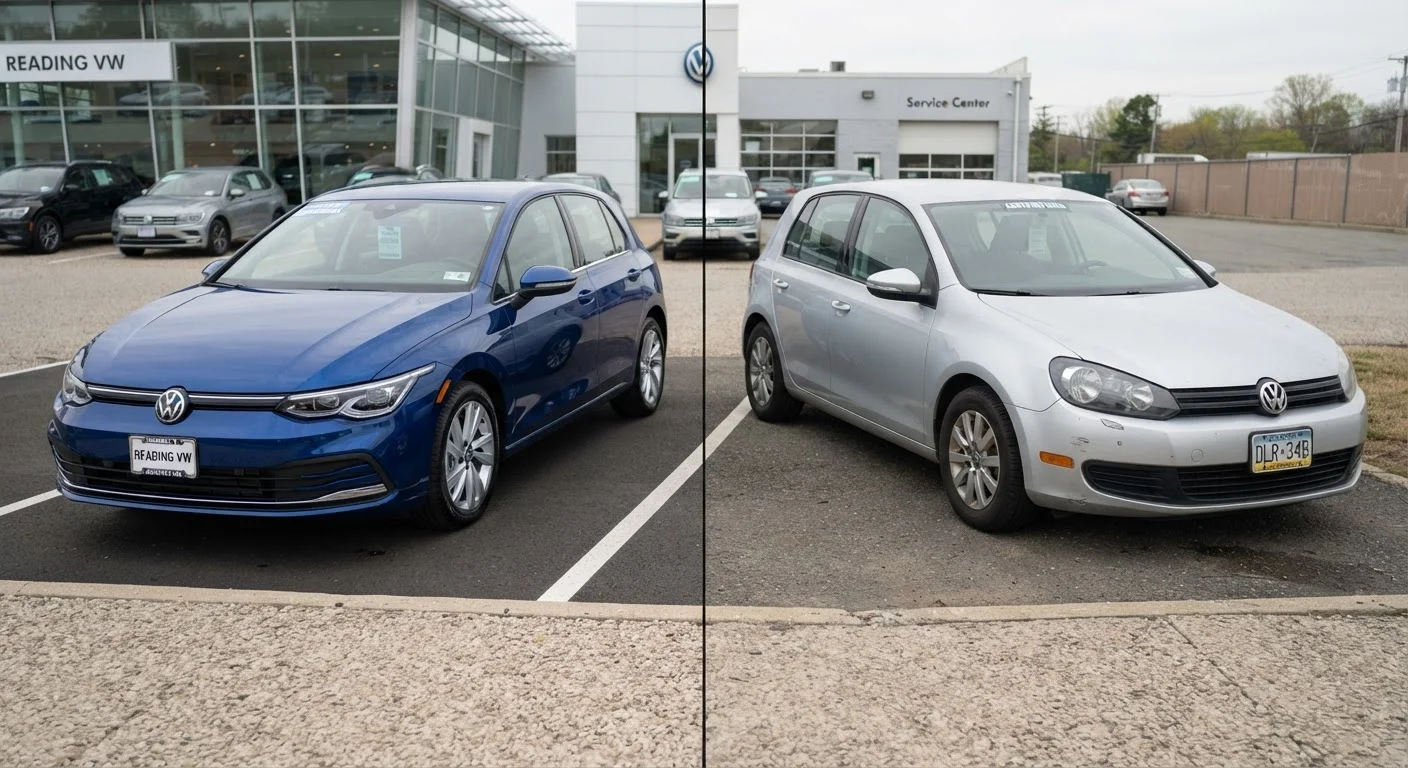
Buying new makes the most sense when you plan to keep the car long-term, want warranty coverage, and can absorb early depreciation. A used car is often the smarter financial move for buyers who want lower upfront costs and are willing to do some homework on the vehicle's history. Neither path is risk-free — the key is being honest about your situation before you sign anything.
Best for buyers who want a straightforward decision framework rather than a sales pitch — whether you're purchasing your first car or replacing one you've outgrown.
The Depreciation Reality Every Buyer Should Understand
A new car loses value the moment it leaves the lot. According to general industry estimates, a new vehicle can lose anywhere from 15% to 25% of its value in the first year alone, and roughly 50% or more within five years. That's not a reason to automatically avoid buying new — but it's a number worth sitting with before you decide.
Used cars have already absorbed the sharpest part of that curve. A two- or three-year-old vehicle in good condition can represent meaningfully more value per dollar spent, simply because someone else absorbed the early depreciation hit. For buyers on a tighter budget, or those who don't plan to keep a car for more than a few years, that math matters a lot.
See our practical guide to what first-time owners wish they'd known for a broader look at how depreciation plays out over a typical ownership period.
Full manufacturer warranty covers major repair costs
New cars typically include at least a 3-year/36,000-mile bumper-to-bumper warranty, plus longer powertrain coverage. This reduces financial exposure to unexpected mechanical failures.
Latest safety and technology features included
Modern standard safety systems — such as automatic emergency braking and blind-spot monitoring — are now common on new vehicles but may be absent in older used models.
No unknown ownership history
You know exactly how the car has been treated from mile zero, removing uncertainty about prior maintenance practices or undisclosed damage.
Lower-interest financing is often available
Automakers and lenders frequently offer lower APR financing on new vehicles compared to used car loans, which can reduce the total interest paid over the loan term.
Lower purchase price reduces upfront financial burden
Used cars generally cost less to acquire, which can mean a smaller down payment, lower monthly payments, or less debt overall.
Steep early depreciation already absorbed by prior owner
A vehicle that is two to four years old has typically already lost the largest share of its value, meaning you get more car per dollar compared to buying new.
More model variety available at accessible price points
The used market offers a wide range of vehicles — including higher trim levels or makes that would be out of reach new — at prices that fit more buyers' budgets.
Where a Used Car Introduces Uncertainty
The tradeoff for lower cost is that a used car comes with an unknown history — even when a vehicle history report shows no major incidents. Prior maintenance habits, climate exposure, and how hard the previous owner drove the car all affect how it will perform going forward.
A pre-purchase inspection by an independent mechanic is one of the most effective ways to reduce this risk. For a modest fee, a qualified technician can identify issues that aren't visible in a test drive or a clean-looking interior. This step is especially important when buying from a private seller rather than a franchised dealership.
It's also worth noting that used car financing typically carries higher interest rates than new car loans. Depending on loan terms, that gap can erode some of the savings you expect from a lower purchase price. For a fuller picture of how payment method affects total cost, see our overview of buying vs financing a car.
Rapid early depreciation erodes value quickly
New vehicles can lose a significant portion of their value in the first year or two, which matters most for buyers who don't plan to keep the car long-term.
Higher purchase price stretches budgets further
New cars cost more upfront, which can mean larger loan amounts, higher monthly payments, and more interest paid over the life of the loan.
Unknown mechanical history increases repair risk
A used car's past maintenance, accident history, and driving conditions may not be fully visible even with a history report, creating uncertainty about long-term reliability.
Typically higher interest rates on used car loans
Lenders generally charge more to finance older vehicles, which can partially offset the savings from a lower purchase price depending on loan term and amount.
May lack current standard safety technology
Older used vehicles are less likely to include features like automatic emergency braking or lane-departure warnings, which are increasingly standard on new models.
What New Cars Actually Offer Beyond the Showroom Feel
Aside from the appeal of being first, a new car comes with practical advantages that are easy to underestimate. Manufacturer warranties — typically covering at least three years or 36,000 miles for basic coverage, and often longer for powertrain — mean that major mechanical failures during that window are covered. That's a form of cost predictability that a used car without a certified pre-owned warranty cannot easily match.
New vehicles also carry the latest standard safety technology. Features like automatic emergency braking, blind-spot monitoring, and lane-keeping assist have become more common in recent years, but older used vehicles — especially those more than four or five years old — may lack them entirely. If you drive frequently in heavy traffic or have young passengers, that gap can be significant.
Certified Pre-Owned: A Middle Ground
Many franchise dealerships offer certified pre-owned (CPO) programs, where used vehicles are inspected to manufacturer standards and come with extended warranty coverage. CPO vehicles typically cost more than non-certified used cars but offer more peace of mind than a straight private-party purchase. If you're leaning toward used but want some of the warranty protection of new, CPO is worth exploring as a category — though terms and coverage vary significantly by manufacturer.
For a complete picture of what ownership will actually cost you on top of the purchase price, our article on the real annual cost of running a car walks through insurance, fuel, maintenance, and more.
Questions to Ask Before You Decide
Rather than defaulting to one path, it's worth stress-testing both options against your actual situation.
- How long do you plan to keep the car? If you hold a new car for eight or more years, the depreciation hit is spread over a longer period and matters less. If you trade in every three years, you're repeatedly absorbing the steepest part of the depreciation curve.
- What does your cash flow look like? A lower-priced used car can mean lower monthly payments, but factor in that maintenance costs typically rise with age and mileage.
- How comfortable are you with uncertainty? If an unexpected $1,500 repair bill would genuinely strain your budget, the predictability of a new-car warranty may be worth something to you.
- What are your daily driving needs? High annual mileage favors a newer vehicle with full warranty coverage; mostly short local trips may be perfectly served by a reliable used car.
If you're still building a framework for car ownership more broadly, our guide to car ownership from day one covers the practical basics new owners often overlook.
~20%
Average new car value lost in year one
General industry estimates suggest a new vehicle can lose roughly 15%–25% of its value within the first 12 months of ownership.
~50%
Value lost within five years on average
Most new vehicles depreciate to roughly half their original value within five years, though rates vary by make, model, and market conditions.