

Key Takeaways
Tyre Pressure
Tyre pressure refers to the amount of air inside your tyres, measured in pounds per square inch (PSI) or kilopascals (kPa). Every vehicle has a manufacturer-specified pressure range that keeps tyres performing safely and efficiently. Running outside that range — even slightly — affects how your car handles, how quickly tyres wear, and how much fuel you use.
Tyre pressure is measured as gauge pressure — the amount above atmospheric pressure — so a reading of 0 PSI on a gauge does not mean the tyre is airless, just that it matches ambient air pressure.
Why Tyre Pressure Deserves Your Attention
Tyres are the only parts of your car that actually touch the road, yet tyre pressure is one of the most consistently neglected maintenance tasks. According to the National Highway Traffic Safety Administration (NHTSA), a significant share of vehicles on U.S. roads are running on at least one underinflated tyre at any given time.
The consequences aren't abstract. Low pressure increases rolling resistance, meaning your engine works harder to move the car — and your fuel economy drops. It also causes the tyre to flex more than it should, generating heat that accelerates internal wear. Overinflation creates a different set of problems: a smaller contact patch, reduced grip, and a ride that transmits every road imperfection directly into the cabin.
For a fuller picture of how pressure fits into overall tyre health, see our guide to tyre basics every driver should know.
~1 PSI
Pressure lost per 10°F temperature drop
A widely cited tyre industry guideline reflecting how air contracts in cold weather.
0.2%
Fuel economy loss per 1 PSI underinflation
The U.S. Department of Energy estimates roughly 0.2% fuel economy loss for each PSI below the recommended level.
25%
Underinflation level that triggers TPMS alert
Federal regulations require TPMS systems to warn drivers when any tyre falls 25% below the vehicle's recommended pressure.
Finding Your Vehicle's Correct Pressure
One of the most common mistakes drivers make is reading the maximum pressure number stamped on the tyre sidewall and treating that as the target. It isn't. That figure is the tyre's structural limit — not what your car needs.
Your actual recommended pressure is set by the vehicle manufacturer and accounts for the car's weight, suspension design, and intended handling. You'll find it on a sticker inside the driver's door jamb, and in your owner's manual. Many vehicles specify different pressures for front and rear tyres, so check both.
Store a Gauge in Your Glovebox
A basic digital or dial pressure gauge costs just a few dollars and fits easily in a glovebox. Having one means you can check pressure accurately anywhere, not just at stations where the machine gauge may be unreliable. Make it part of your monthly routine alongside checking engine oil.
Note that front and rear pressures can differ by several PSI, and some vehicles with heavier loads specify higher rear pressures. Always go by the sticker for your specific vehicle.
How to Check and Adjust Pressure Correctly
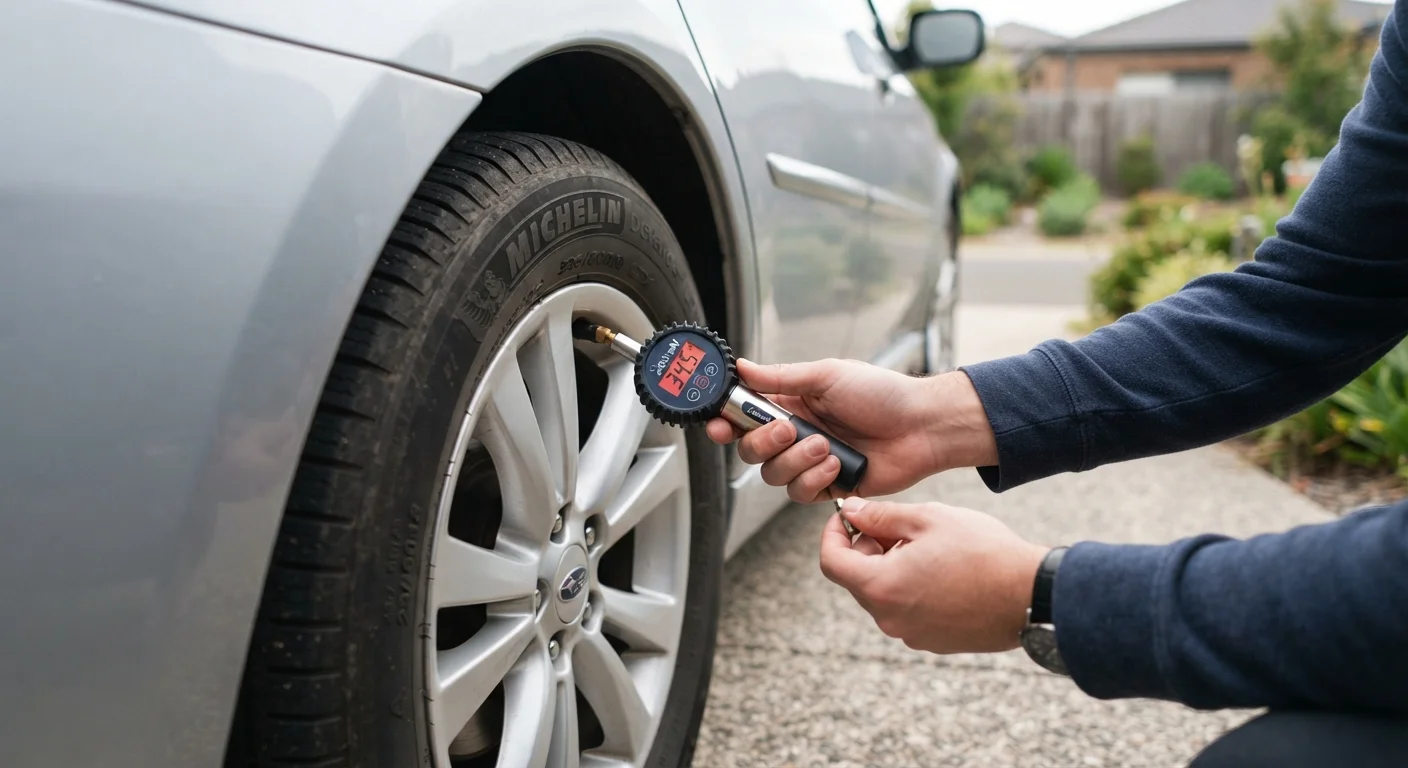
You need an accurate tyre pressure gauge — dial or digital gauges are generally more reliable than the cheap stick-type gauges. Many gas stations have air machines, but their built-in gauges vary in accuracy, so having your own is worthwhile.
- Check cold. Drive no more than a mile before checking, or let a warm tyre sit for at least two hours before measuring.
- Remove the valve cap from each tyre's valve stem and set it somewhere safe.
- Press the gauge firmly onto the valve. A good seal gives you a clean reading in seconds.
- Compare to the sticker. If pressure is low, add air. If it's high, press the small pin inside the valve to release air in short bursts and recheck.
- Replace the valve cap when done — it keeps dirt out of the valve.
The whole process takes about five minutes for all four tyres plus the spare. It's also worth understanding how tyre wear patterns relate to pressure — worn or incorrectly inflated tyres dramatically reduce grip and braking performance.
Temperature Changes and Seasonal Pressure Shifts
Air pressure changes with temperature. A commonly cited rule of thumb, supported by tyre industry guidance, is that tyres lose approximately 1 PSI for every 10°F drop in ambient temperature. That means a tyre properly set at 35 PSI in summer could read closer to 30 PSI by the time winter arrives — even with no slow leak.
This is why checking pressure at the start of each season makes sense, not just when a dashboard light appears. Many modern vehicles have a Tyre Pressure Monitoring System (TPMS) that alerts you when pressure drops roughly 25% below the recommended level — but that threshold is significant underinflation, not a routine prompt to top up.
For a broader look at how routine checks fit into your car's overall maintenance, our article on tyre tread, rotation, and alignment covers the full picture of tyre upkeep.