

Key Takeaways
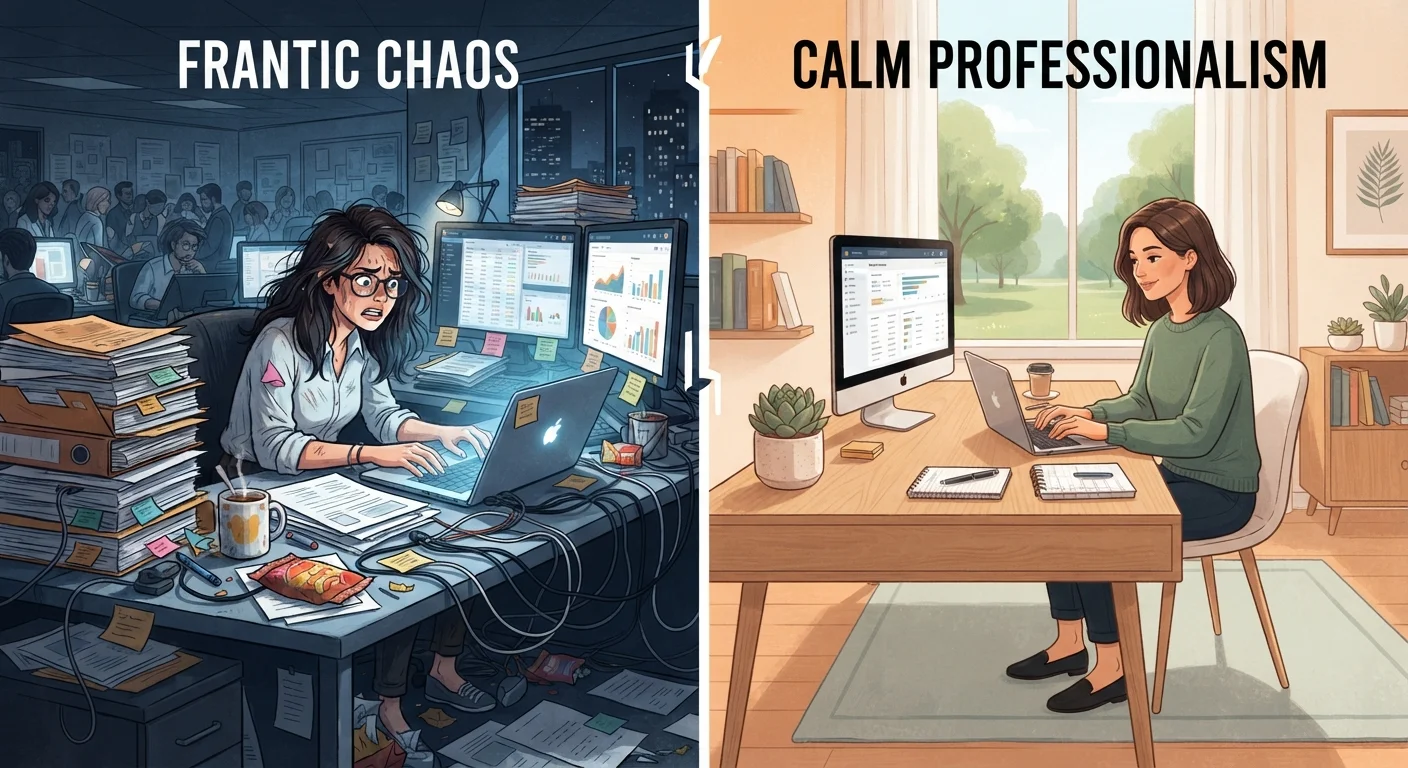
Option A
Hustle Culture
The always-on, grind-until-you-make-it mindset.
Best for: Short-term sprints where output volume and speed are the primary measure of success.
Option B
Sustainable Productivity
The steady, deliberate approach built for the long haul.
Best for: Professionals seeking consistent output, career longevity, and personal well-being over time.
If you're managing a high-stakes, time-limited project with a defined end date
Hustle Culture
Short sprints of intense effort can be effective when the window is clearly bounded and recovery time follows. The risk rises sharply when the sprint never ends.
If you want to perform at a high level consistently over years or decades
Sustainable Productivity
Deliberate pacing, boundaries, and recovery are what allow professionals to compound their skills and output without burning out prematurely.
If you're already experiencing exhaustion, health issues, or loss of motivation
Sustainable Productivity
Continuing to push through chronic burnout rarely produces results — it accelerates decline. Restructuring your workload is likely the higher-yield move.
If your workplace explicitly rewards visible overwork over results
Sustainable Productivity
Even in cultures that glorify busyness, quietly protecting your energy often produces better long-term outcomes. See how workplace culture shapes what's rewarded before adjusting your strategy.
What Each Approach Actually Means
Hustle culture is the belief that working more — longer hours, more days, fewer breaks — is the surest path to success. It frames rest as laziness and busyness as virtue. Popularized heavily in startup and entrepreneurial circles, it has seeped into mainstream workplaces through social media and management rhetoric that equates visible effort with value.
Sustainable productivity takes a fundamentally different position: output quality matters more than output volume, and maintaining your capacity to perform is itself a strategic priority. It draws on concepts from cognitive science and occupational health — the idea that attention, decision-making, and creativity are finite daily resources that deplete and must be replenished.
These aren't just philosophical differences. They produce measurably different results over time, and they carry different costs for health, relationships, and career trajectory. Understanding those costs clearly is what this comparison is about.
| Criterion | Hustle Culture | Sustainable Productivity |
|---|---|---|
| Core belief | More hours = more results | Better energy = better output |
| Short-term output | High volume, fast pace | Consistent, quality-focused |
| Long-term performance | Declines without recovery | Compounds with experience |
| Health impact | Elevated risk with chronic overwork | Lower chronic stress load |
| Career longevity | High burnout risk | More sustainable trajectory |
| Workplace perception | Often visibly rewarded short-term | May require cultural navigation |
| Recovery approach | Treated as optional or weak | Treated as essential and scheduled |
The Real Costs of Each Approach
Hustle culture carries well-documented risks. Research published in occupational health and epidemiology literature has consistently shown that working more than 55 hours per week is associated with elevated risk of cardiovascular events and stroke compared to standard working hours. Separate cognitive research indicates that sleep-deprived workers significantly overestimate their own performance while their actual output declines — meaning hustle culture often produces the illusion of productivity, not the reality.
Beyond physical health, chronic overwork hollows out motivation. What starts as passion often converts to obligation, then resentment. The patterns that erode work-life balance rarely announce themselves — they accumulate quietly through small daily compromises that eventually become a permanent baseline.
Sustainable productivity isn't effortless either. It requires active boundary-setting, which can invite pushback in workplaces that equate visibility with commitment. Workers who leave at reasonable hours or decline after-hours messages may face cultural friction, even when their output is strong. The tension between being visibly busy and quietly effective is real and worth confronting honestly.
55+ hrs
Weekly work hours linked to elevated stroke risk
A large-scale analysis published in The Lancet found that working 55 or more hours per week was associated with a significantly higher risk of stroke than working 35–40 hours.
~33%
U.S. workers reporting chronic work-related burnout
Gallup workplace research has consistently found that roughly one-third of American workers report feeling burned out at work very often or always.
13%
Productivity increase from well-rested workers
Studies in occupational psychology suggest employees who maintain adequate sleep and recovery consistently outperform chronically fatigued counterparts on complex tasks.
Practical Steps to Shift Toward Sustainability
If hustle culture has been your default, the shift doesn't require a dramatic lifestyle overhaul. A few structural changes tend to have an outsized effect:
- Audit your meeting load. Unproductive meetings are one of the most common hustle-culture traps — they create the feeling of work without the output. Principles for running and attending productive meetings can reclaim significant time each week.
- Set hard stopping points. Finishing work at a consistent time each day — not when you're exhausted — helps preserve the cognitive capacity you need for the next day. Energy management is a skill, not a weakness.
- Protect recovery time deliberately. Rest isn't the absence of work; it's what makes sustained work possible. Blocking time for it on your calendar treats it with the same priority as any deliverable.
- Evaluate flexible work arrangements honestly. Remote or flexible schedules can support sustainable productivity — but they can also blur boundaries further. Understanding the real trade-offs of flexible schedules before assuming they'll automatically help is essential.
The goal isn't to work less — it's to work in a way that you can sustain without paying costs that compound against you over time. For most people, that's the higher-yield strategy, full stop.
This Isn't a Debate About Ambition
Sustainable productivity doesn't mean lowering your goals or working less hard. Many high-performing professionals — across fields from medicine to engineering to law — operate within structured limits specifically because they understand that cognitive and physical capacity is finite. The distinction is about how effort is directed, not how much ambition you have. Choosing recovery and focus over volume is often the more demanding discipline, not the easier one.