

Key Takeaways
Our Verdict
Gravel remains the most versatile all-around substrate for community freshwater tanks, offering good bacterial colonization and compatibility with most plants. Sand is the stronger choice when keeping species that naturally sift, burrow, or rest on the bottom. Bare-bottom setups serve a specific purpose — they excel in quarantine, breeding, or high-bioload environments where cleanliness matters more than aesthetics.
| Best for | Recommended |
|---|---|
| Community freshwater tanks with live plants | Gravel |
| Corydoras, loaches, and other burrowing or bottom-dwelling species | Sand |
| Hospital, quarantine, or breeding tanks | Bare-Bottom |
| High-bioload tanks or large cichlid setups needing frequent deep cleans | Bare-Bottom |
Why Substrate Matters More Than It Looks
The material lining the bottom of your aquarium isn't just decorative — it directly influences water chemistry, the health of your nitrogen cycle, fish behavior, and long-term maintenance demands. Choosing incorrectly can stress fish, impede plant growth, or create water quality problems that are difficult to diagnose.
Before selecting a substrate, consider three key factors: the species you're keeping, whether you plan to grow live plants, and how much time you're willing to spend on tank maintenance. To understand why substrate affects water quality, it helps to first understand how the nitrogen cycle works in a fish tank — beneficial bacteria colonize substrate surfaces and play a direct role in breaking down fish waste.
Gravel: The Versatile Standard
Gravel — typically ranging from 2mm to 5mm in diameter — is the most commonly used aquarium substrate for good reason. Its coarse texture allows water to flow through, giving beneficial bacteria ample surface area to colonize. This makes it an effective biological filtration partner alongside your mechanical filter.
Gravel works well with most freshwater community fish and supports rooted live plants, which anchor more readily in its heavier texture than in sand. It also comes in a wide range of colors and types, including inert options that won't alter pH and buffering substrates (such as crushed coral) that raise carbonate hardness for African cichlids or brackish setups.
The main drawback is waste accumulation. Uneaten food, fish waste, and debris settle between particles and decompose, which can spike ammonia and nitrate levels if not addressed. Regular gravel vacuuming during water changes is essential. If you're new to fishkeeping, gravel's forgiving nature makes it a reasonable starting point — but skipping maintenance is a common and costly error.
| Gravel | Sand | Bare-Bottom | |
|---|---|---|---|
| Bacterial colonization | High — large surface area | Moderate — surface only | Low — filter-dependent |
| Ease of cleaning | Moderate — vacuuming required | Easy — waste visible on top | Very easy — nothing to disturb |
| Live plant support | Good — roots anchor well | Poor to moderate | Not suitable |
| Suitability for bottom dwellers | Fair — coarse can injure barbels | Excellent — mimics natural habitat | Poor — no foraging medium |
| Anaerobic gas risk | Low | Moderate if too deep | None |
| Best tank type | Community and planted tanks | Species-specific and natural setups | Hospital, breeding, high-waste tanks |
Sand: The Natural Choice for Bottom Dwellers
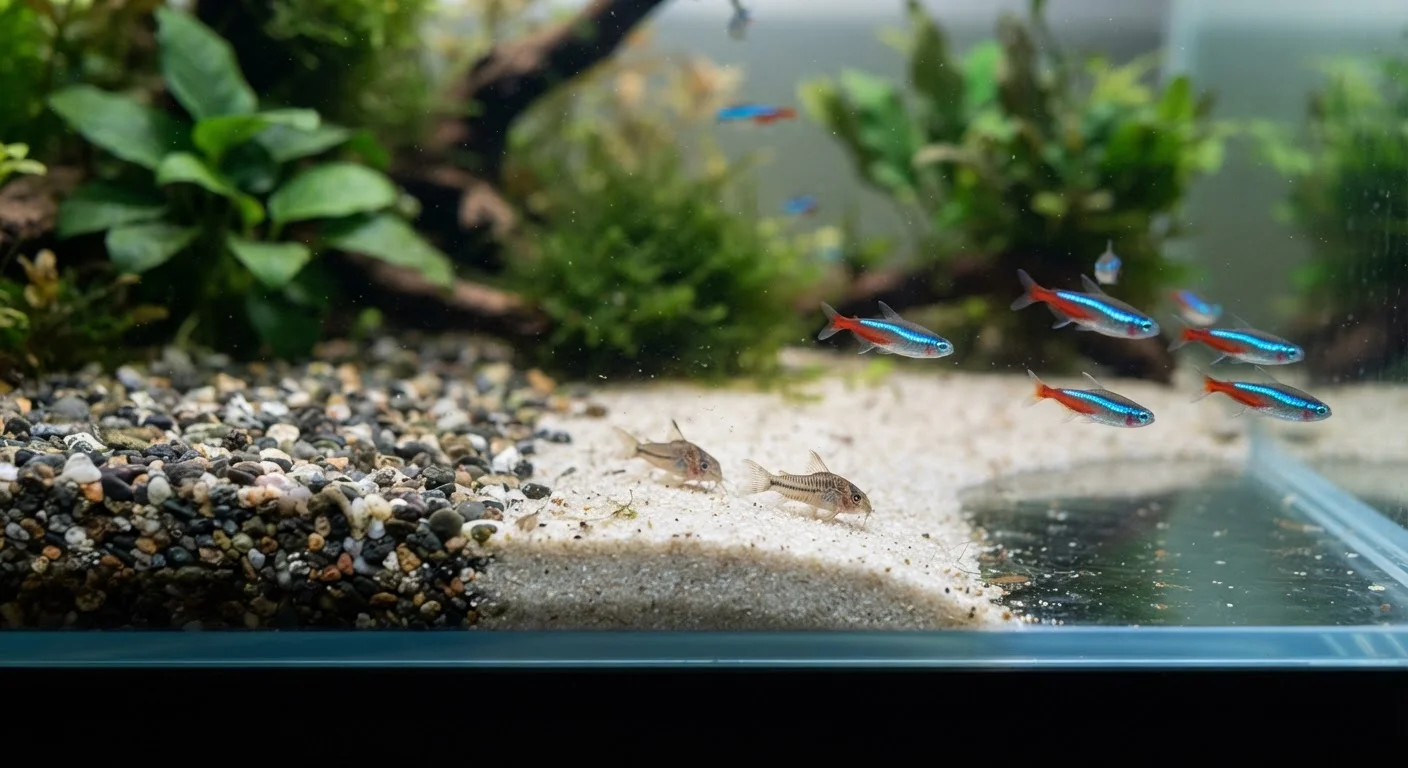
Fine sand — typically 0.5mm to 1mm grain size — closely mimics the riverbeds and lake floors where many popular aquarium species originate. Corydoras catfish, kuhli loaches, most goby species, and several cichlids naturally sift sand through their gills while foraging. Keeping these fish on coarse gravel can damage their delicate barbels (the sensory whiskers near their mouths), leading to infection and chronic stress.
Sand packs more tightly than gravel, which means fish waste sits on the surface rather than sinking in — making it visible and easier to siphon. However, that same compaction creates a risk: stagnant areas deep in the sand can develop anaerobic (oxygen-free) zones where hydrogen sulfide gas accumulates. To prevent this, keep sand beds no deeper than 1 to 2 inches, or add burrowing invertebrates like trumpet snails that naturally aerate the substrate.
Preventing Sand Substrate Problems
Keep fine sand no deeper than 2 inches to reduce the risk of anaerobic pockets forming. Adding Malaysian trumpet snails — small, burrowing invertebrates — to a sand-bottomed tank is a natural and effective way to aerate the substrate and prevent gas buildup. They're largely invisible during the day and do their work overnight.
Sand can be more challenging for live plants, as roots struggle to anchor in its fine, dense texture. Nutrient-rich plant substrates or root tabs can compensate, but heavily planted tanks often do better with gravel or specialized planting substrates.
Bare-Bottom Tanks: Clarity Over Aesthetics
A bare-bottom tank — simply the glass or acrylic floor of the aquarium with no substrate at all — is rarely the first image that comes to mind when setting up a display tank, but it serves critical functions in specific contexts.
Without substrate, waste has nowhere to hide. Every bit of debris is visible and easily removed with a siphon or turkey baster, which makes bare-bottom tanks the standard recommendation for quarantine and hospital tanks, breeding setups, and any tank housing fish that produce large amounts of waste (such as large goldfish or oscars). Water quality is easier to monitor and maintain.
The trade-off is biological filtration. Without substrate, you lose a significant surface area for beneficial bacterial colonies, making the filter — and any additional media like sponge inserts — carry more of that load. Bare-bottom tanks can also stress some fish species that feel exposed or lack natural foraging behavior, so they're generally not recommended as permanent display tanks for community fish. For a comprehensive overview of tank setup decisions, see our guide on setting up a freshwater aquarium that actually stays healthy.
Making the Right Choice for Your Tank
The best substrate depends on the specific needs of your fish, your maintenance habits, and your tank's purpose. A few practical guidelines:
- Species first: Research the natural habitat of every fish you plan to keep. If any are bottom-dwellers or burrowers, sand should rank high on your list.
- Plant goals: If you want a heavily planted tank, look beyond standard gravel — nutrient-rich substrates designed specifically for plants offer a meaningful advantage.
- Bioload awareness: High-waste fish in smaller tanks benefit from the easier cleaning of bare-bottom or sand setups.
- Depth matters: For both gravel and sand, keep substrate depth consistent — typically 2 to 3 inches for gravel, 1 to 2 inches for sand — to balance bacterial surface area against waste buildup and gas pocket risk.
Switching substrate in an established tank is possible but disruptive. If you plan well at the setup stage, you'll avoid the stress of tearing down a cycled tank later.
This article is for general informational purposes only. Always consult a qualified aquatic veterinarian or experienced aquarist for guidance specific to the health needs of your fish.