

Key Takeaways
Option A
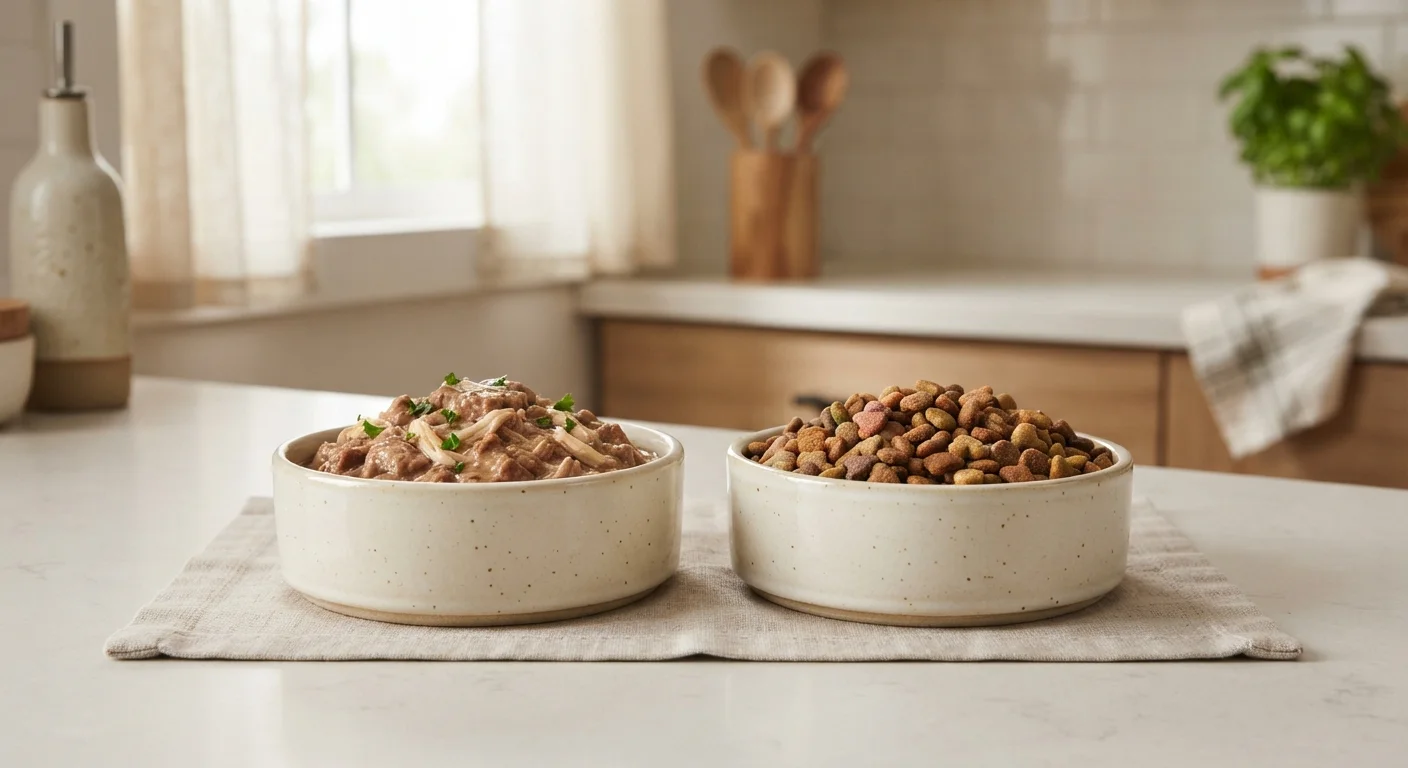
Wet Cat Food
The moisture-rich, protein-forward option.
Best for: Cats prone to urinary issues, picky eaters, seniors, or any cat that struggles to drink enough water on its own.
Option B
Dry Cat Food (Kibble)
The convenient, calorie-dense everyday staple.
Best for: Multi-cat households, busy owners seeking convenience, or cats that graze freely throughout the day.
If your cat has a history of urinary tract issues or kidney disease
Wet Cat Food
The high moisture content in wet food helps flush the urinary system and supports kidney function, which is especially important for cats prone to these conditions.
If convenience and cost management are your top priorities
Dry Cat Food (Kibble)
Kibble stores easily, doesn't spoil quickly after serving, and is generally less expensive per meal than comparable wet food options.
If your cat is overweight or prone to overeating
Wet Cat Food
Wet food's higher water content means fewer calories per gram, which can help cats feel satiated while consuming fewer total calories.
If you have multiple cats with varying schedules
Dry Cat Food (Kibble)
Kibble can be left out for free-feeding without spoiling, making it more practical in multi-cat homes where mealtimes are staggered.
If you want to balance health benefits with daily practicality
Wet Cat Food
A mixed feeding routine — wet food once or twice daily plus access to dry kibble — gives cats hydration benefits alongside the convenience of kibble.
Hydration: The Biggest Practical Difference
Cats evolved as desert animals and have a naturally low thirst drive, meaning they often don't drink enough water on their own. This makes dietary moisture especially important. Wet cat food is typically composed of 70–80% water, while dry kibble contains only about 10%. That gap has real consequences for organ health.
Adequate hydration supports kidney function, reduces the risk of urinary tract disease, and helps prevent the formation of bladder crystals — a common and painful condition in domestic cats. Veterinary guidance consistently identifies chronic mild dehydration as a contributing factor in feline kidney disease, one of the leading causes of illness in older cats.
For cats that rarely seek out their water bowl, wet food can function as a primary hydration source. That said, cats eating kibble exclusively can remain healthy if they drink reliably — a water fountain or multiple bowl placement points can meaningfully increase intake. Understanding how hydration connects to overall nutrition may also help owners appreciate why this factor matters beyond just thirst.
| Criterion | Wet Cat Food | Dry Cat Food (Kibble) |
|---|---|---|
| Moisture content | ~70–80% | ~10% |
| Caloric density | Lower per ounce | Higher per ounce |
| Urinary health support | Strong — high hydration | Requires adequate water intake |
| Dental benefit | Minimal | Minimal (some mechanical effect) |
| Cost per meal | Generally higher | Generally lower |
| Storage & convenience | Refrigerate after opening; perishable | Shelf-stable; easy to store |
| Palatability for picky cats | Often higher | Varies; some prefer texture |
| Suitability for seniors | Generally preferred | Fine with adequate hydration |
Nutrition, Calories, and Weight Management
Both wet and dry cat foods can be nutritionally complete if formulated to meet AAFCO (Association of American Feed Control Officials) standards — look for that statement on the label. The core nutritional difference lies in caloric density and macronutrient ratios.
Dry kibble packs significantly more calories per ounce than wet food, largely because moisture has been removed. This makes portion control more critical when feeding kibble, particularly in less active or indoor cats. Obesity is one of the most prevalent health issues in domestic cats, and free-feeding dry kibble without measuring portions is a common contributor.
Wet food's lower caloric density means cats can eat a satisfying volume while consuming fewer total calories — a meaningful advantage for cats that need to lose weight or maintain a healthy body condition. However, some cats don't find wet food as palatable, especially if they've eaten only dry food for extended periods.
~70–80%
Moisture content in typical wet cat food
Compared to roughly 10% in dry kibble, this difference has a measurable impact on a cat's daily fluid intake.
~30–35%
Estimated prevalence of obesity in US domestic cats
Veterinary surveys consistently identify excess body weight as among the most common preventable health issues in pet cats.
1 in 3
Cats affected by kidney disease in their lifetime
Chronic kidney disease is especially prevalent in older cats, making lifelong hydration habits a meaningful preventive consideration.
For cats managing weight, transitioning gradually between food types — over 7 to 10 days — minimizes digestive upset and improves acceptance. Your veterinarian can recommend appropriate portion sizes based on your cat's age, weight, and activity level.
Dental Health, Cost, and Everyday Practicality
One commonly cited advantage of dry kibble is dental health — the idea being that crunching kibble scrapes plaque from teeth. In practice, the evidence here is limited. Most cats don't chew kibble thoroughly enough for significant mechanical cleaning, and standard kibble is not a substitute for active dental care. Purpose-formulated dental diets exist, but they differ considerably from regular dry food.
Wet food, by contrast, does little for dental hygiene on its own. Regular tooth brushing — ideally with veterinary-approved enzymatic toothpaste — remains the gold standard for feline dental care regardless of food type.
On cost, dry kibble is generally more economical per calorie. Wet food in cans or pouches tends to cost more and must be refrigerated after opening, with uneaten portions discarded within a few hours at room temperature to prevent spoilage. For owners managing tight budgets or feeding multiple cats, this is a genuine practical consideration.
A mixed feeding approach — offering wet food once or twice a day alongside measured access to dry kibble — is a strategy many veterinarians support as a reasonable middle ground. It balances moisture intake, palatability, cost, and convenience without requiring a full commitment to either format. See our comprehensive guide to cat ownership for how diet fits into a broader routine. If you have a dog at home, the wet vs. dry debate looks similar but has key differences for dogs.
When to Involve Your Veterinarian
If your cat has a diagnosed health condition — such as kidney disease, diabetes, hyperthyroidism, or a history of urinary blockages — food format and formulation become medical decisions, not just lifestyle preferences. Your vet can recommend specific diets tailored to those needs. Cats at life-stage transitions (kitten to adult, adult to senior) also benefit from a dietary review at routine check-ups.