

Key Takeaways
Why Subscriptions Are So Easy to Forget
Subscription billing is designed to fade into the background. Charges are small, they recur automatically, and they rarely trigger the same conscious decision as a one-time purchase. Services know this: research from consumer behavior studies consistently shows that people underestimate how many subscriptions they're paying for and by how much.
A few factors make the problem worse. Free trials convert silently. Annual plans renew when you've long since stopped thinking about them. Family plan sign-ups can multiply across household members. And because no single charge feels significant, the total rarely gets scrutinized until something forces a closer look at the budget.
This is a form of the same quiet erosion described in overlooked costs that erode savings progress — small, recurring, and largely invisible until you go looking. The good news is that an audit takes less time than most people expect, and the savings are immediate once you act.
What you will need
What You'll Need Before You Start
This audit doesn't require any special tools or financial expertise. You need access to your statements, somewhere to record what you find, and a willingness to make a decision on each item rather than defer it. Gather the following before you begin.
Bank or credit card statements (3 months)
Primary source for identifying all recurring charges during the audit.
Spreadsheet or notebook
Used to list subscriptions, their costs, and your keep/cancel decision for each.
Email search
Searching your inbox for 'subscription', 'receipt', or 'renewal' can surface services not yet caught in statements.
Calendar or reminder app
Set reminders before free trials or annual renewals so you can decide in advance whether to continue.
Free Trials Often Convert Automatically
Many services require a credit card to start a free trial and will charge you automatically once the trial ends. If you signed up for a trial and forgot about it, you may already be paying. Always note the trial end date and set a calendar reminder before it expires.
How to Audit Your Subscriptions
Follow these steps in order. The whole process typically takes under an hour for most households, and you can save your list partway through if you need to split it across two sessions.
Pull three months of statements
Log in to your bank or credit card account and pull up the last three months of transactions. Three months matters because some subscriptions bill quarterly rather than monthly, and a single statement can miss them. Download or print the statements if it helps you review them without distractions.
Highlight every recurring charge
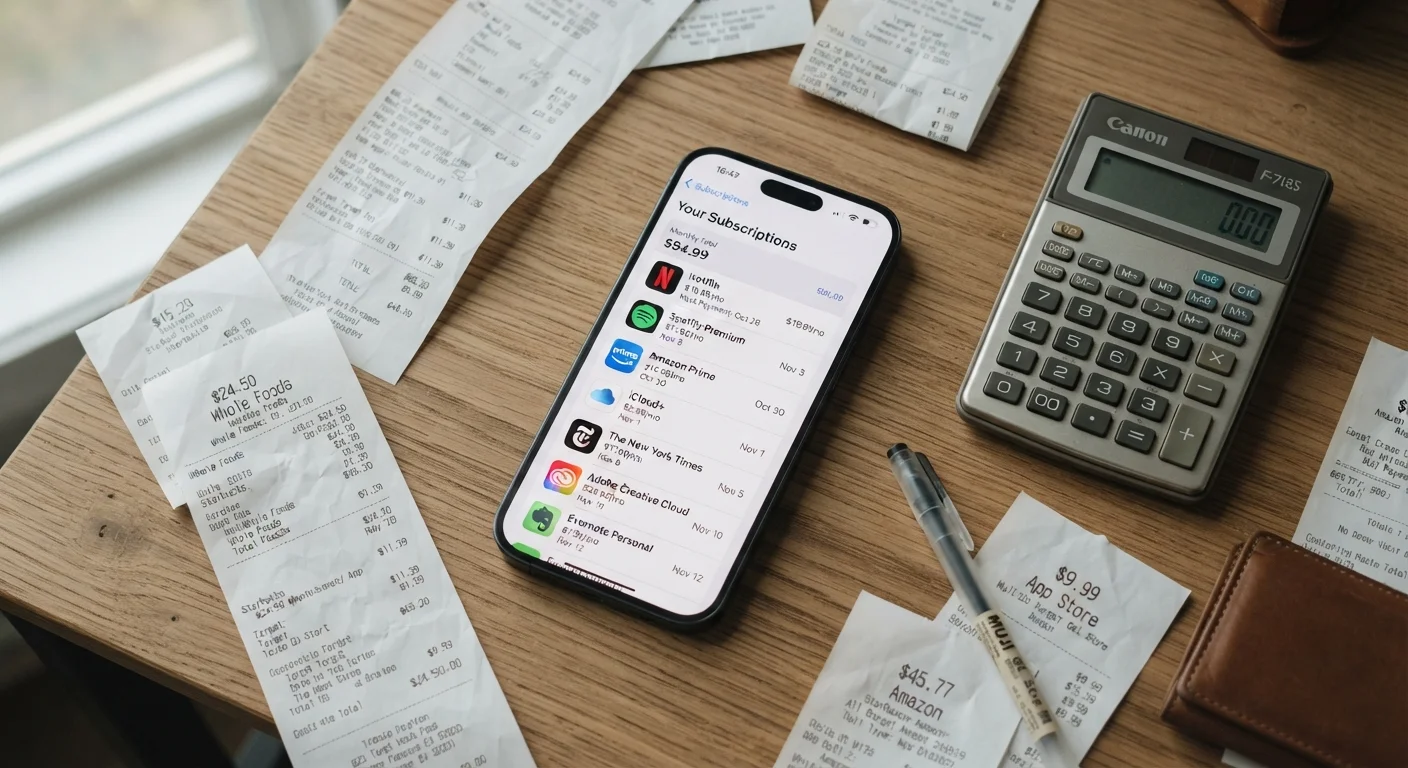
Go line by line and mark any charge that appears more than once or that you recognize as a subscription. Look for streaming services, software tools, cloud storage, news sites, fitness apps, meal kit deliveries, and any membership that bills automatically. Don't try to evaluate them yet — just get them all in one place.
Also search your email inbox for terms like "receipt," "renewal," "subscription confirmed," or "your membership." This often turns up annual charges that haven't hit your statement recently.
Build a simple subscription list
Transfer everything you found into a list with three columns: the service name, the charge amount, and how often it bills (monthly or annually). Calculate an annual cost for each one so you're comparing apples to apples. This is also a good moment to flag any charge you can't immediately identify — research those before moving on.
Rate each subscription by actual use
For each item on your list, ask yourself two honest questions: Have I used this in the past 30 days? And would I notice if it disappeared tomorrow? Services that fail both questions are strong cancellation candidates. Services you use regularly and would genuinely miss are worth keeping. Everything in the middle deserves a harder look.
Be honest about "I might use it someday" reasoning — that's how forgotten subscriptions survive for years.
Cancel what you're keeping out of inertia
For subscriptions you've decided to drop, cancel them now rather than adding them to a to-do list. Most services allow cancellation through account settings online. If a service makes cancellation difficult to find, searching "[service name] cancel subscription" usually surfaces the direct steps. Some services may offer a pause or a downgraded plan — consider these only if you genuinely plan to return.
Set a recurring reminder to revisit
Subscription creep returns gradually. Set a calendar reminder every one to three months to do a brief check — even a five-minute scan of recent charges is enough to catch new additions before they compound. Pairing this with a broader monthly budget review makes it feel less like a separate task. Our monthly budget health check includes prompts that fit naturally alongside a subscription scan.
Use Annual Totals to See the Real Cost
Monthly subscription prices feel small — $6.99 or $12.99 barely registers. Multiply each charge by 12 and list them side by side. Seeing $83 or $155 per year per service tends to shift how you weigh each one against the value you're actually getting.
Keeping Subscription Creep From Coming Back
The audit itself is a one-time reset, but the habits you build afterward determine whether the savings stick. A few practices make a real difference:
- Use one payment method for subscriptions where possible. A single card makes future audits much faster.
- Treat new subscriptions as time-limited by default. When you sign up for something new, decide upfront how long you'll give it before evaluating whether it stays.
- Build the check into existing routines. Adding a subscription scan to a monthly spending audit means it gets done without requiring separate motivation.
Watch for Small, Oddly Named Charges
Some recurring charges appear under unfamiliar billing names that don't match the service you signed up for. If a charge looks unfamiliar, search the exact merchant name before dismissing it — it may be legitimate but worth confirming. Unexplained charges you can't identify should be reported to your card issuer.
If you're thinking about automating your savings once you've freed up cash, it's worth understanding the trade-offs first. Our guide on automating your savings covers what works and what to watch for. And if you want a broader framework for staying on top of your finances each month, the budgeting hub is a practical starting point.
This article is for general informational purposes only and does not constitute personalized financial advice. Consider consulting a qualified financial professional for guidance specific to your situation.