

Key Takeaways
The 50/30/20 Rule
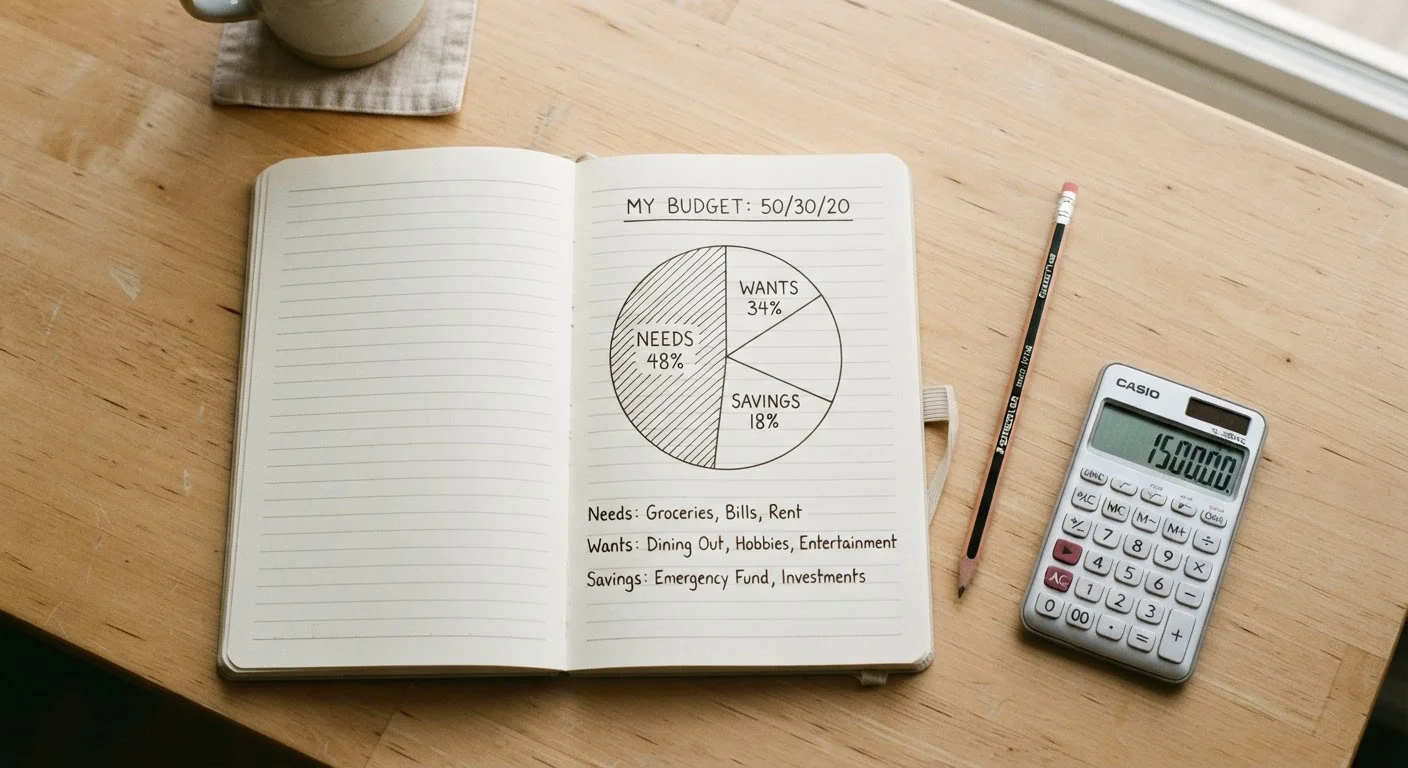
The 50/30/20 rule is a budgeting guideline that divides your after-tax income into three categories: 50% for needs, 30% for wants, and 20% for savings or debt repayment. It gives you a simple starting point without requiring you to track every dollar. The goal is balance — covering essentials, enjoying life, and building financial security at the same time.
The framework is based on after-tax (take-home) income, not gross income. If your employer withholds taxes automatically, use your net paycheck amount as the starting figure.
How the Three Buckets Work
The framework is straightforward on paper. Take your monthly take-home pay and divide it using these targets:
- 50% — Needs: Rent or mortgage, utilities, groceries, health insurance, minimum loan payments, and transportation costs you can't avoid.
- 30% — Wants: Dining out, entertainment, travel, subscriptions, hobbies, and anything that improves your lifestyle but isn't strictly necessary.
- 20% — Savings and debt repayment: Emergency fund contributions, retirement savings, extra debt payments beyond the minimum, and other financial goals.
If your take-home pay is $4,000 a month, the rule suggests roughly $2,000 for needs, $1,200 for wants, and $800 toward savings or debt. The simplicity is the point — you don't need a spreadsheet with 40 line items to get started.
Start With One Month of Real Numbers
Before adjusting percentages, pull up three months of bank and credit card statements and categorize your actual spending into needs, wants, and savings. Most people discover at least one category that surprises them. Knowing your baseline makes the 50/30/20 targets feel concrete rather than arbitrary.
Where the Math Gets Complicated
The 50/30/20 rule was designed as a general guideline, not a universal prescription. Several real-life factors can make the percentages hard to hit.
Housing costs are the biggest pressure point. In many U.S. metro areas, rent alone can consume 40% or more of a moderate income. When rent, utilities, groceries, and transportation are all stacked together, landing at 50% for needs can feel impossible rather than aspirational.
Income level matters a lot. The Consumer Financial Protection Bureau (CFPB) and other consumer finance researchers consistently note that lower-income households spend a higher share of income on basics simply because fixed costs don't shrink proportionally with earnings. A family earning $35,000 a year faces very different math than one earning $90,000.
Irregular income changes the picture. Freelancers, hourly workers, and people with variable pay often find fixed percentages awkward because income fluctuates month to month. In those cases, working from an average monthly income — or budgeting more conservatively from a minimum expected amount — is a more stable approach.
~30%
Of income spent on housing alone by many renters
The U.S. Department of Housing and Urban Development traditionally considers households spending more than 30% of gross income on housing to be cost-burdened, meaning housing alone can consume a significant portion of the 50% needs target.
1 in 3
Americans have no budget at all
A survey by the National Foundation for Credit Counseling found that roughly one-third of U.S. adults do not maintain any household budget, underscoring how even a simple framework like 50/30/20 represents a meaningful step forward.
$1,000
Emergency fund target many financial educators suggest as a starting goal
While the 20% savings bucket encompasses broader goals, many personal finance educators recommend prioritizing a small emergency fund first before other savings targets, since unexpected expenses are a common reason budgets fail.
Adjusting the Rule to Fit Your Reality
Think of 50/30/20 as a starting template, not a grade you have to achieve. If your needs genuinely exceed 50%, the most practical response is to compress the wants category first, then revisit the savings target as your income grows or fixed costs shift.
Some people use a 60/20/20 or 70/20/10 split and still benefit from having the three-bucket structure. What matters is that you're making deliberate choices about each category rather than spending without a plan.
A few adjustments worth considering:
- If you carry high-interest credit card debt, shifting more of the 30% toward payoff often makes mathematical sense before building savings beyond a small emergency fund.
- If you have aggressive savings goals — buying a home, retiring early — you might tighten the wants category to push the savings allocation higher.
- If your income is irregular, set your baseline percentages from a conservative monthly estimate and redirect windfalls intentionally.
Before tweaking percentages, it helps to know exactly where your money is currently going. A monthly spending audit can surface spending patterns you might not realize exist.
Is This the Right Framework for You?
The 50/30/20 rule works well for people who want a straightforward structure without the time commitment of detailed tracking. It's especially useful if you're budgeting for the first time and feel overwhelmed by more granular systems.
It works less well if you need precise control — for example, if you're in aggressive debt payoff mode, managing a very tight budget, or have income that swings significantly each month. In those cases, a method like zero-based budgeting gives you more control over each dollar. You can compare both approaches directly in our guide on zero-based budgeting vs. the 50/30/20 rule.
The honest answer is that the best budgeting method is the one you'll actually use. A rough version of the 50/30/20 rule that you follow consistently will serve you better than a perfect system you abandon after two weeks. At the end of each month, asking yourself a few honest questions — Did I cover my needs? Did I save anything? Did my wants stay in check? — is a productive habit regardless of the framework you use. Our monthly budget health check can help make that review quick and actionable.
This article is for general informational purposes only and does not constitute personalized financial advice. Consider speaking with a qualified financial professional about decisions specific to your situation.